


Grand Fir Identification (Abies grandis)

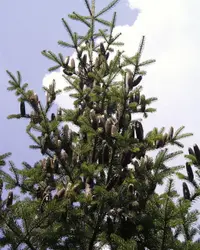
Recognize Grand Fir by its flat needles set in two side rows, each usually with a notched tip and two white bands beneath. Needles are longest near the middle of the shoot.

Also check the smooth gray bark on young trees and the narrow, spire-like crown.

Abies grandis Identification

Check Your Plant ID

Upload a clear image to check whether your plant ID is correct.

Clear images work best. Avoid photos taken too close or too far away

Check the overall form first, then the needles and cones.

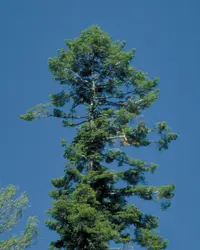
  • A tall, narrow conifer with a straight trunk and a dense, spire-like crown.
  • Needles are flat, soft-looking, and mostly 1 to 2 inches (2.5 to 5 cm) long.
  • Needles spread in two flat rows along the twig, giving many side shoots a combed appearance.
  • Each needle attaches directly to the twig and often has a notched or rounded tip.
  • Cones stand upright on upper branches, long and cylindrical rather than hanging.

Look for the flat, two-ranked needles together with upright cones to confirm Abies grandis.

Abies grandis shows age-related changes in form, bark, and cone production that aid identification.

  • Seedling: Seedlings carry soft, flat first needles on a slender upright stem, with a simple outline and little lateral branching compared with older plants.
  • Young plant: Young plants form a narrow, symmetrical spire; side branches become regular and layered, and needles often appear combed into flatter sprays than seedlings.
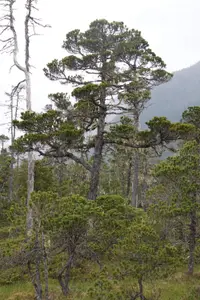
  • Mature plant: Mature trees develop a tall, straight trunk and broad conical crown, often 100-200 feet (30-61 m) tall, with thicker gray-brown bark becoming furrowed.
  • Fruiting stage: At the fruiting stage, upright cylindrical cones appear high in the crown, about 2.5-4.5 inches (6-11 cm) long, unlike non-coning younger trees.

In spring, Abies grandis shows fresh, soft new needles at shoot tips, often a lighter green than older foliage. This pale flush can make branch ends look brighter for a short time. By late summer into fall, upright seed cones become easier to spot high in the crown. In winter, the evergreen needles remain, while pointed buds stand out more clearly on bare twig tips.

Several Pacific Northwest firs are commonly confused with Abies grandis.

white fir(Abies concolor)

Both have soft, flattened needles and a tidy fir shape. White fir needles are usually similar in length on both sides of the twig and often curve upward. Grand fir more often shows two obvious needle rows, with shorter needles above the shoot.

Pacific silver fir(Abies amabilis)

Both are tall western firs with flat needles and upright cones. Pacific silver fir usually has shorter, more crowded needles and a darker, neater spray. Grand fir typically has longer needles, often 1 to 2 inches (2.5 to 5 cm).

Abies grandis is native to the Pacific Northwest of North America, from southeastern Alaska and coastal British Columbia south to northern California, with inland populations in the northern Rockies. It is most often found in moist conifer forests, from near sea level to about 5,900 feet (1,800 m). This helps narrow identification because true firs in wet coastal and inland mountain forests in this range are more likely to be Abies grandis than many eastern or drier-site species.

Scan. Check. Confirm.

Use Botan to identify or confirm a plant from a photo when a closer check can help avoid mix-ups.

FAQ

Needles attach singly and spread mostly in two flat rows along the twig, often with shorter upper needles angled upward. This comb-like arrangement is a strong clue when identifying Grand Fir.

More Plant Identification Guides

Scan Your Plant. Get the Details.

Identify a plant from a photo with Botan, then review plant details, care information, and common problems.

Botan app identifying a plant from a photo
12 Best Cold-Hardy Vegetables for Cold Weather

7 min read · 13 Oct 2026

12 Best Cold-Hardy Vegetables for Cold Weather

Cold-hardy vegetables can keep a garden productive through chilly fall, winter, and early spring weather. This guide covers 12 reliable crops, their frost tolerance, and practical growing tips for better cold-season harvests.

Plant Recommendations
12 Best Cold-Hardy Vegetables for Cold Weather
15 Best Scary Halloween Plants and Fungi for a Spooky Garden

8 min read · 9 Oct 2026

15 Best Scary Halloween Plants and Fungi for a Spooky Garden

Want a garden that looks eerie in October? Here are 15 Halloween plants and fungi, from carnivorous traps to bleeding mushrooms. For each species, we cover its appearance, care requirements, and potential uses in your landscape.

Plant Recommendations
15 Best Scary Halloween Plants and Fungi for a Spooky Garden
13 Best Front Yard Trees for Every Home and Yard

12 min read · 7 Aug 2026

13 Best Front Yard Trees for Every Home and Yard

A front yard tree can stay for decades. Therefore, choosing one deserves serious consideration. Here are 13 trees that have proven themselves, sorted by their purpose. You'll also find five species to avoid and basic planting information.

Plant Recommendations
13 Best Front Yard Trees for Every Home and Yard