
sugar maple Identification (Acer saccharum)

Recognize sugar maple by its opposite leaves, each leaf usually with five main lobes and smooth, rounded U-shaped spaces between them. Leaves are typically 3 to 6 inches (8 to 15 cm) wide.

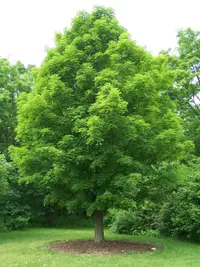
On larger trees, look for a straight central trunk and a broad, rounded crown with evenly spaced branches.

Acer saccharum Identification

Check Your Plant with Botan

Check your plant ID by uploading a clear photo to Botan.

Clear images work best. Avoid photos taken too close or too far away

Check the leaf shape, twig pattern, and paired seeds first.

  • Leaves are simple and opposite, usually 3-5 inches (8-13 cm) long, with 5 main lobes and mostly smooth-edged margins between the points.
  • The lobes have broad, rounded U-shaped spaces between them, giving the leaf a full, balanced outline.
  • Twigs and leaves occur in opposite pairs along the branch, a clear maple trait visible without tools.
  • Fruits are paired winged samaras, with the two wings spreading at a wide angle from each other.

Use several traits together, especially the 5-lobed opposite leaves and wide-angled paired samaras.

Acer saccharum shows useful visual differences from seedling through fruiting and maturity.

  • Seedling: First leaves are opposite and simple, then small three- to five-lobed true leaves appear on a thin green stem.
  • Young plant: Saplings form a narrow crown with slender gray bark; leaves are clearly five-lobed and usually 3-5 inches (8-13 cm) long.
  • Mature plant: Older trees develop a broad, rounded crown and thick trunk; bark breaks into long vertical plates with edges that curl slightly.
  • Fruiting stage: Paired winged samaras hang on long stalks; the two wings spread at a wide angle, making fruiting branches easy to recognize.

Several sugar maple selections are identifiable by crown shape or leaf color.

  • 'Columnare': Narrow, upright crown, staying much slimmer than the broad, rounded canopy of the typical form.
  • 'Globosum': Dense, rounded crown with a more globe-shaped outline than standard trees.
  • 'Monumentale': Strongly columnar habit, with branches held close to the trunk for a tall, tight profile.
  • 'Oakes Golden': Leaves emerge bright yellow to yellow-gold, rather than the usual medium green spring foliage.
  • 'Sweet Shadow': Leaves are variegated with creamy white patches and margins, unlike the plain green leaves of the species.

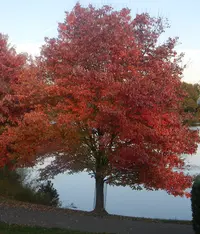
In spring, sugar maple shows small yellow-green flower clusters as leaves unfold. By late spring to early summer, paired winged samaras become visible and often hang below the foliage. Fall is a strong clue. Leaves turn clear yellow, orange, or red. After leaf drop, the opposite branching and pointed brown buds are easier to see through winter.

Several maples can be mistaken for sugar maple at a glance.

black maple(Acer nigrum)

Often confused because the leaves are similarly 3- to 5-lobed and the bark becomes furrowed with age. Black maple usually has drooping leaf sides and a softer, often downy underside.

Norway maple(Acer platanoides)

Similar in overall leaf shape and crown form. Norway maple usually has broader leaves with fewer coarse teeth, and its leaf stalk releases milky sap when broken.

red maple(Acer rubrum)

Can overlap in leaf size and general outline. Red maple usually has shallower V-shaped sinuses between lobes and a paler, often whitish leaf underside.

Acer saccharum is native to eastern North America, from southeastern Canada south through the Northeast and Great Lakes, and along the Appalachian Mountains into parts of the southeastern United States. It is most characteristic of rich deciduous forests, mesic uplands, and cool slopes, often with beech and basswood. In the wild, finding a mature maple in these regions and habitats helps narrow identification better than geography alone.

Scan. Check. Confirm.

Use Botan to identify or verify a plant from a photo, which helps avoid mix-ups before you label, buy, or plant it.

FAQ

The leaf is the clearest clue. It usually has 5 lobes with smooth, rounded U-shaped sinuses and few teeth. The underside is paler, and the leaf stalk often releases clear, not milky, sap.

More Plant Identification Guides

From Plant ID to Plant Info

Identify a plant from a photo with Botan, then review care information, safety notes, and common problems for that species.

Botan app identifying a plant from a photo
How Long Can Flowers Go Without Water? Everything You Need to Know

6 min read · 10 Jul 2026

How Long Can Flowers Go Without Water? Everything You Need to Know

Flowers can survive without water anywhere from 1-2 hours to several months, depending on the plant type, species, and growing conditions. Some strong-looking flowers are drought-sensitive, while delicate-looking plants may tolerate long dry periods surprisingly well.

Plant Care
How Long Can Flowers Go Without Water? Everything You Need to Know
Plants That Repel Bugs – 20 Effective Options

12 min read · 16 Jul 2026

Plants That Repel Bugs – 20 Effective Options

Mosquitoes on the patio? Gnats in the kitchen? Some plants keep them away with the scent of their own leaves. Here are 20 that deal with mosquitoes, flies, aphids, and more, plus where to put them so they help.

Plant Recommendations
Plants That Repel Bugs – 20 Effective Options
Can Plants Grow With Artificial Light?

6 min read · 15 Sept 2026

Can Plants Grow With Artificial Light?

Plants can grow under artificial light when the setup provides a suitable spectrum, enough intensity, and sufficient daily exposure. This guide explains how artificial lighting compares with sunlight, which options work indoors, and how to match a setup to houseplants.

Plant Care
Can Plants Grow With Artificial Light?