
common chickweed Identification (Stellaria media)

Recognize common chickweed by its small, opposite oval leaves, low sprawling stems, and a single line of fine hairs running along one side of each stem.

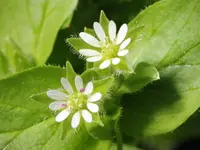
The flowers are tiny and white, with five deeply split petals that often look like ten, and they sit on slender stalks above the foliage.

Stellaria media Identification

Is This common chickweed?

Upload a plant photo and check the identification in seconds.

Clear images work best. Avoid photos taken too close or too far away

Check these visible traits on common chickweed before looking closer.

  • Low, sprawling plant that forms loose mats, with many branching stems.
  • Leaves are opposite in pairs, oval to egg-shaped, usually about 1/2-1 inch (1-2.5 cm) long.
  • Lower leaves often have short stalks, while upper leaves sit directly on the stem.
  • Stems are slender and show a single line of fine hairs running along one side.
  • Flowers are small and white, about 1/4 inch (6 mm) across, with 5 deeply split petals that can look like 10.

The one-sided hairy stem is especially useful when flowers are absent.

Stellaria media shows useful visual shifts from tiny sprouts to flowering, seed-setting mats.

  • Seedling: Seedlings show paired oval seed leaves, then the first true leaves appear opposite, small, and smooth-edged on a thin, delicate stem.
  • Young plant: Young plants begin trailing and branching, with opposite pointed leaves and a clearer single line of hairs running along one side of each stem.
  • Flowering stage: At flowering, common chickweed forms low mats about 2-8 inches (5-20 cm) across, bearing small white star-like flowers from leaf axils on slender stalks.
  • Fruiting stage: After flowering, the green oval capsule becomes more noticeable than the petals, staying upright and enclosed by sepals before splitting to release seeds.

Flowers are the main seasonal clue on common chickweed. In cool weather, especially spring and often again in fall, the plant is easier to spot when small white star-like flowers open above the leafy mats. After flowering, tiny oval seed capsules become visible. In hot summer or during dry spells, patches often look thinner or die back, so the low green mats may be less obvious until cooler weather returns.

A few small, white-flowered weeds are regularly mistaken for Stellaria media.

mouse-ear chickweed(Cerastium fontanum)

It forms similar low mats with opposite leaves and small white flowers. The quickest check is texture: mouse-ear chickweed is densely hairy, giving leaves and stems a gray-green look, while Stellaria media is much less hairy and often shows a single line of hairs on the stem.

scarlet pimpernel(Lysimachia arvensis)

Seedlings can resemble chickweed because both stay low with small opposite leaves. Scarlet pimpernel usually has orange to salmon flowers, not white, and its leaves are smooth-edged and often dotted underneath.

Stellaria media is native to Europe and much of temperate Asia, though it is now widespread far beyond that range. Native range matters less than habitat here, because this species is commonly found wherever the ground is disturbed. For identification, look in gardens, crop fields, lawns, paths, waste ground, and moist open sites in towns and farmland. Finding it in low, regularly disturbed ground is a useful clue and helps separate it from less weedy woodland or alpine Stellaria species.

Does Your Plant Match?

Use Botan to compare a photo and help confirm the plant, which can save time before you decide what to do next.

FAQ

The most reliable trait is the single line of fine hairs running along one side of the stem, switching sides at each node. In common chickweed identification, paired oval leaves and weak, branching stems support the ID.

More Plant Identification Guides

Find Out What Plant It Is

Identify it from a photo with Botan, then review plant details, care information, and common problems matched to the species.

Botan app identifying a plant from a photo
How Long Can Flowers Go Without Water? Everything You Need to Know

6 min read · 10 Jul 2026

How Long Can Flowers Go Without Water? Everything You Need to Know

Flowers can survive without water anywhere from 1-2 hours to several months, depending on the plant type, species, and growing conditions. Some strong-looking flowers are drought-sensitive, while delicate-looking plants may tolerate long dry periods surprisingly well.

Plant Care
How Long Can Flowers Go Without Water? Everything You Need to Know
Planting Grass Seed in Summer – What Works and What Fails

7 min read · 6 Aug 2026

Planting Grass Seed in Summer – What Works and What Fails

Summer seeding succeeds when the grass type suits the season, and the soil stays moist. Find out how to prepare the seedbed and choose a safe window for planting.

Plant Care
Planting Grass Seed in Summer – What Works and What Fails
How to Winterize Your Garden in 6 Steps

5 min read · 28 Sept 2026

How to Winterize Your Garden in 6 Steps

Learn how to prepare your garden for winter with a practical six-step checklist covering cleanup, tender plant care, watering, mulching, winter protection, and winterizing equipment and containers.

Plant Care
How to Winterize Your Garden in 6 Steps