
Bush Honeysuckle Identification (Halleria elliptica)

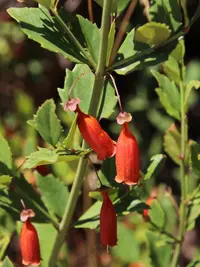
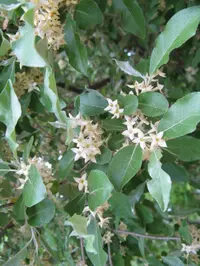
Recognize Halleria elliptica by its opposite, elliptic leaves and clusters of narrow, tubular orange-red flowers borne directly on older branches and the trunk.

It usually grows as a many-stemmed shrub or small tree, with leaves about 1 to 3 inches (2.5 to 7.5 cm) long.

Halleria elliptica Identification

Check Your Plant ID

Upload a plant photo and check the identification in seconds.

Clear images work best. Avoid photos taken too close or too far away

Check the stem-flowering habit and simple opposite leaves of Halleria elliptica.

  • Usually a large shrub or small tree, often about 10 to 20 feet (3 to 6 m) tall, with many branches.
  • Leaves are simple, oval to elliptic, opposite, and usually around 1 to 3 inches (2.5 to 7.5 cm) long.
  • Flowers are tubular and red to orange-red, borne directly on older stems and the trunk rather than only at twig tips.
  • Fruits are small, rounded berries that follow the stem-borne flowers.

Stem-borne tubular flowers are the fastest visual clue.

Halleria elliptica shows useful visual shifts as stems age and reproductive parts appear.

  • Young plant: Usually a small, leafy shrub with slender green to gray stems and opposite leaves; the trunk is not yet thickened or fissured.
  • Mature plant: Becomes a woody shrub or small tree, often 6-15 feet (1.8-4.6 m) tall, with a thicker trunk, rougher bark, and a broader, branching crown.
  • Flowering stage: Flowers appear directly on older stems and trunk, not just branch tips, as narrow tubular red to orange blooms that stand out against the bark.
  • Fruiting stage: After flowering, rounded fleshy berries replace the tubes along older wood, creating a dotted pattern on stems that is absent before fruit develops.

Halleria elliptica is often easiest to recognize when it flowers. In spring to early summer, clusters of tubular orange to red flowers stand out along older stems and branches, not just at the tips. After flowering, small fleshy berries become visible and can persist for a time, adding another seasonal clue.

Halleria elliptica is native to southern Africa, including South Africa, Eswatini, and Lesotho. It occurs in forest margins, wooded ravines, streambanks, and rocky slopes, often in moister sites within otherwise drier landscapes. This habitat is useful for identification because the species is more likely in sheltered woodland or near water than in open grassland. In the field, location in eastern and southern African montane or coastal bush can help narrow an identification.

Scan. Check. Confirm.

Use Botan to identify or verify a plant from a photo when a closer check can help avoid mix-ups.

FAQ

Flowers are borne in tight clusters directly from older stems and the trunk, not just at branch tips. This cauliflorous pattern, with tubular orange to red blooms packed along woody parts, is a strong Halleria elliptica identification clue.

More Plant Identification Guides

Find Out What Plant It Is

Identify a plant from a photo with Botan, then get species-specific care information, safety notes, and common problems.

Botan app identifying a plant from a photo
Best Time to Mow Lawn – A Complete Guide

5 min read · 10 Aug 2026

Best Time to Mow Lawn – A Complete Guide

Explore when to mow your lawn for its health and a pleasant green color. Find out the best time for this task during the summer heat, and follow practical tips for correctly cutting the grass, and learn common mistakes to avoid.

Plant Care
Best Time to Mow Lawn – A Complete Guide
Top 15 Plants That Don’t Need Sunlight

8 min read · 17 Sept 2026

Top 15 Plants That Don’t Need Sunlight

Some plants thrive in dim rooms, shaded corners, and places with indirect light. In this guide, you’ll explore the top 15 species best suited to low-light conditions and how to care for them.

Plant Recommendations
Top 15 Plants That Don’t Need Sunlight
Rice Water for Plants – Which Plants Love It and How to Make It

8 min read · 14 Jul 2026

Rice Water for Plants – Which Plants Love It and How to Make It

Rice water can be an ideal DIY solution for orchids, roses, or fruiting plants. It supports growth, leaf count, and height. We’ll share how to make and apply it correctly for your plant.

Plant Care
Rice Water for Plants – Which Plants Love It and How to Make It