
Norway spruce Identification (Picea abies)

To recognize Norway spruce, look for four-sided needles borne singly all around the twig, each attached on a small woody peg, and long cylindrical cones that hang downward from the branches.

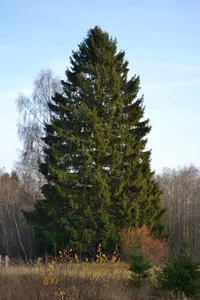
It typically forms a tall, narrow conical tree with a straight trunk and noticeably drooping secondary branchlets.

Picea abies Identification

Identify Your Plant with Botan

Take or upload a photo to confirm your plant ID with Botan.

Clear images work best. Avoid photos taken too close or too far away

Check the overall shape and the needles first on Picea abies.

  • Tall, narrow, strongly conical tree with layered horizontal branches and drooping branchlets.
  • Needles are single, stiff, sharply pointed, and about 1/2 to 1 inch (1.5 to 2.5 cm) long.
  • Needles attach all around the twig on tiny peg-like bases, giving twigs a rough look after needles drop.
  • Cones hang down from branch tips and are long and narrow, often 4 to 7 inches (10 to 18 cm) long.

Drooping secondary branchlets are one of the quickest field clues.

Picea abies shows clear age-related changes in form, branching, and cone production.

  • Seedling: Seedlings are a single upright shoot with short, crowded needles and little branching, lacking the layered side branches seen later.
  • Young plant: Young plants develop a narrow conical outline, regular whorled branches, and strongly drooping secondary branchlets that begin to define the species.
  • Mature plant: Mature trees become tall and very spire-shaped, often 100-180 feet (30-55 m), with a straight trunk and broad lower branch tiers.
  • Fruiting stage: Fruiting branches carry long, pendent cones, typically 4-7 inches (10-18 cm), hanging from upper crown branches and absent on younger plants.

Several cultivated forms of Norway spruce are easy to separate by crown shape, shoot habit, or needle color.

  • 'Pendula': Has a strongly weeping outline, with the main leader and side branches hanging downward instead of forming the usual broad conical crown.
  • 'Nidiformis': Forms a low, nest-like mound, often 3-6 feet (0.9-1.8 m) tall and wider than tall, rather than a tall tree.
  • 'Acrocona': Shows many red spring cones held at branch tips, making cone display far more obvious than on the typical form.
  • 'Inversa': Develops a narrow, cascading habit with drooping branches and usually needs staking to gain height, unlike the self-supporting standard form.
  • 'Aurea': New growth emerges yellow to golden, especially in spring, instead of the normal medium green.

Picea abies stays green year-round, so seasonal color change is limited. The clearest shift is in spring, when fresh light-green new shoots appear at branch tips and stand out against the older, darker needles. By late summer into fall, the long hanging cones are the main seasonal clue. In winter, those cones may still be present, and the layered branches with strongly drooping side branchlets are easier to see.

Several conifers can be mistaken for Norway spruce at a glance.

Serbian spruce(Picea omorika)

Similar narrow, drooping outline. It differs by flatter needles with bright white bands beneath, giving a two-toned look; its crown is much slimmer.

Sitka spruce(Picea sitchensis)

Also has sharp single needles and hanging branchlets. Check the cones: Sitka spruce has thin, papery scales with irregular toothed edges, unlike the smoother-edged cones of Picea abies.

Douglas-fir(Pseudotsuga menziesii)

Often confused when not in cone. It differs fastest by cones with long three-pointed bracts sticking out between the scales; spruce cones lack those protruding bracts.

Picea abies is native to northern, central, and eastern Europe, from Scandinavia south into major mountain systems including the Alps, Carpathians, and Balkans. In the wild it is most often associated with cool conifer forests, which helps separate it from spruces native to North America. It commonly grows in boreal woodland and montane forest, including moist slopes and valleys, often forming extensive stands at middle to high elevations in southern parts of its range.

Check Your Plant ID

Use Botan to compare a photo and help identify or confirm the plant before you label it incorrectly.

FAQ

Yes. This species bears long, hanging seed cones, often 4 to 7 inches (10 to 18 cm) long. It does not make pods. The cones are much longer and more pendulous than on many other spruces.

Everything About Norway spruce

More Plant Identification Guides

Find the Plant. Get the Details.

Identify a plant from a photo with Botan, then review plant details, care information, and common problems.

Botan app identifying a plant from a photo
Best Time to Mow Lawn – A Complete Guide

5 min read · 10 Aug 2026

Best Time to Mow Lawn – A Complete Guide

Explore when to mow your lawn for its health and a pleasant green color. Find out the best time for this task during the summer heat, and follow practical tips for correctly cutting the grass, and learn common mistakes to avoid.

Plant Care
Best Time to Mow Lawn – A Complete Guide
Banana Peel Water for Plants: 5 Things to Know Before Trying It

5 min read · 9 Jul 2026

Banana Peel Water for Plants: 5 Things to Know Before Trying It

Banana water can provide potassium and some nutrients that may support plant growth, but it is not a universal fix. Use it carefully and only when the plant actually shows signs of nutrient deficiency rather than as a routine treatment.

Plant Care
Banana Peel Water for Plants: 5 Things to Know Before Trying It
How Long Can Flowers Go Without Water? Everything You Need to Know

6 min read · 10 Jul 2026

How Long Can Flowers Go Without Water? Everything You Need to Know

Flowers can survive without water anywhere from 1-2 hours to several months, depending on the plant type, species, and growing conditions. Some strong-looking flowers are drought-sensitive, while delicate-looking plants may tolerate long dry periods surprisingly well.

Plant Care
How Long Can Flowers Go Without Water? Everything You Need to Know