

bradford pear Identification (Pyrus calleryana)

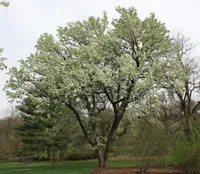
Recognize Pyrus calleryana by its upright, narrowly oval crown, glossy oval leaves with fine teeth arranged alternately, and dense clusters of five-petaled white flowers borne on short spurs.

Most trees form a straight trunk with many steeply ascending branches, creating a tight, symmetrical outline.

Pyrus calleryana Identification

Check Your Plant ID

Not sure about your plant ID? Upload a photo and check it with Botan.

Clear images work best. Avoid photos taken too close or too far away

Use these fast visual checks for Pyrus calleryana.

  • Tree is usually upright with a dense, narrow-oval to rounded crown and many ascending branches.
  • Leaves are simple, alternate, glossy, and broadly oval to nearly round, often 1.5-3 inches (4-8 cm) long, with fine teeth.
  • Flowers appear in tight clusters; each flower has 5 white petals and a flat, open face.
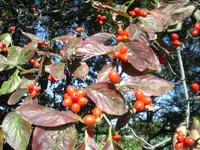
  • Fruits are small, round pomes, about 0.5 inch (1 cm) wide, hanging on slender stalks.

Check several traits together, especially the branching shape, leaf form, and clustered white flowers.

Bradford pear shows clear visual shifts from youth to flowering and fruiting maturity.

  • Young plant: Young plants are strongly upright, often narrowly oval, with slender stems and glossy, broad-oval leaves about 1-3 inches (2.5-7.5 cm) long.
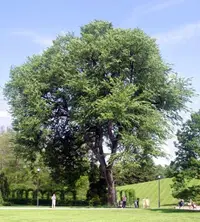
  • Mature plant: Mature trees develop a denser crown and more rigid branch framework, with multiple ascending limbs and a broader, rounded to narrowly pyramidal outline.
  • Flowering stage: In flower, bare or newly leafing branches carry dense clusters of white five-petaled blossoms, making the canopy look pale and finely textured.
  • Fruiting stage: After flowering, small round pomes hang in clusters, shifting the visual cue from blossom masses to persistent speckled fruit among the foliage.

Several bradford pear cultivars can be separated in the landscape by crown shape and mature size.

  • 'Bradford': Broadly rounded to spreading crown with very dense branching; typically 30 to 50 feet tall and 20 to 35 feet wide (9 to 15 m by 6 to 11 m).
  • 'Chanticleer': Much narrower, upright pyramidal crown, often only 15 to 20 feet wide at maturity (4.5 to 6 m).
  • 'Aristocrat': Wider branch angles and a more open, broadly pyramidal crown than the typical dense form; leaves are also slightly larger.
  • 'Capital': Strongly columnar habit, staying notably narrow compared with the usual rounded crown.

In early spring, Pyrus calleryana becomes easy to spot when dense clusters of white flowers open before or with the first leaves. The glossy leaves then expand and create a full, rounded canopy through the growing season. In fall, the leaves often turn red, purple, orange, or yellow before dropping. After leaf fall, the upright branching and small, persistent brown fruits can remain visible into winter.

Several spring-flowering trees are often mistaken for bradford pear.

apple serviceberry(Amelanchier arborea)

It shares early white flowers and a similar small-tree shape. Serviceberry leaves are finely toothed and usually softer-looking, while bradford pear leaves are thicker, glossier, and more rounded. Serviceberry also has smooth gray bark and forms small purple fruits.

common pear(Pyrus communis)

This can be confused by its white flower clusters and pear-like leaves. Common pear usually has a more open crown and often larger, edible fruits, while bradford pear keeps a denser, upright branching pattern and small hard fruits.

Pyrus calleryana is native to eastern Asia, including China, Taiwan, Korea, Japan, and Vietnam. In its native range it occurs in mixed woodland edges, thickets, valleys, and disturbed open ground rather than deep forest. That setting helps with identification because this species often appears where tree lines, roadsides, and other open margins meet developed or semi-wild areas. Finding a pear-like tree naturalizing in those edge habitats can help narrow it to Pyrus calleryana.

Confirm the Species with Botan

Upload a photo to compare key details and get help identifying the plant or confirming your ID.

FAQ

The flowers are small, white, and five-petaled, borne in dense clusters before or with the leaves in early spring. Their strong, often unpleasant odor is a notable clue when identifying bradford pear.

More Plant Identification Guides

One Photo. More About Your Plant.

Identify a plant from a photo with Botan, then get plant details, care information, and common problems for that species.

Botan app identifying a plant from a photo
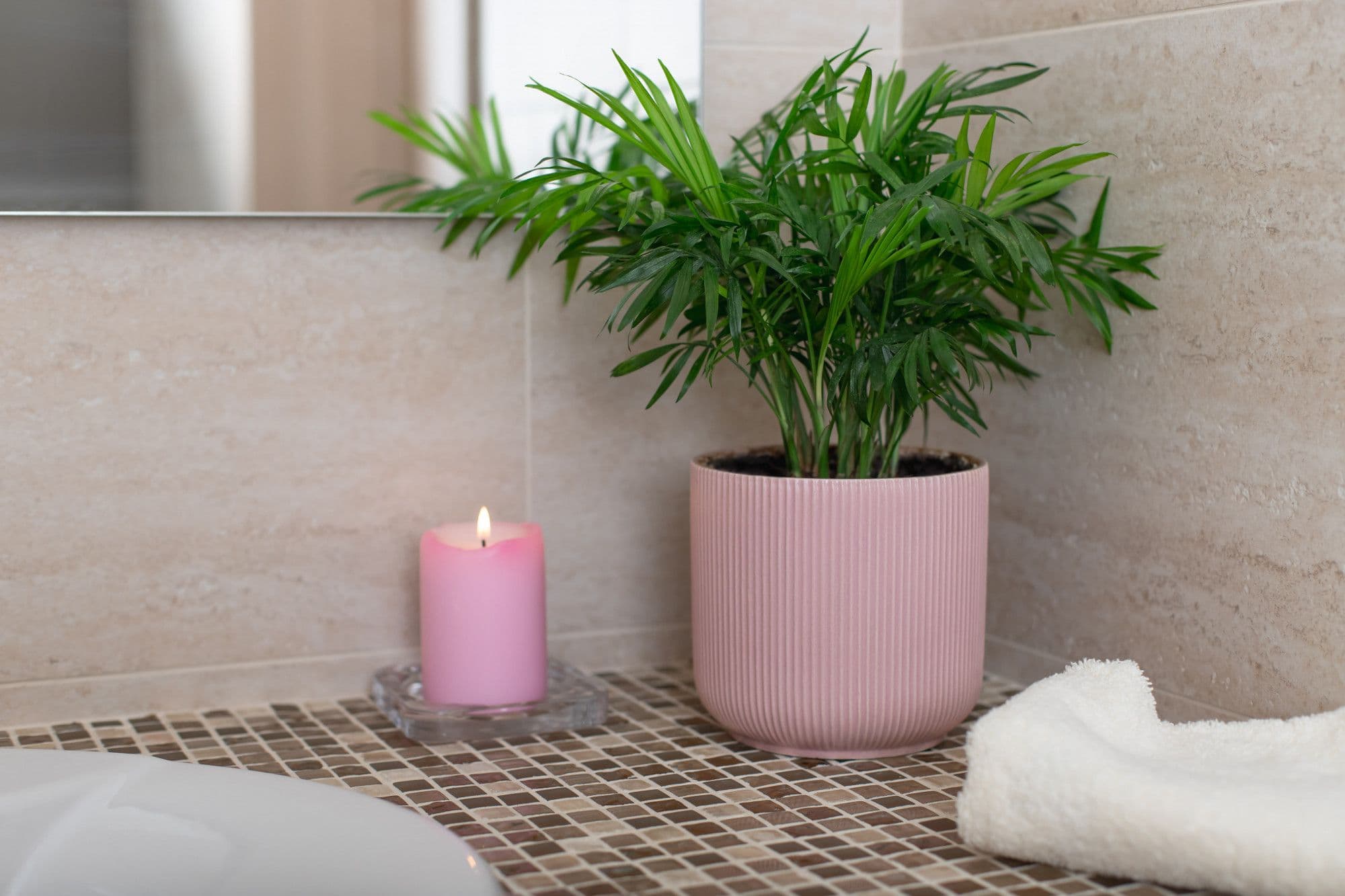
12 Best Plants for Bathroom That Thrive in Humid Conditions

9 min read · 29 Sept 2026

12 Best Plants for Bathroom That Thrive in Humid Conditions

Discover the 12 best plants for bathroom spaces. Each pick comes with its own advantages, plus light, humidity, watering, and placement tips. Take a look and match the plant to your specific bathroom.

Plant Recommendations
12 Best Plants for Bathroom That Thrive in Humid Conditions
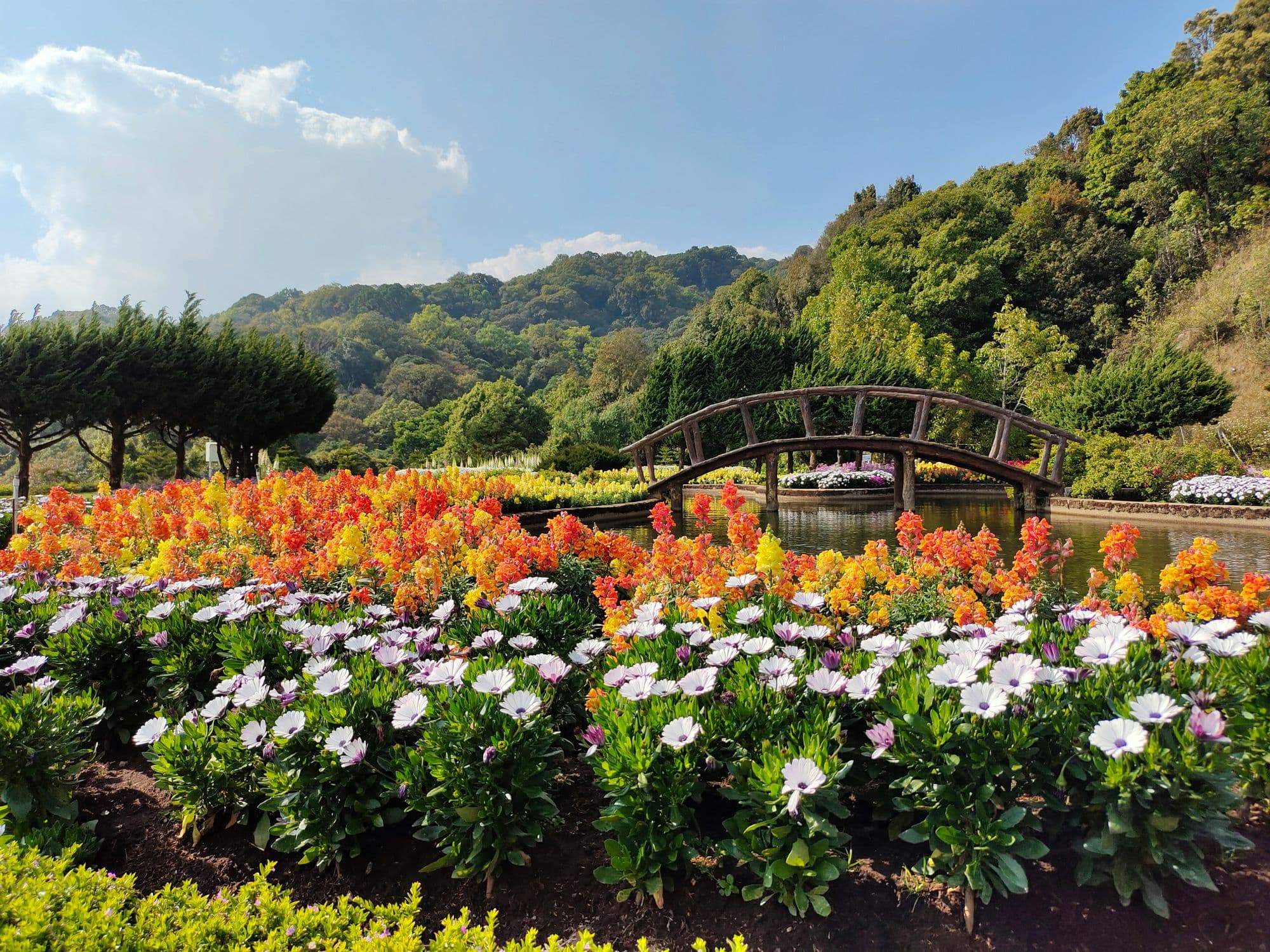
10 Easy Garden Flowers to Grow

8 min read · 10 Sept 2026

10 Easy Garden Flowers to Grow

Discover 10 garden flowers that require minimal care. Learn which characteristics make plants easy to grow and follow tips on how to create a beautiful corner from beginner-friendly blooms on your property.

Beginner Guides
10 Easy Garden Flowers to Grow
How Fast Does Bamboo Grow Per Day, Month, and Year

10 min read · 7 Jul 2026

How Fast Does Bamboo Grow Per Day, Month, and Year

Bamboo grows extremely fast: some species can reach 5-6 m in just 3-4 months under the right conditions. This guide explains how much bamboo can grow per day, week, and year, and what affects its growth rate.

Plant Recommendations
How Fast Does Bamboo Grow Per Day, Month, and Year