


American elm Identification (Ulmus americana)

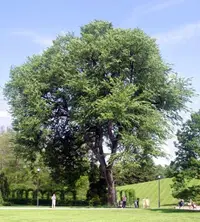
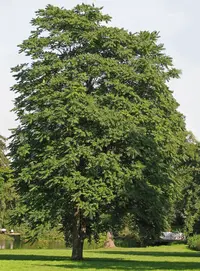
Recognize American elm by its broad vase-shaped crown, often with a single trunk that divides into several arching main branches. Leaves are alternate, 3 to 6 inches (8 to 15 cm) long, oval with a strongly uneven leaf base and sharply double-serrated edges.

The bark is gray-brown with long, intersecting ridges that form diamond-like furrows.

Ulmus americana Identification

Check Your Plant with Botan

Not sure about your plant ID? Upload a photo and check it with Botan.

Clear images work best. Avoid photos taken too close or too far away

Use these visible traits to check whether a tree is Ulmus americana.

  • Crown broad and vase-shaped, with a single trunk and arching limbs that spread upward then outward.
  • Leaves are alternate, simple, and 3-6 inches (8-15 cm) long, with a sharply pointed tip.
  • Leaf bases are uneven, with one side set lower than the other where the blade meets the stalk.
  • Leaf edges are doubly serrated, meaning each large tooth carries smaller teeth.
  • Fruit appears as a flat, round samara, a papery winged seed, with the seed centered.

Check several leaves on one branch, since size and symmetry can vary.

American elm shows clear visual shifts from low seedling to broad, high-canopied adult.

  • Seedling: First growth has a slender upright stem with alternate, simple leaves already asymmetrical at the base, but smaller and thinner than later foliage.
  • Young plant: Saplings form a narrow, vase-leaning outline with ascending branches; leaves enlarge to about 3-6 inches (8-15 cm) long and show stronger double serration.
  • Mature plant: The crown expands into the classic high arching vase form, with heavy scaffold limbs and a deeply furrowed trunk unlike smoother younger bark.
  • Fruiting stage: After flowering, branches carry many flat, round samaras, each with a central seed, creating a temporary pale fringe before full leaf expansion.

Several named selections of American elm are recognizable by crown shape or leaf coloring.

  • 'Princeton': Typically shows a broad vase-shaped crown and glossy dark green leaves, often denser and more symmetrical than the typical form.
  • 'Lewis & Clark': Usually has a narrower, more upright crown, with a mature spread often around 25-30 feet (7.6-9.1 m), less broad than most seedlings.
  • 'Valley Forge': Forms a strongly arching vase shape with a broad crown, often wider and more pendulous in outline than upright selections.
  • 'Jefferson': Recognized by a tall, narrow vase form, with a tighter crown and more ascending branch structure than the species is known for.
  • 'Aurea': Differs clearly by yellow to yellow-green foliage rather than the usual medium green leaves.

In early spring, American elm often shows small reddish to purplish flower clusters before or as the leaves emerge. Soon after, flat round samaras, the winged seeds, appear and briefly hang through spring before dropping. By fall, the leaves turn yellow, then drop to reveal the species' arching, vase-shaped branch framework. In winter, the bare crown and gray to dark gray ridged bark become easier to recognize.

Several elms are often mistaken for American elm.

slippery elm(Ulmus rubra)

Similar vase-like shape and uneven leaf bases can confuse ID. Slippery elm usually has much rougher, larger leaves and twigs that are hairy rather than mostly smooth.

rock elm(Ulmus thomasii)

Another native elm with similar leaves and bark. It is usually separated by corky wing-like ridges on twigs and a narrower crown, not the broad vase form.

Japanese elm(Ulmus davidiana var. japonica)

Common in plantings and similar in leaf shape. It typically shows a more upright crown and smaller samaras, the flat winged seeds elms produce.

Ulmus americana is native to eastern and central North America, from southern Canada through the eastern United States and west into the Great Plains. Its broad native range is useful context, especially when separating it from Asian elm species planted outside that area. In the wild, it is most typical of bottomlands, floodplains, streambanks, moist woods, and other lowland sites. Finding a large elm in rich, seasonally wet ground within that native range can help narrow identification.

Confirm the Species with Botan

Use a photo to identify or verify the plant, which helps avoid mix-ups before buying, planting, or recording it.

FAQ

The quickest clue is the strongly uneven leaf base paired with coarse double-serrated edges. Mature trees also tend to form a broad vase-shaped crown, a classic feature used in American elm identification.

More Plant Identification Guides

Identify First. Learn What Comes Next.

Use a photo with Botan to identify the plant, then get species-specific care information, safety notes, and common problems.

Botan app identifying a plant from a photo
Dill Companion Plants – What to Grow Next to Dill

9 min read · 17 Jul 2026

Dill Companion Plants – What to Grow Next to Dill

Dill is an easy-to-grow plant that gets along well with many vegetables. This guide describes 15 plants that can be planted alongside it, a few to avoid, and mistakes that can quietly sabotage the entire process.

Plant Recommendations
Dill Companion Plants – What to Grow Next to Dill
Plants That Repel Bugs – 20 Effective Options

12 min read · 16 Jul 2026

Plants That Repel Bugs – 20 Effective Options

Mosquitoes on the patio? Gnats in the kitchen? Some plants keep them away with the scent of their own leaves. Here are 20 that deal with mosquitoes, flies, aphids, and more, plus where to put them so they help.

Plant Recommendations
Plants That Repel Bugs – 20 Effective Options
Thorny Plants: A Comprehensive Guide

10 min read · 25 Aug 2026

Thorny Plants: A Comprehensive Guide

Many plants defend themselves with sharp thorns. This guide explores over 20 examples among flowers, shrubs, trees, and vines. You'll learn what each plant looks like, why it grows thorns, and how to quickly identify them.

Plant Recommendations
Thorny Plants: A Comprehensive Guide