hackberry Identification (Celtis occidentalis)

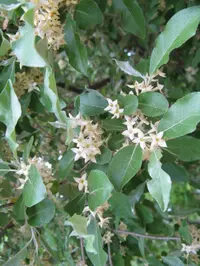
To recognize hackberry, look for simple, alternate leaves with an uneven leaf base and three main veins rising from the base.

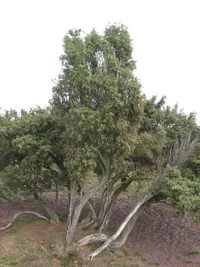
Also check the trunk: mature Celtis occidentalis usually shows pale gray bark broken into thick, corky, warty ridges and bumps.

Celtis occidentalis Identification

Scan to Confirm hackberry

Take or upload a photo to confirm your plant ID with Botan.

Clear images work best. Avoid photos taken too close or too far away

Use these visible traits to check for hackberry.

  • Leaves are alternate, simple, and usually 2–5 inches (5–13 cm) long.
  • Each leaf is ovate with a long pointed tip and three main veins rising from the base.
  • Leaf margins are unevenly toothed on the upper half, while the base is often lopsided.
  • Twigs are slender and slightly zigzag between leaves and buds.
  • Bark on the trunk is light gray with corky, warty ridges and irregular bumps.

Fruit, when present, appears as small round drupes borne singly on slender stalks.

Celtis occidentalis shows clear age-related changes in form, bark, and fruit display.

  • Seedling: Seedlings have alternate, simple leaves on a slender green stem; leaves are thinner and less rough than on older plants.
  • Young plant: Young plants form an upright sapling with a narrow crown. Bark is still fairly smooth, before the corky ridges and warty bumps stand out.
  • Mature plant: Mature hackberry develops a broad, irregular crown and a trunk with distinctive corky, wart-like bark. Leaves are often 2 to 5 inches (5 to 13 cm) long.
  • Fruiting stage: Fruiting branches carry small, round drupes that shift from orange-red to dark purple, hanging singly on slender stalks from the leaf axils.

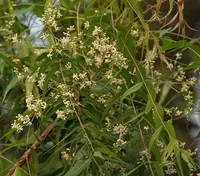
In spring, Celtis occidentalis leafs out with light green, rough-textured leaves, and small greenish flowers may be visible as the foliage expands. By late summer into fall, orange to dark purple berry-like drupes often stand out against yellow fall color. After leaf drop, the gray bark with corky, warty ridges and the broad, arching branch pattern are easier to see.

Several trees are regularly mistaken for hackberry.

sugarberry(Celtis laevigata)

Often confused because both have uneven leaf bases and small dark drupes. Sugarberry leaves are usually narrower and smoother, and its bark is less corky and warty.

American elm(Ulmus americana)

Can look similar from a distance because both are large deciduous trees with rough, uneven-based leaves. Elm leaves are doubly serrated throughout, and elm fruits are flat, round samaras, not berry-like drupes.

basswood(Tilia americana)

Sometimes confused by its broad, toothed leaves and gray bark. Basswood leaves are more heart-shaped and symmetrical at the base, and its pale hanging flower-and-fruit clusters are attached to a strap-like bract.

Celtis occidentalis is native to much of eastern and central North America, from southern Canada south to parts of the central and eastern United States. In the wild it is most often found in floodplains, streambanks, open woods, and limestone-rich bottomlands. Seeing it in lowland river corridors or rich woodland edges can help separate it from look-alikes more typical of drier uplands.

Not Sure About the ID?

Use Botan to identify or confirm it from a photo, which helps avoid mix-ups with similar plants.

FAQ

Yes. Mature trees often develop gray bark with distinctive corky warts and ridges, a key feature for hackberry identification. They also form a broad, rounded crown, while younger trees usually have smoother bark and a narrower outline.

More Plant Identification Guides

Identify It. Learn More About It.

Identify a plant from a photo with Botan, then get species-specific care information, safety notes, and common problems.

Botan app identifying a plant from a photo
Best Water for Plants – How to Choose the Right Type

7 min read · 13 Aug 2026

Best Water for Plants – How to Choose the Right Type

Rainwater, filtered, distilled, and tap water affect plants differently. Learn which types support healthy growth and which cause slow damage. Match each to your plants and discover how to easily improve tap water quality.

Plant Care
Best Water for Plants – How to Choose the Right Type
Best Time to Water Grass in Summer – Lawn Watering Tips

5 min read · 21 Jul 2026

Best Time to Water Grass in Summer – Lawn Watering Tips

Summer watering is easy to get wrong. This guide explains when to turn on your sprinkler, how much liquid your grass needs each week, and how to tell if you're overwatering or underwatering.

Plant Care
Best Time to Water Grass in Summer – Lawn Watering Tips
12 Best Landscaping Trees for Your Garden

8 min read · 6 Oct 2026

12 Best Landscaping Trees for Your Garden

Choosing the landscape tree depends on what your garden needs most. These 12 options include compact flowering specimens, colorful deciduous trees, shade varieties, and evergreens suitable for screening and year-round structure.

Plant Recommendations
12 Best Landscaping Trees for Your Garden