
autumn olive Identification (Elaeagnus umbellata)

To recognize autumn olive, look for a multi-stemmed shrub or small tree with alternate, narrow oval leaves, silvery undersides, and short spines on some branches. Leaves are usually 2-4 inches (5-10 cm) long.

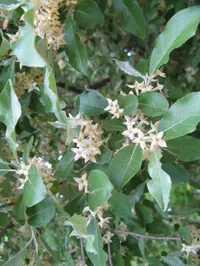
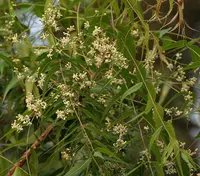
Another strong clue is the small, tubular, four-lobed flowers borne in the leaf axils, singly or in clusters.

Elaeagnus umbellata Identification

Is This autumn olive?

Upload a clear image to check whether your plant ID is correct.

Clear images work best. Avoid photos taken too close or too far away

Check the shrub’s leaf shape, twig pattern, flowers, and fruit on Elaeagnus umbellata.

  • Shrub is dense and many-stemmed, often arching, usually 6-16 feet (1.8-4.9 m) tall.
  • Leaves are alternate, narrow oval to lance-shaped, about 2-4 inches (5-10 cm) long, with smooth edges.
  • Leaf undersides look silvery to whitish and are covered with tiny reflective scales.
  • Small pale yellow to cream flowers hang in short clusters from the leaf axils.
  • Fruits are round, red, about 1/4 inch (6 mm) wide, and dotted with silvery speckles.

The silvery-scaled leaf undersides and speckled red fruits are especially useful field marks.

Elaeagnus umbellata shows useful visual changes from early shrub growth through fruiting.

  • Young plant: Young plants are sparsely branched, with slender twigs and narrower leaves; the silvery undersides and speckled stems already show clearly.
  • Mature plant: Mature plants form a dense, many-stemmed shrub about 6-16 feet (1.8-4.9 m) tall, often with arching branch tips and a broader, thicket-forming outline.
  • Flowering stage: Flowering plants carry many small, tubular, pale yellow to creamy flowers in leaf axils, making the twiggy framework look finely dotted.
  • Fruiting stage: Fruiting branches show rounded red drupes with silvery speckles hanging along the stems, a much heavier and more conspicuous look than flowering stage.

In spring, autumn olive leafs out with narrow green leaves that show a silvery underside. Small, pale yellowish-white flowers become visible in spring, often tucked along the stems. By late summer into fall, the shrub stands out for many small red berries with silvery speckles. After leaf drop, the dense twiggy branching is easier to see.

A few shrubs are regularly mistaken for autumn olive.

Russian olive(Elaeagnus angustifolia)

Often confused because both have silvery foliage and speckled fruit. Russian olive has much narrower, willow-like leaves and usually thornier twigs. Its fruit is more oval than round.

Silverthorn(Elaeagnus pungens)

Confusion comes from the silvery leaf undersides and red speckled fruit. Silverthorn is usually evergreen, with thicker, broader leaves and a more leathery texture. Elaeagnus umbellata is deciduous with thinner leaves.

Goumi(Elaeagnus multiflora)

Similar silver-dusted leaves and red speckled fruits can mislead. Goumi fruits are usually larger and hang singly or in pairs on longer stalks, while Elaeagnus umbellata typically bears many fruits in clusters.

Elaeagnus umbellata is native to eastern Asia, including China, Korea, Japan, and the Himalayas. It occurs in open woods, forest edges, thickets, disturbed slopes, and streamside ground, often in sunny to lightly shaded places. That setting helps with identification because this species commonly turns up as a shrub of edges and clearings rather than deep forest. Finding it in brushy margins, old fields, or open woodland can help separate it from look-alikes tied to wetter wetlands or dense shade.

Check Your Plant ID

Use Botan to compare a photo and help confirm the plant, which is useful before labeling it or making decisions about it.

FAQ

The clearest feature is the dense silvery scaling on the undersides of the leaves and on young stems. In fall, this plant often carries many small red berries covered with tiny silver speckles.

More Plant Identification Guides

Identify Your Plant and Learn More

Use Botan to identify it from a photo, then see plant details, care information, and common problems.

Botan app identifying a plant from a photo
Plant Pot Sizes: How to Choose the Right Plant Container

7 min read · 20 Aug 2026

Plant Pot Sizes: How to Choose the Right Plant Container

Plant pot sizes can be confusing because the number on the label only tells you part of the required information. A container may look spacious but actually be too shallow. So, how to choose pot size for plant species?

Beginner Guides

Plant Pot Sizes: How to Choose the Right Plant Container
How to Increase Humidity for Plants – 8 Simple Ways That Work

8 min read · 14 Aug 2026

How to Increase Humidity for Plants – 8 Simple Ways That Work

Dry indoor air stresses a lot of houseplants. You usually notice it first in the browning leaf tips. This guide describes 8 simple ways to raise the moisture around your plants, from humidifiers to pebble trays.

Plant Care
How to Increase Humidity for Plants – 8 Simple Ways That Work
13 Best Front Yard Trees for Every Home and Yard

12 min read · 7 Aug 2026

13 Best Front Yard Trees for Every Home and Yard

A front yard tree can stay for decades. Therefore, choosing one deserves serious consideration. Here are 13 trees that have proven themselves, sorted by their purpose. You'll also find five species to avoid and basic planting information.

Plant Recommendations
13 Best Front Yard Trees for Every Home and Yard