
flowering dogwood Identification (Cornus florida)

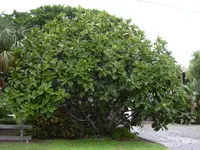
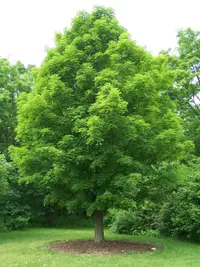
Recognize flowering dogwood by its opposite, oval leaves with strongly curved side veins and its low-branched, broad-spreading form, often 15 to 30 feet tall (4.6 to 9.1 m).

Its showy bloom structure has four large white bracts surrounding a tight central cluster of true flowers.

Cornus florida Identification

Is This flowering dogwood?

Take a photo and use Botan to confirm your plant identification.

Clear images work best. Avoid photos taken too close or too far away

Use a few easy traits to check for Cornus florida.

  • Small tree with a broad, layered crown, often wider than tall.
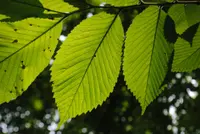
  • Leaves grow in opposite pairs, are oval, and usually 3-6 inches (8-15 cm) long with smooth edges.
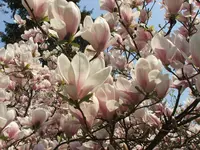
  • Flower display shows four large white or pink bracts around a tiny central cluster; each bract has a shallow notch at the tip.
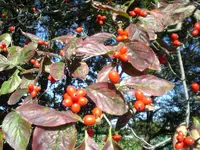
  • Fruits appear in tight clusters of bright red, oval drupes.

Check several features together, especially opposite leaves and the four notched bracts.

Cornus florida shows clear visual shifts from early growth through flowering and fruiting stages.

  • Young plant: Young plants are usually upright with a narrow outline, slender stems, opposite leaves, and little horizontal layering compared with older specimens.
  • Mature plant: Mature plants form a low-branched, broadly spreading small tree, often 15-30 feet (4.6-9.1 m) tall, with distinctly tiered lateral branches.
  • Flowering stage: In bloom, branch tips display showy four-bracted heads about 3-5 inches (7.6-12.7 cm) across, making the otherwise fine twig structure easier to recognize.
  • Fruiting stage: After flowering, tight clusters of glossy red drupes replace the flower heads at branch tips, standing out against the simple opposite leaves.

Several flowering dogwood selections are identifiable by bract color or leaf variegation.

  • 'Cherokee Chief': Bracts open deep rose-red to red instead of the usual white, making spring display the clearest field mark.
  • 'Cherokee Princess': Shows larger white bracts than many typical seedlings, often giving a broader, brighter flower display.
  • 'Rubra': Bracts are pink to rosy pink rather than white, usually softer in tone than red-flowering selections.
  • 'Rainbow': Leaves are variegated with irregular yellow margins and patches, unlike the plain green leaves of the typical form.
  • f. pendula: Branches droop to form a distinctly weeping crown instead of the normal broad, layered habit.

In spring, flowering dogwood is easiest to spot when its showy white to pink bracts open before or with the leaves. By late summer into fall, clusters of bright red fruits stand out against the foliage. Fall leaves often turn red to reddish purple before dropping. In winter, the layered branching and small, opposite buds become more visible after leaf drop.

Several dogwoods can be mistaken for Cornus florida at a glance.

Kousa dogwood(Cornus kousa)

Often confused because both are small trees with four white bracts. Kousa blooms after leaves expand, while flowering dogwood blooms before or with leaf-out. Its fruit is a single round, bumpy red ball, not a cluster of red drupes.

Pacific dogwood(Cornus nuttallii)

Similar layered branching and large white bracts can mislead. Pacific dogwood usually has 6 bracts, not 4, and grows taller, often 20 to 50 feet (6 to 15 m). Its flower clusters also tend to be larger.

Cornus florida is native to eastern North America, from southern Maine to Florida and west to eastern Texas, Oklahoma, and southern Ontario. It is most often found in deciduous woodlands, forest edges, and slopes, usually as an understory tree beneath taller hardwoods. Seeing a dogwood in shaded eastern woods helps narrow identification, especially where similar ornamental dogwoods are planted rather than native.

Confirm It from a Photo

Use Botan to identify or verify a plant from an image, helping avoid mix-ups with similar species.

FAQ

The most distinctive feature is the showy spring display of four large white or pink bracts around a tight cluster of tiny yellow-green true flowers. That pattern is central to flowering dogwood identification.

Everything About flowering dogwood

More Plant Identification Guides

One Photo. More About Your Plant.

Use Botan to identify a plant from a photo, then review plant details, care information, and common problems.

Botan app identifying a plant from a photo
How to Winterize Your Garden in 6 Steps

5 min read · 28 Sept 2026

How to Winterize Your Garden in 6 Steps

Learn how to prepare your garden for winter with a practical six-step checklist covering cleanup, tender plant care, watering, mulching, winter protection, and winterizing equipment and containers.

Plant Care
How to Winterize Your Garden in 6 Steps
Planting Grass Seed in Summer – What Works and What Fails

7 min read · 6 Aug 2026

Planting Grass Seed in Summer – What Works and What Fails

Summer seeding succeeds when the grass type suits the season, and the soil stays moist. Find out how to prepare the seedbed and choose a safe window for planting.

Plant Care
Planting Grass Seed in Summer – What Works and What Fails
Is Sugar Water Good for Plants?

4 min read · 14 Sept 2026

Is Sugar Water Good for Plants?

Sugar water may sound like an easy boost, but most rooted plants do not need extra sucrose. This guide explains how green tissues produce carbohydrates, when a sweetened solution can be useful, and why too much can cause problems.

Plant Care
Is Sugar Water Good for Plants?