

Ceylon cinnamon Identification (Cinnamomum verum)

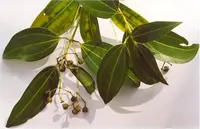
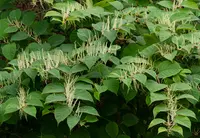
Recognize Ceylon cinnamon by its opposite, oval to lance-shaped leaves with three strong veins rising from the leaf base, a clear first-pass marker.

It usually grows as a small tree with smooth pale bark and dense clusters of small greenish-white flowers held in branched sprays near the shoot tips.

Cinnamomum verum Identification

Check Your Plant with Botan

Take a photo and use Botan to confirm your plant identification.

Clear images work best. Avoid photos taken too close or too far away

Start with the leaves and overall branching pattern of Cinnamomum verum.

  • Leaves are opposite or nearly opposite, simple, oval to lance-shaped, and about 3-7 inches (8-18 cm) long.
  • Each leaf shows three strong veins rising from the base and running toward the tip.
  • New twigs are slender, smooth, and often green, with dense leafy growth toward branch ends.
  • The plant forms a small tree or large shrub with multiple stems or a short trunk and a rounded crown.

Crush-free visual checks work best here because leaf shape and vein pattern are especially useful.

Ceylon cinnamon shows clear visual shifts from a slender seedling to a branched fruiting tree.

  • Seedling: Seedlings usually have a single upright stem with opposite leaves that are narrower, thinner, and softer than later foliage, with veins standing out clearly.
  • Young plant: Young plants form multiple side branches and a denser outline. Leaves broaden to about 4-7 inches (10-18 cm) and look thicker, glossier, and more leathery.
  • Flowering stage: At flowering, branch tips carry open, many-branched clusters of small pale flowers, adding a fine, airy texture not present in purely leafy stages.
  • Fruiting stage: After flowering, those clusters hold fleshy oval drupes that turn dark and stand out against the leaves, making the canopy look more dotted and weighted.

Cinnamomum verum is evergreen, so it does not develop a bare winter outline. Seasonal clues are limited, but new leaf flushes can stand out when young leaves emerge pinkish to coppery before turning green. When flowering is visible, look for small pale greenish-white blooms in clusters, followed by oval purple to black fruits as they mature.

Several other cinnamon trees can be mistaken for Cinnamomum verum.

cassia cinnamon(Cinnamomum cassia)

Confusion happens because both are evergreen trees with glossy, oval leaves and three main veins from the leaf base. C. cassia usually has broader, thicker, stiffer leaves, and older bark is rougher and darker.

Indonesian cinnamon(Cinnamomum burmannii)

It is similar in leaf shape and vein pattern. A quick check is leaf texture and new growth: C. burmannii often has thicker leaves and bronzy to reddish young leaves, while true cinnamon is usually thinner-leaved.

Cinnamomum verum is native to Sri Lanka and parts of southern India. In the wild, it occurs in tropical evergreen forest, especially humid lowland to lower montane areas. This range helps with identification because true cinnamon is not a species of dry woodland, scrub, or temperate forest. A cinnamon tree found naturalized or cultivated far outside this South Asian rainforest setting is less useful as evidence than the plant’s botanical features.

Does Your Plant Match?

Use Botan to compare a photo and confirm the plant, which helps avoid mix-ups with similar species.

FAQ

The clearest feature is the leaf venation. Each leaf usually shows three strong veins starting at the base, with a glossy surface and an opposite arrangement on the twig, useful for identifying Ceylon cinnamon.

More Plant Identification Guides

Know What Plant You Have

Identify it from a photo with Botan, then review plant details, care information, and common problems for that species.

Botan app identifying a plant from a photo
Planting Grass Seed in Summer – What Works and What Fails

7 min read · 6 Aug 2026

Planting Grass Seed in Summer – What Works and What Fails

Summer seeding succeeds when the grass type suits the season, and the soil stays moist. Find out how to prepare the seedbed and choose a safe window for planting.

Plant Care
Planting Grass Seed in Summer – What Works and What Fails
Top 5 Best Indoor Plants for Air Quality

5 min read · 11 Sept 2026

Top 5 Best Indoor Plants for Air Quality

Indoor plants can make a room feel fresher thanks to their air-purifying qualities. Here are 5 of the most suitable choices for your routine and living space.

Plant Recommendations
Top 5 Best Indoor Plants for Air Quality
Plants That Repel Bugs – 20 Effective Options

12 min read · 16 Jul 2026

Plants That Repel Bugs – 20 Effective Options

Mosquitoes on the patio? Gnats in the kitchen? Some plants keep them away with the scent of their own leaves. Here are 20 that deal with mosquitoes, flies, aphids, and more, plus where to put them so they help.

Plant Recommendations
Plants That Repel Bugs – 20 Effective Options