
Northern Red Oak Identification (Quercus rubra)

Recognize Northern Red Oak by its alternate leaves with 7 to 11 pointed lobes, each ending in a tiny bristle tip, usually 5 to 9 inches (13 to 23 cm) long.

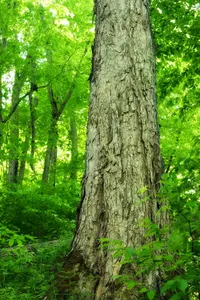
Also check the bark: on mature trunks it forms broad, flat ridges with shallow furrows and pale vertical stripes.

Quercus rubra Identification

Check Your Plant ID

Upload a clear image to check whether your plant ID is correct.

Clear images work best. Avoid photos taken too close or too far away

Check Northern Red Oak by its leaves, bark, and acorns.

  • Leaves are alternate, simple, and usually 5-9 inches (13-23 cm) long with 7-11 pointed lobes.
  • Each lobe ends in a short bristle tip, and the sinuses between lobes are fairly shallow.
  • Bark on mature trunks is dark gray to brown with broad, flat ridges and lighter vertical stripes.
  • Acorns are oval, about 3/4-1 inch (2-2.5 cm) long, with a shallow, saucer-like cap covering about one-quarter of the nut.

Use several traits together, especially leaf lobes and the shallow acorn cap.

Northern Red Oak shows clear visual shifts from seedling leaves to broad, acorn-bearing crown.

  • Seedling: Seedlings have a slender stem with alternate first leaves, then small bristle-tipped lobed leaves; the young shoot is thin and lightly branched.
  • Young plant: Young plants form a straight central leader and stronger side branches; leaves become larger, often 5-9 inches (13-23 cm) long, with deeper lobes.
  • Mature plant: Mature trees develop a tall single trunk and broad rounded crown; lower bark turns into long, flat ridges, unlike the smoother bark of younger plants.
  • Fruiting stage: Fruiting branches carry rounded acorns with shallow caps, hanging singly or in pairs, a visible feature absent on nonfruiting younger plants.

In spring, Quercus rubra leafs out with pinkish to reddish new growth that soon turns green. Flowering also becomes visible then, with hanging yellow-green male catkins and small female flowers near new shoots. By fall, the leaves usually shift to red, russet, or reddish-brown before dropping. After leaf drop, winter makes the tree easier to recognize by its broad crown, stout twigs, and pointed terminal buds.

Several oaks can be mistaken for Quercus rubra at a glance.

black oak(Quercus velutina)

Both have large, bristle-tipped lobed leaves. Black oak usually has deeper, more irregular sinuses and a duller leaf surface; mature bark is darker and more ridged.

pin oak(Quercus palustris)

Its leaves are also deeply lobed with bristle tips, causing confusion. Pin oak typically has much deeper U-shaped sinuses and a more pyramidal crown with lower branches angled downward.

scarlet oak(Quercus coccinea)

This species shares glossy, sharply lobed leaves. Scarlet oak usually shows deeper sinuses that cut close to the midrib, and its acorn cup covers about one-half of the nut.

Quercus rubra is native to eastern and central North America, from southeastern Canada south through the eastern United States and west into the central states. It is most often found in deciduous woodland and mixed forest, especially on upland slopes, valleys, and well-drained low hills. In its native range, seeing a large oak in mesic forest, meaning moderately moist woodland, helps narrow identification better than geography alone.

  • Acorns and leaves: Acorns, young leaves, and wilted leaves contain tannins. Ingestion can be harmful to pets, especially dogs, and to livestock; large amounts may also upset humans.
  • Exposure type: The main concern is ingestion rather than skin contact. Routine handling of bark or leaves is not a well-established hazard for most people.

Confirm the Species with Botan

Upload a photo to compare key details and help confirm whether the plant matches the species you have in mind.

FAQ

Look for leaves with 7 to 11 pointed lobes tipped by tiny bristles, shallow to moderate sinuses, and bark with broad, flat ridges that often show pale vertical stripes on older trunks.

More Plant Identification Guides

Know Your Plant Better

Identify a plant from a photo with Botan, then get plant details, care information, and common problems for that species.

Botan app identifying a plant from a photo
How Often to Water Fruit Trees

7 min read · 11 Aug 2026

How Often to Water Fruit Trees

Irrigation needs change as roots establish and weather shifts. This guide gives practical starting intervals, explains how soil and tree type change them, and shows how to recognize both excess moisture and drought stress.

Plant Care
How Often to Water Fruit Trees
How To Revive a Dying Plant: 6 Steps To Bring A Plant Back To Life

6 min read · 1 Sept 2026

How To Revive a Dying Plant: 6 Steps To Bring A Plant Back To Life

Drooping leaves and brown tips don't always mean the end, and a weakened plant can often recover with a little help. These six simple steps will help you revive a dying plant and restore its health.

Plant Care
How To Revive a Dying Plant: 6 Steps To Bring A Plant Back To Life
13 Best Front Yard Trees for Every Home and Yard

12 min read · 7 Aug 2026

13 Best Front Yard Trees for Every Home and Yard

A front yard tree can stay for decades. Therefore, choosing one deserves serious consideration. Here are 13 trees that have proven themselves, sorted by their purpose. You'll also find five species to avoid and basic planting information.

Plant Recommendations
13 Best Front Yard Trees for Every Home and Yard