

black raspberry Identification (Rubus occidentalis)

To recognize black raspberry, look for arching, cane-like stems with a whitish bloom, leaves divided into three leaflets, and a shrubby thicket-forming habit that often reaches about 3 to 6 feet tall (0.9 to 1.8 m).

The leaflets are arranged alternately along the canes, and the stems are round rather than ridged.

Rubus occidentalis Identification

Check Your Plant ID

Take a photo and use Botan to confirm your plant identification.

Clear images work best. Avoid photos taken too close or too far away

  • 1 free identification
  • No sign-up
  • 30,000+ plants in database

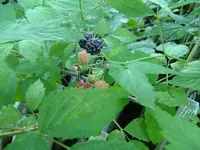
Check the canes, leaves, flowers, and fruit on Rubus occidentalis.

  • Arching, shrubby canes often root where the tips touch the ground.
  • Stems are round and covered with a pale whitish bloom, with small curved prickles.
  • Leaves are usually divided into 3 leaflets, sometimes 5; the undersides look noticeably whitish.
  • Flowers are small, white, and 5-petaled, held in short clusters.
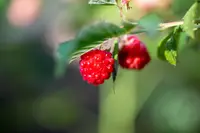
  • The berry is 1/2 to 3/4 inch (1.3 to 1.9 cm) wide, black when ripe, and hollow when picked.

Use several traits together, especially the whitish canes, leaflet pattern, and hollow black fruit.

Rubus occidentalis shows clear visual shifts from first-year canes to flowers and fruit.

  • Young plant: First-year canes are long, arching, and often unbranched, with a whitish bloom and hooked prickles; leaves are mostly three leaflets, sometimes five.
  • Mature plant: Older plants form thickets from tip-rooted canes. Second-year canes branch laterally and carry shorter flowering shoots, giving a denser, more divided outline.
  • Flowering stage: Flowering laterals hold small clusters of five-petaled white flowers, each about 1/4 to 1/2 inch (6-13 mm) across, above the leaves.
  • Fruiting stage: After flowering, the clustered drupelets darken to purple-black and separate cleanly from the receptacle, leaving the fruit hollow when picked.

In spring, black raspberry leafs out and soon shows small white flowers. By early summer, the flowers give way to clusters of raspberries that ripen from red to a dull purplish black. After leaf drop in fall, the long arching canes stand out. Their whitish bloom, a pale waxy coating, and hooked prickles are easier to see through winter.

Several brambles can be mistaken for black raspberry at a glance.

blackberry(Rubus allegheniensis)

Both are arching, thorny brambles with dark aggregate fruit. Blackberry canes are usually strongly ridged or angled, while Rubus occidentalis often has a whitish bloom on rounder canes. The ripe fruit also stays attached to the core in blackberry, but slips off hollow in black raspberry.

red raspberry(Rubus idaeus)

This species shares the same cane-forming habit and usually has white leaf undersides. The clearest visible difference is fruit color at maturity, red rather than black. Red raspberry canes also tend to be less heavily glaucous, meaning less coated with a bluish-white waxy bloom.

Rubus occidentalis is native to eastern and central North America, from southern Canada into the eastern and midwestern United States. It is most often found in open woods, forest edges, thickets, old fields, roadsides, and streambanks. Finding a wild black raspberry in these partly sunny, disturbed habitats helps separate it from less common brambles of deeper forest or very wet ground.

  • Prickles on stems: The arching canes carry prickles that can scratch or puncture skin during handling. This is a skin-contact hazard for humans and pets moving through dense growth.
  • Look-alike confusion: Black raspberry can be confused with other brambles, but this is not a well-established poisoning risk. Safety concern is mainly mechanical injury from prickly stems, not toxic parts.

Not Sure About the ID?

Use Botan to compare a photo and help confirm the plant so you can make a more confident identification.

FAQ

Flowers are small, white, and usually about 1/4 to 1/2 inch (6 to 12 mm) across. They have five petals and many stamens, and they appear in short clusters near the tips of second-year canes.

More Plant Identification Guides

Know What Plant You Have

Identify it from a photo with Botan, then review plant details, care information, and common problems for that species.

Botan app identifying a plant from a photo
Plants That Repel Bugs – 20 Effective Options

12 min read · 16 Jul 2026

Plants That Repel Bugs – 20 Effective Options

Mosquitoes on the patio? Gnats in the kitchen? Some plants keep them away with the scent of their own leaves. Here are 20 that deal with mosquitoes, flies, aphids, and more, plus where to put them so they help.

Plant Recommendations
Plants That Repel Bugs – 20 Effective Options
How to Clean Plant Leaves: A Simple Care Guide

6 min read · 4 Aug 2026

How to Clean Plant Leaves: A Simple Care Guide

Dusty leaves look dull and don't absorb light well. Below, you'll find simple ways to clean them, which tools are truly effective, how often you should do it, and what causes damage.

Beginner Guides
How to Clean Plant Leaves: A Simple Care Guide
20 Funny Plant Names That Make You Laugh

8 min read · 16 Oct 2026

20 Funny Plant Names That Make You Laugh

Some plants carry names that sound like jokes. This guide explains the origins of 20 funny plant names. You will also see which of these plants you can grow at home.

Plant Recommendations
20 Funny Plant Names That Make You Laugh