


goat willow Identification (Salix caprea)

Recognize goat willow by its broad, oval to nearly round leaves set alternately on stout twigs, and by its compact form as a large shrub or small tree, often 20 to 30 feet tall (6 to 9 m).

The short trunk and dense, rounded crown also help confirm Salix caprea.

Salix caprea Identification

Is This goat willow?

Upload a clear photo to check your plant identification with Botan.

Clear images work best. Avoid photos taken too close or too far away

Check the broad leaves and stout catkins of goat willow.

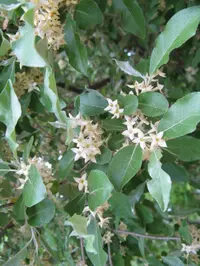
  • Leaves are oval to broadly elliptic, about 2-5 inches (5-12 cm) long, with a rounded to slightly heart-shaped base and a short pointed tip.
  • Leaves sit alternately along the twig, not in opposite pairs.
  • The upper leaf surface looks dull green, while the underside is paler and softly hairy.
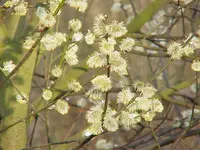
  • Catkins are thick, oval, and held close to the twigs, giving a chunky look rather than a long, slender one.

Look for several of these traits together on the same plant.

Salix caprea shows clear visual shifts from sapling form to flowering and fruiting structure.

  • Young plant: Young plants are upright and shrubby, with several stems and relatively large, broad oval leaves crowded along new shoots.
  • Mature plant: Mature plants become a small tree or large shrub, often 20-30 feet (6-9 m) tall, with a thicker trunk and broader, irregular crown.
  • Flowering stage: Before full leaf expansion, branches carry dense, oval catkins; male catkins look thicker and brighter, while female catkins appear slimmer and less showy.
  • Fruiting stage: After flowering, female catkins lengthen and loosen as capsules develop, giving the branch tips a more tapered, less compact look than during bloom.

In late winter to early spring, goat willow often stands out before leaf-out. Large, silky catkins appear on bare twigs, then lengthen and become yellow as pollen is released, creating one of the clearest seasonal identification clues. Leaves expand soon after flowering. In fall, the foliage turns yellow before dropping, which exposes the stout buds, gray twigs, and rounded branching pattern through winter.

A few pussy-willows and hybrids are often mistaken for goat willow.

grey willow(Salix cinerea)

Often confused because both have broad willow leaves and soft spring catkins. Grey willow usually has narrower leaves with a greyer underside and denser twig hair; Salix caprea typically has broader, rounder leaves on stouter twigs.

common osier(Salix × smithiana)

This recognized hybrid can overlap in leaf size and catkin look. It is usually a taller shrub with more elongated leaves, while Salix caprea tends to have shorter, broader leaves and a heavier, less wand-like habit.

Salix caprea is native across most of Europe and into western and central Asia. That range helps separate it from similar willows that are mainly North American or strongly tied to river margins. It is most often found in woodland edges, clearings, hedgerows, scrub, and disturbed ground, rather than in standing marsh or streamside thickets. Seeing a willow in drier inland settings can help narrow the identification.

Confirm the Species with Botan

Upload a photo to compare key details and help verify the identification before labeling or buying the plant.

FAQ

The best clue is the broad, oval leaves with a pale, felted underside and strong veins. In spring, large silky catkins appear before the leaves. Together, these are central to goat willow identification.

More Plant Identification Guides

Identify the Plant and Get Its Profile

Upload a photo with Botan to identify it, then see plant details, care information, and common problems.

Botan app identifying a plant from a photo
How Often to Water Fruit Trees

7 min read · 11 Aug 2026

How Often to Water Fruit Trees

Irrigation needs change as roots establish and weather shifts. This guide gives practical starting intervals, explains how soil and tree type change them, and shows how to recognize both excess moisture and drought stress.

Plant Care
How Often to Water Fruit Trees
12 Best Plants That Repel Spiders For Your Home and Garden

8 min read · 24 Jul 2026

12 Best Plants That Repel Spiders For Your Home and Garden

Spiders constantly appear in places you don't want them. A few common plants can help repel them using scent alone. Here are 12 options suitable for both indoors and outdoors, plus care tips for each.

Plant Recommendations
12 Best Plants That Repel Spiders For Your Home and Garden
Best Water for Plants – How to Choose the Right Type

7 min read · 13 Aug 2026

Best Water for Plants – How to Choose the Right Type

Rainwater, filtered, distilled, and tap water affect plants differently. Learn which types support healthy growth and which cause slow damage. Match each to your plants and discover how to easily improve tap water quality.

Plant Care
Best Water for Plants – How to Choose the Right Type