

poison ivy Identification (Toxicodendron radicans)

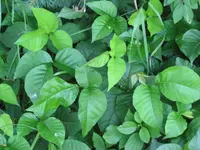
To recognize poison ivy, check for leaves in groups of three leaflets on a single stalk, with the middle leaflet on a longer stem and the side leaflets on shorter ones.

Toxicodendron radicans usually grows as a climbing or trailing woody vine, often with many short aerial rootlets along the stem.

Toxicodendron radicans Identification

Check Your Plant ID

Upload a clear photo to check your plant identification with Botan.

Clear images work best. Avoid photos taken too close or too far away

Use these visible traits to check Toxicodendron radicans.

  • Each leaf is split into 3 leaflets.
  • The middle leaflet sits on a longer stalk than the two side leaflets.
  • Leaflets are usually 2-6 inches (5-15 cm) long and often oval to diamond-shaped.
  • Leaflet edges may be smooth, toothed, or shallowly lobed on the same plant.
  • It grows as a trailing ground vine, a climbing vine, or a low shrub.

Look at several leaves and stems together before deciding.

Poison ivy shows useful visual changes as it shifts from low shoots to vines.

  • Seedling: First growth appears as a small upright shoot with a single three-leaflet leaf, then quickly forms alternate leaves on a slender green stem.
  • Young plant: Young plants are usually low and bushy or trailing, with thinner stems and smaller leaves, often 2-6 inches (5-15 cm) long.
  • Mature plant: Mature plants often climb trees or walls as woody vines, developing thick stems with many brown aerial rootlets that give a hairy-looking surface.
  • Fruiting stage: Fruiting plants carry tight clusters of round, pale berries along the stems, adding a conspicuous structure not present on nonfruiting shoots.

In spring, poison ivy leaflets emerge reddish or bronze, then turn green as they expand. Small greenish flowers may be visible in late spring to early summer. By late summer into fall, pale berries often stand out against foliage. Fall leaves commonly turn yellow, orange, or red before dropping, exposing bare, woody stems in winter.

Several vines and shrubs are commonly mistaken for poison ivy.

Virginia creeper(Parthenocissus quinquefolia)

Often confused when young because both can climb and have divided leaves. Virginia creeper usually has five leaflets, not three, and its tendrils end in small adhesive pads.

Boxelder(Acer negundo)

Seedlings can mimic the three-leaflet pattern. Boxelder leaves are opposite on the stem, while Toxicodendron radicans leaves are alternate.

Fragrant sumac(Rhus aromatica)

This shrub also has three leaflets, so the outline can seem similar. Its leaflets are more consistently lobed, especially the terminal leaflet, and it grows as a mounded shrub rather than a climbing vine.

Toxicodendron radicans is native to much of eastern and central North America, from southeastern Canada through most of the eastern United States and west into the Great Plains, with regional extension into parts of the Southwest, Mexico, and Central America. It commonly occurs in woodland edges, floodplains, fencerows, thickets, streambanks, and other disturbed sites. Finding it in shady woods or climbing trees at forest margins can help narrow identification, especially where vine and shrub forms occur together.

  • Skin contact: Leaves, stems, roots, and the sap contain urushiol. In humans and many pets, skin contact can cause an irritating allergic rash.
  • Smoke exposure: Burning plant parts can carry urushiol in smoke. Contact with this smoke is hazardous to humans and pets, especially if inhaled.
  • Look-alike risk: It is sometimes confused with Virginia creeper. Poison ivy usually has three leaflets; Virginia creeper usually has five.

Scan. Check. Confirm.

Use Botan to identify or verify a plant from a photo, helping avoid mix-ups when names or online images seem unclear.

FAQ

For fast poison ivy identification, check for three leaflets on one leaf, with the middle leaflet on a longer stalk. Leaves are alternate on the stem, not opposite, and the edges may be smooth or toothed.

More Plant Identification Guides

Identify the Plant and Get Its Profile

Use Botan to identify a plant from a photo, then review plant details, care information, and safety notes.

Botan app identifying a plant from a photo
What Plants Don't Like Epsom Salt?

11 min read · 29 Jul 2026

What Plants Don't Like Epsom Salt?

Learn which plants can be seriously damaged by Epsom salt and which will thrive on it. We’ll explain when and how to use it properly, provide tips for indoor & outdoor plants — read on and enjoy a healthy garden.

Plant Care

What Plants Don't Like Epsom Salt?
How to Group Plants in Landscaping: A Practical Layout Guide

8 min read · 31 Aug 2026

How to Group Plants in Landscaping: A Practical Layout Guide

Good plant grouping can mean the difference between a well-planned garden and one that looks sloppy. This guide explores layers, spacing, cluster shapes, and the plants that thrive when you group them.

Plant Care
How to Group Plants in Landscaping: A Practical Layout Guide
Frozen vs Fresh Vegetable Nutrients: Which Option Is Healthier?

6 min read · 8 Sept 2026

Frozen vs Fresh Vegetable Nutrients: Which Option Is Healthier?

Frozen and fresh vegetables are nutritionally comparable: frozen produce often retains vitamins just as well as fresh and may sometimes contain more. Here’s how blanching and storage affect nutrients—and when to choose each.

Plant Recommendations
Frozen vs Fresh Vegetable Nutrients: Which Option Is Healthier?