
wild yam Identification (Dioscorea villosa)

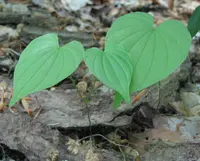
To recognize wild yam, look for a slender twining vine with leaves in opposite pairs on the lower stem, each leaf broadly heart-shaped with several strong veins rising from the base.

Mature plants also show smooth, unbranched stems and small greenish flowers held in narrow, drooping spikes from the leaf axils.

Dioscorea villosa Identification

Check Your Plant ID

Take a photo and use Botan to confirm your plant identification.

Clear images work best. Avoid photos taken too close or too far away

  • 1 free identification
  • No sign-up
  • 30,000+ plants in database

Use a few leaf and stem traits to check Dioscorea villosa by eye.

  • A twining vine with slender stems that climb rather than stand upright.
  • Leaves are usually alternate, sometimes in small whorls, and often crowd toward the lower stem.
  • Leaf blades are broadly heart-shaped with a pointed tip and several strong veins radiating from the base.
  • Leaves are often about 2-6 inches (5-15 cm) long, with smooth to slightly wavy edges.

Check more than one leaf position, since arrangement can vary on the same plant.

Wild yam shows several visible form changes as stems lengthen, flower, and later fruit.

  • Young plant: Early shoots are slender and twining, with smaller heart-shaped leaves and a simpler outline before the vine extends and becomes more obviously climbing.
  • Mature plant: By maturity, the vine is longer and more branched, commonly reaching 6-12 feet (1.8-3.7 m), with broader heart-shaped leaves spaced along winding stems.
  • Flowering stage: Flowering plants bear small greenish to yellowish flowers in narrow dangling clusters, adding a finer, more threadlike look than leaf-only stems.
  • Fruiting stage: After flowering, female plants show three-winged capsules that hang from the vine, creating a flatter, papery structure not present earlier.

In spring, Dioscorea villosa sends up fresh twining stems with new heart-shaped to broadly oval leaves. By late spring into summer, the small greenish flowers may be visible in the leaf axils, adding a useful clue on mature plants. By fall, the foliage yellows and dies back. As the plant goes dormant, the above-ground vine disappears, so it is much harder to recognize once leaves and stems are gone.

Several twining woodland vines can be mistaken for Dioscorea villosa at a glance.

black bryony(Dioscorea communis)

Similar because both are slender climbing yams with heart-shaped leaves. Black bryony usually has shinier, thicker leaves and later forms clusters of bright red berries; Dioscorea villosa has drier-looking foliage and a 3-winged capsule instead of berries.

greenbrier(Smilax rotundifolia)

Can resemble it through its climbing habit and broad, rounded leaves. Greenbrier stems usually bear sharp prickles and the leaves show a netted vein pattern, not the strong parallel arching veins typical of wild yam.

Dioscorea villosa is native to eastern North America, from the eastern and central United States into parts of southern Canada. Its known range helps separate it from similar yams more often encountered outside this region. In the wild, it is typically found in moist woods, thickets, woodland edges, and streamside habitats. Seeing a twining vine in shaded to partly shaded deciduous woodland can support an identification, especially when the site is not dry, open, or heavily disturbed.

Scan. Check. Confirm.

Use Botan to identify or verify a plant from a photo, helping avoid mix-ups before you label it or compare references.

FAQ

Yes. Identifying wild yam often relies on its twining vine, heart-shaped to broadly oval leaves with several strong veins from the base, and leaves that are opposite on lower stems but often alternate higher up.

More Plant Identification Guides

One Photo. More About Your Plant.

Identify a plant from a photo with Botan, then review its profile, care information, and common problems.

Botan app identifying a plant from a photo
Best Time to Plant Grass Seed: When to Seed Your Lawn

6 min read · 19 Nov 2026

Best Time to Plant Grass Seed: When to Seed Your Lawn

The best time to plant grass seed depends on your climate and grass type. Cool-season lawns establish best in late summer or early fall, while warm-season grasses perform best once soil warms in late spring or early summer.

Plant Care
Best Time to Plant Grass Seed: When to Seed Your Lawn
How to Water Succulents: When, How Often, and How Much

7 min read · 18 Nov 2026

How to Water Succulents: When, How Often, and How Much

Yellowing, mushy, or shriveled leaves can all point to a watering problem, yet each can have a different cause. This guide explains how to water succulents, when to wait, and how soil, pots, and seasons change the routine.

Plant Care
How to Water Succulents: When, How Often, and How Much
Top 15 Fast-Growing Trees For Your Garden

13 min read · 28 Jul 2026

Top 15 Fast-Growing Trees For Your Garden

Learn which of the 15 fastest-growing trees will suit your area. We’ll share detailed information on each: growth rate, mature spread, key tree demands, and main vulnerabilities. Read on and make the best choice possible.

Plant Recommendations
Top 15 Fast-Growing Trees For Your Garden