
Purslane Identification (Portulaca oleracea)

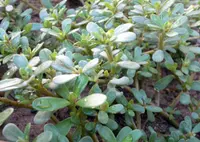
To recognize Purslane, look for a low, mat-forming plant with smooth, reddish stems that branch from the base, small spoon-shaped leaves in clusters or alternate along the stem, and tiny five-petaled yellow flowers at the stem tips.

Plants usually stay only a few inches tall but spread outward across the ground.

Portulaca oleracea Identification

Check Your Plant ID

Not sure about your plant ID? Upload a photo and check it with Botan.

Clear images work best. Avoid photos taken too close or too far away

Use these quick checks to recognize Purslane by sight.

  • Low, spreading plant that mats across the ground rather than standing upright.
  • Stems are smooth, thick, and succulent, often reddish, branching from the base.
  • Leaves are small, fleshy, spoon-shaped to oval, usually 1/2 to 1 inch (1.3 to 2.5 cm) long.
  • Leaves sit in clusters or near-opposite pairs at stem joints.
  • Flowers are tiny, yellow, with 5 petals, often tucked at stem tips or leaf axils.

Check several stems, since the low habit and fleshy leaves together are the strongest visual clues.

Portulaca oleracea shows clear visual shifts from sprout to flowering, mat-forming adult plant.

  • Seedling: Seedlings start upright, with two narrow seed leaves, then quickly produce tiny, smooth, fleshy true leaves on reddish stems.
  • Young plant: Young plants begin branching at the base; stems turn more prostrate, and spoon-shaped succulent leaves become clustered at nodes and stem tips.
  • Mature plant: Mature plants form a flat, radiating mat often 4-12 inches (10-30 cm) across, with thicker red stems and broader oval leaves.
  • Flowering stage: Small yellow flowers, about 1/4 inch (6 mm) wide, appear singly or in small terminal clusters, making stem tips look denser and more compact.

In warm months, Portulaca oleracea is easiest to recognize when its tiny yellow flowers open on sunny days, usually from summer into early fall. Soon after, small capsule fruits become visible at the stem tips. After frost or in cool weather, the plant disappears rather than leaving woody stems or persistent seed heads. That warm-season, low mat of succulent stems and paddle-shaped leaves is the main seasonal clue.

A few low, succulent weeds are regularly mistaken for Purslane.

spotted spurge(Euphorbia maculata)

Often confused because both sprawl flat with small oval leaves and reddish stems. Spotted spurge usually has opposite leaves, often with a dark leaf spot, and milky sap if broken; Portulaca oleracea has thicker, smoother leaves and clear sap.

carpetweed(Mollugo verticillata)

Can look similar at a glance as a mat-forming summer weed. The key check is the leaves: carpetweed has 3-8 narrow leaves in whorls at each node, while Portulaca oleracea has fewer, broader, fleshy leaves and thicker succulent stems.

Portulaca oleracea has an uncertain original native range, often cited as parts of Eurasia and North Africa, so geography alone is not a reliable ID clue. Habitat is more useful. It commonly appears in disturbed ground such as gardens, crop fields, roadsides, sidewalk cracks, and waste places, especially in open, compacted, sunny sites. Finding it in heavily disturbed urban or agricultural settings can help narrow the identification.

  • Oxalates in leaves and stems: Portulaca oleracea contains oxalates in the above-ground parts. Ingestion can be a concern for humans and pets because oxalates can irritate the digestive tract and may contribute to kidney problems in susceptible individuals.
  • Spurge look-alike risk: A realistic hazard is confusion with prostrate spurges (Euphorbia species), which can grow in the same places. Spurges bleed white milky sap when stems are broken; Portulaca oleracea does not. Spurge sap can irritate skin and eyes, and ingestion is harmful to humans and pets.

Confirm It from a Photo

Use Botan to identify or confirm the plant from a photo, which helps reduce mix-ups before you label or compare it.

FAQ

Yes. Identifying Purslane is often possible from its smooth, reddish, prostrate stems and thick, spoon-shaped leaves. Leaves are alternate to nearly opposite and cluster at stem joints, giving mats a fleshy, low-growing look.

More Plant Identification Guides

One Photo. More About Your Plant.

Identify a plant from a photo with Botan, then get its profile, care information, and common problems in one place.

Botan app identifying a plant from a photo
How To Revive a Dying Plant: 6 Steps To Bring A Plant Back To Life

6 min read · 1 Sept 2026

How To Revive a Dying Plant: 6 Steps To Bring A Plant Back To Life

Drooping leaves and brown tips don't always mean the end, and a weakened plant can often recover with a little help. These six simple steps will help you revive a dying plant and restore its health.

Plant Care
How To Revive a Dying Plant: 6 Steps To Bring A Plant Back To Life
How Long Can Flowers Go Without Water? Everything You Need to Know

6 min read · 10 Jul 2026

How Long Can Flowers Go Without Water? Everything You Need to Know

Flowers can survive without water anywhere from 1-2 hours to several months, depending on the plant type, species, and growing conditions. Some strong-looking flowers are drought-sensitive, while delicate-looking plants may tolerate long dry periods surprisingly well.

Plant Care
How Long Can Flowers Go Without Water? Everything You Need to Know
12 Most Wanted Rare Houseplants to Grow at Home

6 min read · 21 Sept 2026

12 Most Wanted Rare Houseplants to Grow at Home

Rare houseplants can turn an ordinary corner in your apartment into a living botanical collection. This guide covers 12 most admired picks, what makes them special, and how to grow them successfully at home.

Plant Recommendations
12 Most Wanted Rare Houseplants to Grow at Home