8 Glow-in-the-Dark Plants and Fungi That Really Exist
Plants that glow in the dusk really exist. Some of them produce their own light, while others need UV exposure or special treatments. Explore eight fascinating examples, including glowing petunias, bioluminescent mushrooms, fluorescent flowers, and experimental succulents.

On this page
- Do Plants Really Glow in the Dark? Bioluminescent, Fluorescent, and Phosphorescent Varieties
- 1. Firefly Petunia (Petunia × hybrida 'Firefly')
- 2. Foxfire Fungi (Panellus stipticus and Armillaria spp.)
- 3. Jack-o'-Lantern Mushroom (Omphalotus illudens)
- 4. Glowing Phalaenopsis Orchid (Phalaenopsis spp.)
- 5. Glowing-in-the-Dark Tillandsia (Tillandsia spp.)
- 6. Glowing Echeveria (Echeveria 'Mebina')
- 7. Four O'Clock Flower (Mirabilis jalapa)
- 8. Moss Rose (Portulaca grandiflora)
- Night Flowers That Seem to Glow in Moonlight
- How to Plan Bioluminescent Landscaping at Home
Do glow-in-the-dark plants really exist? Yes, although their glowing effects vary. Some species fluoresce under UV light, while engineered varieties glow on their own.
Discover eight fascinating plants and fungi, where to find them, and how to create a mysterious garden using Botan tips on the practice.
Name | Glow Type | Natural or Engineered | Where Can I Get It? |
Bioluminescence | Genetically engineered | In the U.S., authorized retailers | |
Bioluminescence | Natural fungi | In the wild forests. There are also selected cultures | |
Bioluminescence | Natural fungus | Wild hardwood forests | |
Fluorescence under blacklight | Genetically engineered | Research exhibitions | |
Artificial phosphorescent afterglow | Surface treatment | Ordinary plants are available. Glowing versions unverified | |
Phosphorescence (afterglow particles) | Laboratory-treated | Experimental | |
Fluorescence under UV/blue light | Natural | Seeds suppliers and garden centers | |
Fluorescence under blue light | Natural | Seeds suppliers and garden centers |
Do Plants Really Glow in the Dark? Bioluminescent, Fluorescent, and Phosphorescent Varieties
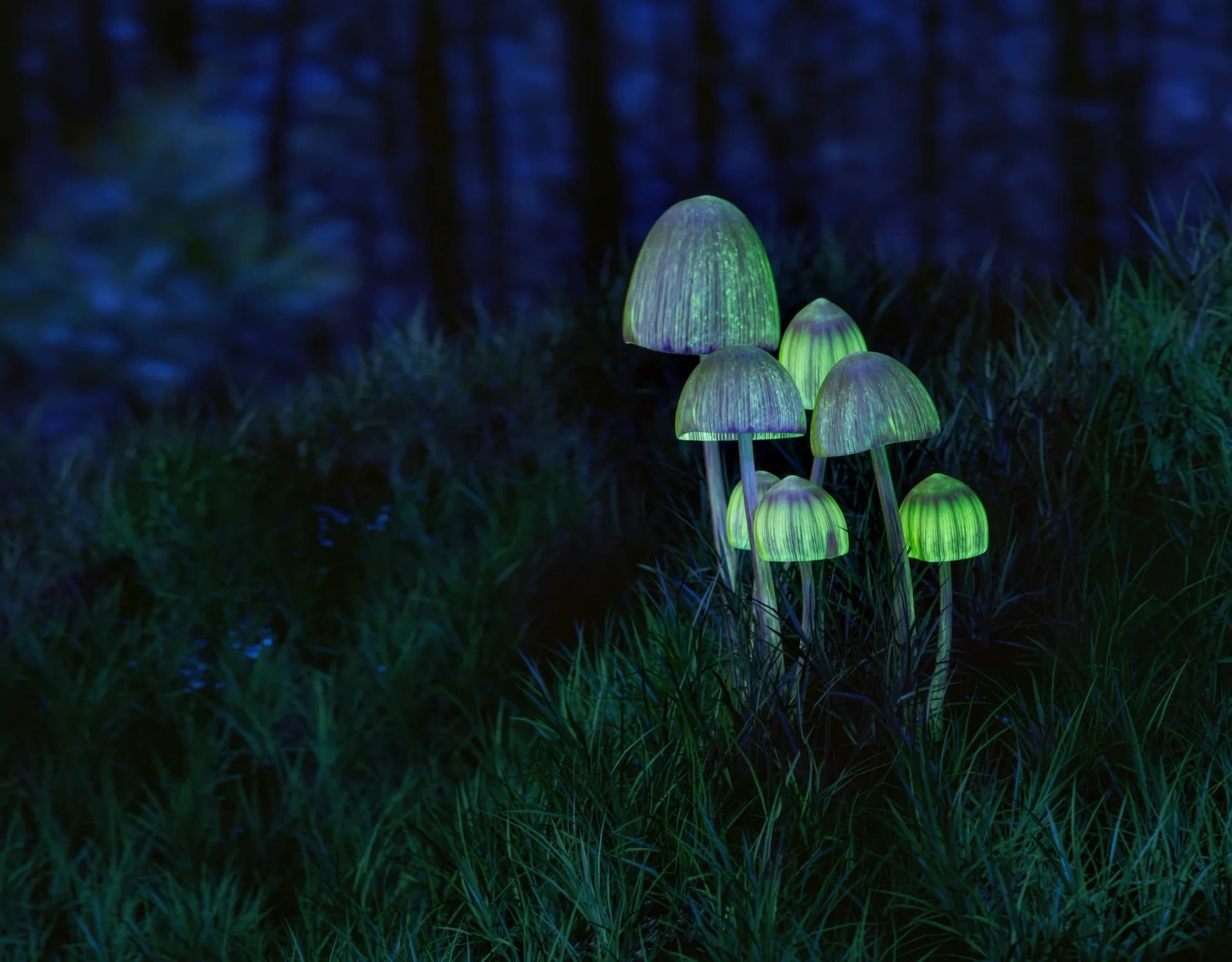
Not all bioluminescent plants, fluorescent flowers, and mushrooms produce light in the same way. The luminous appearance can be explained by one of three processes: bioluminescence, fluorescence, or phosphorescence.
The table below shows how each works, whether an external light source is needed, and which plants and fungi display these effects.
Glow Type | How It Works | Needs a Light Source? | Examples |
Bioluminescence | A natural chemical reaction involving luciferin, luciferase, and oxygen produces light | No need for external illumination, as the organism makes its own light | Firefly petunia, foxfire fungi, jack-o'-lantern mushroom |
Fluorescence | Pigments or proteins absorb UV or blue light and immediately emit a fluorescent glow | Yes, continuously | Glowing phalaenopsis orchid, four o'clock, moss rose |
Phosphorescence (afterglow) | Specialized materials absorb light energy and release it gradually | Yes, to charge beforehand | Glowing echeveria, glowing-in-the-dark tillandsia |
None of the glowing flowers are bioluminescent in nature, although engineered varieties do. The organisms commonly described as plants that glow in the dark naturally are actually fungi. Other flowers display fluorescence, while phosphorescent materials can give plants a temporary afterglow.
Identify Your Plant
Scan the plant and get a result with 98% accuracy
1. Firefly Petunia (Petunia × hybrida 'Firefly')

Firefly Petunia is one of the magical glow-in-the-dark flowers that produces visible, soft moon-like light without external illumination. Introduced in 2024 as a genetically engineered plant, it contains bioluminescent fungal genes, allowing its cells to produce a greenish-white glow.
The firefly petunia’s soft light is produced 24/7. However, it is visible to human eyes only in complete darkness. If you come across a petunia at a garden center and aren’t sure which variety it is, identify a flower by picture using a special app and additionally ask the retailer.
- Glow Type: Bioluminescence
- Light Needs: Full sun
- Growing Season: Spring through fall
- Where to Get It: Authorized U.S. retailers
- USDA Hardiness Zone: 9-11 for perennial and 8 and below for annual
- Toxicity: Non-Toxic for pets
2. Foxfire Fungi (Panellus stipticus and Armillaria spp.)

Foxfire fungi are another type of plant that glows in the dark naturally. These living organisms, which are found in damp, decaying wood and reproduce by releasing spores, emit a bluish-green glow that is explained by the natural chemical reaction between luciferin, oxygen, and an enzyme called luciferase.
Since foxfire fungi have dim and scary notes, they are a good choice if you are looking for Halloween plants for your property.
- Glow Type: Bioluminescence
- Light Needs: Shaded, moist woodland conditions
- Growing Season: Mainly during moist growing and fruiting periods
- Where to Get It: Forests and selected educational fungal cultures
- USDA Hardiness Zone: 3-9
- Toxicity: Do not consume unidentified wild fungi
3. Jack-o'-Lantern Mushroom (Omphalotus illudens)

This plant that glows in the dark is also perfectly suitable for creating spooky and mysterious charm in your garden space during the Halloween season. Omphalotus illudens forms bright orange clusters on decaying hardwood, buried roots, trunks, or debris.
And when complete darkness comes, a faint greenish glow from their gills is displayed. This is a result of the reaction of luciferin with oxygen.
- Glow Type: Bioluminescence
- Light Needs: Full shade to partial shade
- Growing Season: Summer through fall
- Where to Get It: Wild hardwood forests
- USDA Hardiness Zone: 4-9
- Toxicity: Poisonous if eaten
4. Glowing Phalaenopsis Orchid (Phalaenopsis spp.)

Phalaenopsis orchid, developed by the research group at Chiba University in Japan and presented publicly in 2024, is valued for its yellow-green plankton-like light.
A genetically introduced fluorescent protein causes its butterfly-shaped flowers, stems, and leaves to fluoresce. Phalaenopsis orchid is one of the fluorescent plants that don’t glow naturally without blacklight.
- Glow Type: Fluorescence
- Light Needs: Bright, indirect sunlight and UV illumination for the glowing effect
- Growing Season: Evergreen; flowering varies
- Where to Get It: Research exhibitions, not routine retail
- USDA Hardiness Zone: 10-12 outdoors
- Toxicity: Non-toxic to cats and dogs
Don’t know if your plant glows in the dark?
Scan with Botan for detailed information
5. Glowing-in-the-Dark Tillandsia (Tillandsia spp.)

Unlike bioluminescent flowers and fluorescent plants, tillandsia is a tropical epiphyte. This air plant attaches to other plants or rocky substrates with its roots and absorbs water from the environment through trichomes.
Its glowing effect is a result of a phosphorescent coating applied to its leaves. It absorbs light energy and gradually releases it as a visible glow, even after the light source is removed.
- Glow Type: Artificial phosphorescence
- Light Needs: Bright, indirect light
- Growing Season: Year-round indoors
- Where to Get It: Ordinary types at plant retailers
- USDA Hardiness Zone: 9-13
- Toxicity: Coating safety cannot be assumed
6. Glowing Echeveria (Echeveria 'Mebina')

There’s a reason this succulent is listed alongside the glowing night flowers, as its fleshy leaves release previously absorbed energy. This plant comes in green, blue, and red colors.
- Glow Type: Phosphorescence
- Light Needs: Bright light; sunlight or suitable lamps recharge the particles
- Growing Season: Mainly spring through fall
- Where to Get It: Experimental research, not established retail
- USDA Hardiness Zone: Frost-sensitive; usually grown indoors in colder climates
- Toxicity: Non-toxic
7. Four O'Clock Flower (Mirabilis jalapa)

Mirabilis jalapa is valuable for its fragrant trumpet-shaped flowers that often open in the late afternoon. Yellow varieties contain betaxanthins, pigments capable of absorbing blue light and emitting a contrasting green fluorescent pattern on the flower’s petals.
Such a glow, in turn, is attractive to pollinators.
- Glow Type: Natural fluorescence
- Light Needs: Full sun to partial shade; blue illumination reveals fluorescence
- Growing Season: Summer through fall
- Where to Get It: Garden centers and seed suppliers
- USDA Hardiness Zone: 9-11
- Toxicity: Seeds and roots are poisonous if swallowed
8. Moss Rose (Portulaca grandiflora)

Moss Rose is a favorite among plant lovers for its vivid flowers and excellent heat tolerance. This low-growing succulent with yellow flowers contains fluorescent betaxanthin pigments that can emit green light when excited by blue wavelengths.
Unlike night-blooming plants, Moss Rose usually closes its flowers during the evening.
- Glow Type: Natural fluorescence
- Light Needs: Full sun; blue light for fluorescence observation
- Growing Season: Late spring through fall
- Where to Get It: Garden centers and seed retailers
- USDA Hardiness Zone: Grown primarily as a warm-season annual
- Toxicity: Toxic to cats, dogs, and horses
Night Flowers That Seem to Glow in Moonlight
Not all real glowing flowers at night produce light themselves. Many pale-colored, night-blooming species simply reflect moonlight, creating the impression of illumination. Here are the most common among them:
- Moonflower (Ipomoea alba) – large white trumpet-shaped flowers open at dusk and attract nighttime moths.
- Evening Primrose (Oenothera biennis) – pale yellow or pink blossoms open in the evening and are visible to bees and moths.
- Queen of the Night (Epiphyllum oxypetalum) – large, fragrant white flowers open their petals at night and close them in the morning.
- Woodland Tobacco (Nicotiana sylvestris) – white tubular flowers release a stronger fragrance in the evening.
- Lamb's Ear (Stachys byzantina) – silvery, woolly foliage reflects available light and serves as a good shelter for insects to spend the night.
The moon garden from the mentioned flowers remains visually interesting after sunset and at the same time supports moths and other evening pollinators.

How to Plan Bioluminescent Landscaping at Home
When considering creating bioluminescent landscaping, start with a small area near a patio or garden path where nighttime viewing is convenient. Placement matters because even moderate artificial lighting can overwhelm faint biological light. So, follow these practical tips:
- Grow firefly petunias in containers near the terrace where their subtle glow can be viewed closely.
- Add white moonflowers and silver-leaved plants along paths to reflect ambient moonlight.
- Minimize outdoor lighting nearby so naturally glowing specimens remain visible.
- Use a low-power UV flashlight briefly to observe fluorescent flowers.
For a cohesive nighttime display, group plants in your landscape according to their light and watering needs.
FAQ
Firefly petunias produce a soft, pale green glow rather than bright illumination. The effect is typically strongest in young flowers and shoots. If you take a photo with a long exposure, the flower may be brighter in the frame than it looks in real life.
Found this helpful?
Add Botan as a preferred source on Google.
Svitlana Shramenko
Botany Enthusiast
11+ years of experience in texts writing
Svitlana is passionate about the plant world and skillfully combines this interest with science-based botanical writing. She creates engaging, informative articles for both beginner gardeners and experienced plant enthusiasts, helping them better understand the plants around them, maintain their health, and provide proper care.
Related Articles
4 min read · 20 Oct 2026
When to Harvest Tomatillos: How to Tell When They're Ripe
Tomatillos grow inside papery husks, making it hard to judge ripeness at a glance. This guide explains how to know when tomatillos are ripe and offers practical advice on harvesting and storage.
8 min read · 16 Oct 2026
20 Funny Plant Names That Make You Laugh
Some plants carry names that sound like jokes. This guide explains the origins of 20 funny plant names. You will also see which of these plants you can grow at home.

7 min read · 13 Oct 2026
12 Best Cold-Hardy Vegetables for Cold Weather
Cold-hardy vegetables can keep a garden productive through chilly fall, winter, and early spring weather. This guide covers 12 reliable crops, their frost tolerance, and practical growing tips for better cold-season harvests.
Explore Plants by Care Needs
Identify the plant and problem. Help your plant recover
Identify plant problems early, understand what's wrong, and get clear care guidance. Botan helps you turn guesswork into confident plant care