Control Plant Spread
Use a sharp spade in early spring to slice and remove outer clumps that creep into nearby plants, then replant or discard divisions so the mat stays dense but not invasive when growing Woolly hedgenettle.

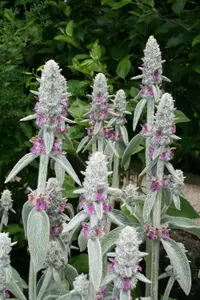
Woolly hedgenettle, also known as lamb’s ear, is a low-growing perennial herb grown mainly for its soft, silvery foliage. Stachys byzantina forms dense clumps or mats, with leaves covered in fine hairs that give a velvety texture.
In the wild it occurs in parts of the Middle East and western Asia, but it is widely used in ornamental gardens in temperate climates. The plant is generally easy to grow because it tolerates poor soils and short dry spells, though it dislikes heavy, waterlogged ground.
It prefers sunny, open sites and well-drained soil, which helps keep the foliage healthy and compact. Gardeners often find it straightforward to care for Woolly hedgenettle once it is established.

Care Difficulty
Easy Care

Light Preference
Full Sun

Water Requirements
Low Water

Temperature Preference
Cold Hardy

Hardiness Zone
4–9

Soil Texture
Sandy, Loamy, Rocky

Soil pH
Slightly acidic (6.5–7.0), Slightly alkaline (7.0–7.5)

Soil Drainage
Well-drained

Fertilization
Minimal (feed rarely)
Scan your plant to receive care tips personalized for your specific plant
Available on iOS and Android
Stachys byzantina prefers bright conditions with several hours of direct sun for dense, silvery foliage.
This plant prefers slightly dry conditions and is more tolerant of drought than excess moisture.
This hardy perennial tolerates a wide temperature range but performs best within a moderate band.
Humidity is rarely critical for this species, which prefers dry to moderately dry air.
Stachys byzantina prefers lean, well-draining soil that stays on the dry side.
This species is suitable for container growing when drainage is carefully controlled.
Stachys byzantina needs only light feeding, as it naturally thrives in relatively lean soils.
Stachys byzantina responds well to light, targeted pruning that keeps the clump dense and tidy.
This species is more often transplanted in the garden than repotted, as it forms low, spreading mats.
Stachys byzantina is commonly propagated to extend groundcover patches and rejuvenate older plantings.
This plant is generally cold hardy and needs minimal winter care in most temperate climates.

Plant Health Check
Not sure what's wrong with your plant? Check your plant's health inside the app.
The dense, woolly hairs on the leaves trap a layer of air that reduces water loss and reflects intense sunlight, helping the plant tolerate hot, dry sites better than many other ornamentals.
This species is naturally adapted to poor, dry soils and shows notable tolerance to drought and even some soil salinity, which is why it performs well along paths, in rock gardens, and near roads where conditions are harsh.
Stachys byzantina forms a low, spreading mat mainly through short, creeping stems that root as they touch the soil, creating a living ground cover that suppresses many competing weeds.

Historical records and horticultural literature indicate that Stachys byzantina was cultivated in Europe by at least the 18th century, valued not only for its silver foliage in knot gardens and formal borders but also as a traditional edging plant that visually outlines garden beds with a soft, pale border.
This species spreads steadily by short rhizomes and self-seeding, forming dense mats over time. It is usually manageable, but in ideal conditions can edge into nearby planting spaces, so edging or occasional division helps contain it.
Keep your plants happy and healthy with plant identification, disease detection, and easy care guidance.