Provide sturdy supports
Install discreet pea sticks or a low mesh plant support in early spring before stems elongate so the airy growth can lean on it without flopping in summer wind and rain.

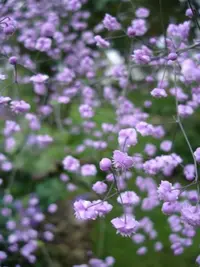
Chinese meadow rue, Thalictrum delavayi, is a clump-forming perennial grown for its airy, cloud-like sprays of small, nodding flowers and fine-textured foliage. It typically has upright, branching stems with lacy, divided leaves that give a light, almost fern-like look in mixed borders.
This species is native to mountainous regions of China, where it grows in cool, moist, partially shaded habitats. In gardens it prefers humus-rich, well-drained soil that stays evenly moist and performs best in dappled light or morning sun.
Gardeners who want to care for hinese meadow rue should note that it resents drought but is otherwise fairly undemanding when planted in suitable conditions.

Care Difficulty
Moderate Care

Light Preference
Partial Shade

Water Requirements
Regular Water

Temperature Preference
Cold Hardy

Hardiness Zone
5–7

Soil Texture
Loamy, Silty, Organic-rich

Soil pH
Acidic (5.5–6.5), Slightly acidic (6.5–7.0)

Soil Drainage
Moist but well-drained

Fertilization
Minimal (feed rarely)
Scan your plant to receive care tips personalized for your specific plant
Available on iOS and Android
This perennial prefers bright, gentle conditions that mimic light woodland shade.
This plant prefers evenly moist, never waterlogged soil, especially during active growth.
This hardy perennial thrives in cool to mild conditions with distinct seasons.
This species prefers moderate humidity but grows reliably in typical outdoor garden conditions.
Thalictrum delavayi prefers consistently moist, humus-rich, well-aerated soil that does not stay waterlogged.
This species can be grown in containers if the pot is large, deep, and very stable.
This perennial benefits from modest feeding to support flowering but does not need heavy fertilization.
Thalictrum delavayi responds well to light, timed pruning that maintains structure and flowering performance.
This plant is most often grown in the ground, so focus on careful transplanting rather than frequent repotting.
Thalictrum delavayi is commonly propagated by seed or by careful division of established clumps.
This hardy perennial usually needs only minimal winter care in most temperate climates.

Plant Health Check
Not sure what's wrong with your plant? Check your plant's health inside the app.
This species forms airy panicles with hundreds of tiny lavender-pink flowers, each with showy stamens that create a misty, cloud-like effect above the foliage for many weeks in midsummer.
Its finely divided, blue-green leaves resemble those of maidenhair fern, but they are true flowering-plant leaves, not fern fronds, and emerge from herbaceous perennial stems that die back in winter.
It is native to cool, moist mountain regions of western China, where it grows on forest margins and rocky slopes, which helps explain its preference for moderate temperatures and consistent soil moisture in cultivation.

The species is named in honor of the French missionary and botanist abbé Jean Marie Delavay, whose extensive plant collecting in Yunnan in the late 19th century introduced many important ornamental garden species to Europe.
The flowers are rich in nectar and pollen and strongly attract bees, hoverflies, and some butterflies. Planting several clumps together creates a useful food source and supports local pollinator populations throughout mid to late summer.
Keep your plants happy and healthy with plant identification, disease detection, and easy care guidance.