Rock crevice placement
Tuck plants into narrow rock crevices or between stacked stones so roots stay cool and well-drained while the crown sits just high enough to avoid waterlogging in heavy rain.

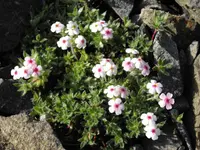
Androsace villosa is a compact alpine perennial forming low, cushion-like mats of small rosettes. It belongs to the primrose family and stays very small and tidy. In spring, it produces clusters of delicate white to pink flowers that rise just above the foliage, giving a neat, refined look. The leaves are often slightly hairy, which helps the plant cope with cold and dryness.
This species is native to European mountain regions, where it grows in rocky, well-drained habitats with cool conditions. It can be challenging for beginners because it dislikes excess moisture and heat, so success depends on careful soil preparation and drainage. Gardeners who want to care for Androsace villosa should aim to recreate its natural alpine environment with bright light, cool air, and gritty, free-draining soil.

Care Difficulty
Hard Care

Light Preference
Full Sun

Water Requirements
Low Water

Temperature Preference
Cold Hardy

Hardiness Zone
3–7

Soil Texture
Sandy, Loamy, Rocky

Soil pH
Acidic (5.5–6.5), Slightly acidic (6.5–7.0)

Soil Drainage
Well-drained

Fertilization
Minimal (feed rarely)
Scan your plant to receive care tips personalized for your specific plant
Available on iOS and Android
This alpine cushion plant prefers bright, cool conditions with protection from harsh midday sun.
This species needs careful watering that keeps the root zone moist but never saturated.
This alpine species prefers cool conditions and tolerates significant cold when well drained.
This alpine species prefers relatively dry air and usually does not need extra humidity control.
This plant needs sharply drained, gritty soil that stays moist but never waterlogged.
This species is well suited to containers, especially alpine troughs and shallow pots.
Feeding needs are modest, as Androsace villosa is adapted to nutrient-poor alpine soils.
Pruning needs are light and focus on keeping cushions compact and healthy in Androsace villosa.
Transplanting is infrequent, as this alpine prefers stable conditions and dislikes root disturbance.
Propagation is usually done by seed or careful division for Androsace villosa in cultivation.
Winter care is moderate; the species is fairly hardy but dislikes prolonged wet and ice in the crown.

Plant Health Check
Not sure what's wrong with your plant? Check your plant's health inside the app.
This species naturally forms dense, woolly cushions on siliceous or limestone rocks in high-alpine zones of central and southern European mountains, including the Alps and Pyrenees. The cushion form reduces heat loss and protects growing points from desiccating winds and frost.
Its small rosettes carry narrow leaves densely covered with long, soft hairs that create a felt-like surface. These hairs trap a layer of still air, reducing water loss and shielding tissues from intense ultraviolet radiation at high elevations.
In habitat, it typically flowers shortly after snowmelt, often in late spring to early summer, producing clusters of white to pale pink, yellow-eyed flowers. The timing allows it to complete flowering and seed set during the short alpine growing season.

Androsace villosa shows notable geographic and ecological variation across its range, and some botanists recognize several subspecies or regional forms that differ subtly in leaf hairiness, cushion density, and flower characteristics, reflecting local adaptation to different alpine microclimates and bedrock types.
This alpine species performs best outdoors in cool, well-drained rock gardens, troughs, or crevices. Indoor conditions are usually too warm, stagnant, and humid, so Androsace villosa indoor care is challenging and rarely successful long term.
Keep your plants happy and healthy with plant identification, disease detection, and easy care guidance.