Early vine training
Install a sturdy trellis or netting at planting time and gently wind new stems onto it weekly so the vines climb vertically instead of tangling on the ground and shading their own foliage.

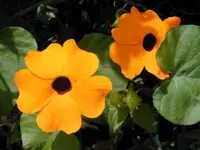
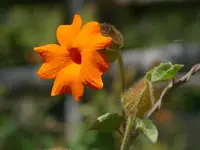
Black-eyed Susan vine, Thunbergia alata, is a fast-growing, twining climber often grown as an annual in cooler climates. It produces small, flat, usually orange or yellow flowers with a dark central eye.
In its native East Africa, it scrambles through shrubs and along fences, creating a loose, leafy curtain. In gardens and containers, it is commonly trained up trellises, arches, or hanging baskets.
This species grows quickly in warm conditions and responds well to regular moisture and fertile, well-drained soil. Once established, it is considered relatively easy to care for Black-eyed Susan vine, provided it receives ample light and support for climbing.

Care Difficulty
Moderate Care

Light Preference
Full Sun

Water Requirements
Regular Water

Temperature Preference
Tropical / Frost Sensitive

Hardiness Zone
10–11

Soil Texture
Sandy, Loamy, Organic-rich

Soil pH
Acidic (5.5–6.5), Slightly acidic (6.5–7.0)

Soil Drainage
Moist but well-drained

Fertilization
Moderate (every 2–4 weeks)
Scan your plant to receive care tips personalized for your specific plant
Available on iOS and Android
This fast-growing climber thrives with ample sun but benefits from some protection in hot climates.
This vine prefers evenly moist, well-drained soil without long dry spells or waterlogging.
This species grows best in warm, frost-free conditions typical of late spring through early fall.
This vine copes with a range of humidity but flowers best in moderately moist air.
Thunbergia alata prefers loose, well-aerated soil that drains quickly yet holds steady moisture.
This species grows well in containers when the pot supports its vigorous climbing habit.
Black-eyed Susan vine responds well to moderate feeding during its active growing season.
Thunbergia alata benefits from light, regular shaping to stay dense and flowering.
This fast-growing vine often outgrows containers and appreciates timely repotting or transplanting.
This vine is commonly multiplied by seeds and softwood cuttings for reliable renewal.
Thunbergia alata is frost-sensitive and usually grown as an annual in cold climates.

Plant Health Check
Not sure what's wrong with your plant? Check your plant's health inside the app.
The dark central eye of the flower is created by a dense concentration of pigments that absorb light, which makes the surrounding yellow to orange petals appear brighter and more attractive to pollinating insects.
Individual flowers typically last only 1–2 days, but the vine produces new blooms continuously over a long season, so the plant can stay in flower for months under suitable conditions.
This species climbs by twining its flexible stems around nearby supports, allowing it to rapidly cover trellises, fences, or other plants where it can sometimes behave as a weed in frost-free climates.

In several warm regions outside its native East Africa, Thunbergia alata has naturalized and is listed as an invasive or environmental weed because it can form dense tangles that smother local vegetation and reduce native plant diversity.
Lack of flowers usually comes from insufficient light, too much nitrogen fertilizer, or stress from drought, rootbound pots, or temperature swings. Check light first, then adjust feeding and watering, and deadhead spent blooms to redirect energy.
Keep your plants happy and healthy with plant identification, disease detection, and easy care guidance.