Ivy-leaved cyclamen Care (Cyclamen hederifolium)

Also known as: Sowbread
Ivy-leaved cyclamen

About Ivy-leaved cyclamen

Ivy-leaved cyclamen (Cyclamen hederifolium) is a small, tuberous perennial often grown for its autumn flowers and patterned, ivy-like foliage. It grows from a round underground tuber and forms low, spreading clumps that suit shady borders, under trees, and naturalized areas.

The plant is native to woodlands and rocky slopes in the Mediterranean region, where it copes with dry summers and cooler, moist winters. Its seasonal growth pattern, with summer dormancy and active cool-season growth, is the main trait that affects how to care for Ivy-leaved cyclamen.

It generally prefers dappled light, well-drained soil rich in leaf litter, and moderate moisture during its growing season, making it manageable for many home gardeners if its cycle is respected.

Main Plant Requirements

Care Difficulty

Moderate Care

Light Preference

Partial Shade

Water Requirements

Moderate Water

Temperature Preference

Cold Hardy

Hardiness Zone

5–9

Soil Texture

Loamy, Peaty, Organic-rich

Soil pH

Acidic (5.5–6.5), Slightly acidic (6.5–7.0)

Soil Drainage

Well-drained

Fertilization

Minimal (feed rarely)

Get Personalized Care Plan

Scan your plant to receive care tips personalized for your specific plant

Available on iOS and Android

How to Care for the Ivy-leaved cyclamen

This species prefers bright but gentle light that mimics dappled woodland conditions.

  • Provide 3–5 hours of soft morning sun or light shade under deciduous trees; avoid strong midday and afternoon sun that can scorch leaves.
  • Allow partial to full shade in summer dormancy; emerging autumn growth benefits from filtered light through thinning foliage above.
  • In hotter regions, position Ivy-leaved cyclamen where it receives early sun and afternoon shade to prevent leaf scorch and prolonged soil drying.

Cyclamen hederifolium needs moisture during active growth but must not sit in saturated soil.

  • Water when the top 3–5 cm of soil feel dry, aiming for evenly moist but not soggy soil during autumn and winter growth.
  • Reduce or stop watering once leaves yellow and die back in late spring, keeping the tubers in barely moist to dry, sharply drained soil through summer dormancy.
  • Watch for limp, drooping leaves and dry soil as signs of underwatering, and for yellowing, mushy bases or a sour smell as signs of overwatering.

This hardy cyclamen grows best in cool to mild conditions with protection from extreme heat.

  • Aim for active growth temperatures around 45–65°F (7–18°C), which match typical autumn and early spring conditions in many temperate gardens.
  • Mature tubers tolerate brief drops to about 5°F (−15°C) if soil drains well and there is some leaf or mulch cover over the planting area.
  • Provide afternoon shade and extra mulch where summer temperatures exceed 85°F (29°C), as prolonged heat can stress plants and shorten flowering.

This species prefers cool, moderately moist air and reacts if conditions are too dry or too damp.

  • Aim for 40–60% humidity, avoiding warm, stagnant rooms that trap moisture around foliage.
  • Leaves may curl, droop, or develop crisp edges in very dry air, while prolonged dampness encourages botrytis grey mold.
  • Increase humidity locally with a nearby tray of damp pebbles, but keep the pot base above water to protect the Ivy-leaved cyclamen tuber.

Cyclamen hederifolium grows best in light, airy soil that mimics a humus-rich woodland floor.

  • Use a loose mix such as 40% fine bark, 30% peat-free compost, and 30% grit or perlite for strong drainage.
  • Keep pH slightly acidic to neutral (pH 6.0–7.0), avoiding strongly alkaline or chalky substrates that limit nutrient uptake.
  • Improve aeration by including coarse particles (grit, perlite, or small bark) so the tuber sits in well-ventilated spaces, not dense paste.
  • Avoid heavy clay, waterlogged sites, or pure peat mixes, which hold too much water and promote tuber rot.

This woodland cyclamen adapts well to container growing when drainage and tuber position are carefully managed.

  • Choose a wide, shallow pot so the tuber can sit just below the surface with room for spreading roots rather than deep rooting.
  • Select terracotta or other porous material to release excess moisture, reducing the risk of rot during its cool, wet growth season.
  • Elevate the pot and ensure fast runoff from drainage holes so rain or watering cannot pool under the tuber.

This woodland bulb is modest in its feeding needs but responds to light nutrition in containers or poor soils.

  • Use a balanced liquid fertilizer at 1/4–1/2 strength every 4–6 weeks during active growth in fall and winter.
  • Apply a thin layer of fine compost over the root zone once a year for outdoor clumps of Ivy-leaved cyclamen.
  • Avoid feeding during summer dormancy when leaves have died back, as the tuber is resting.
  • Choose a low-salt, balanced NPK product and water before and after feeding to reduce root burn risk.

Cyclamen hederifolium needs only light, targeted pruning to stay healthy and tidy.

  • In autumn and winter, pinch or cut off spent flowers at the base to direct energy back to the tuber.
  • Remove yellowing or damaged leaves with clean scissors to limit disease and improve airflow.
  • Leave healthy foliage intact, as it feeds the tuber through photosynthesis and supports next season’s flowering.
  • Avoid cutting into the tuber; always trim stems just above soil level.

This species is usually long-lived in one spot and only occasionally needs transplanting or repotting.

  • Check containers every 3–4 years; crowded tubers, roots circling the pot, or weak flowering suggest the need to move it.
  • Shift or divide clumps in late summer dormancy when leaves are absent and tubers are least disturbed.
  • Replant tubers shallowly in well-drained, humus-rich soil, spacing them so they do not touch each other.
  • Water lightly after planting, then keep soil just barely moist until strong new leaves appear to limit transplant shock.

Cyclamen hederifolium is usually propagated from seed, with division of large tubers used less often.

  • Collect ripe seeds in late spring and sow fresh in shallow trays of gritty, humus-rich mix.
  • Maintain cool, shaded conditions and even moisture; germination may take several months.
  • Grow seedlings in their tray for 1–2 years before moving small tubers to individual pots or a prepared bed.
  • For division, cut a large, healthy tuber into pieces with at least one growth point each, dust cuts with fungicide, and replant during dormancy.

This hardy cyclamen tolerates typical winters in much of the US and generally needs minimal winter care outdoors.

  • Established tubers survive light to moderate frosts when planted in well-drained soil.
  • Apply a 3–5 cm layer of leaf mold or bark mulch in colder regions to buffer freeze–thaw cycles.
  • For containers in areas below about 10°F, move pots into a cold, bright, frost-free shelter until severe cold passes.

Care Tips

Summer dormancy handling

When foliage yellows and dies back in late spring, stop watering, move pots to a dry shaded spot, and keep the tubers almost dry through summer dormancy to avoid rot.

Shallow tuber planting

Position tubers just below the soil surface with the top slightly exposed and oriented upward, as this supports healthy leaf and flower production and reduces the risk of water collecting in the crown.

Self-seeding management

Allow some seed capsules to ripen and drop if you want a naturalized colony, but gently lift and relocate unwanted seedlings in late winter while they are small and easy to move.

Leaf litter mulching

In outdoor plantings, maintain a thin layer of leaf litter or fine bark over the root zone to mimic woodland conditions while keeping the tuber itself lightly covered or exposed at the surface.

Container rotation strategy

For container plants, group dormant pots out of sight in a dry, protected area and label them clearly so that caring for Ivy-leaved cyclamen resumes correctly when new growth appears in late summer or early fall.

Common Pests and Diseases

Cyclamen mite

This pest is a microscopic mite that deforms new leaves, flowers, and buds, causing stunting and twisted growth. Symptoms include distorted, brittle foliage and malformed or aborted flowers, often starting in the crown of the plant.

Solution

Isolate affected plants at once, then trim and discard the worst damaged leaves and flower stalks in the household trash. Improve air movement, avoid overhead misting, and use a targeted miticide labeled for cyclamen mites, repeating as directed, since multiple treatments are often needed for effective Cyclamen hederifolium care instructions.

Botrytis blight

This disease is a fungal infection that creates soft, water-soaked spots on leaves, flowers, and stems, often covered with gray, fuzzy mold. Symptoms include rapid collapse of flowers and yellowing or rotting patches on foliage, especially in cool, damp conditions.

Solution

Remove and discard all affected flowers, leaves, and plant debris immediately, keeping the tuber and crown as clean and dry as possible. Provide stronger air circulation, avoid wetting the foliage, water at soil level in the morning, and if needed apply a fungicide labeled for Botrytis on ornamentals according to the product directions.

Vine weevil

This pest is a beetle whose adults notch the leaf edges while the white, legless larvae feed on roots and tubers. Symptoms include irregular leaf notches on older foliage, poor vigor, wilting, and in severe cases sudden collapse as the tuber is eaten.

Solution

Inspect plants for adult beetles at night and hand-pick them off leaves, then remove pots to check the soil for grubs around the tuber and discard heavily infested soil. Repot into fresh mix if grown in containers, and use biological controls such as nematodes labeled for vine weevil or targeted insecticides, focusing treatments on the soil zone where larvae feed.

Bacterial soft rot

This disease causes the crown, petioles, and sometimes the tuber to become soft, mushy, and foul-smelling. Symptoms include water-soaked areas at the base of the leaves, rapid wilt, and a collapse of the central growth point under warm, wet conditions.

Solution

Discard severely affected plants since the bacteria spread quickly and are difficult to eradicate. For mild, early cases, cut out all soft tissue with a sterile knife, dust the wound with sulfur or a similar drying agent, allow it to dry in a well-ventilated place, then replant in fresh, free-draining medium while maintaining careful, moderate watering.

Cyclamen mosaic virus

This disease is a viral infection that causes mottled, streaked, or distorted leaves and flowers, often with uneven color and reduced vigor. Symptoms include irregular lighter or darker patterns on leaves, poor flowering, and gradual decline over time.

Solution

Remove and destroy infected plants because viruses cannot be cured and are easily spread through sap and contaminated tools. Disinfect cutting tools between plants, control sap-sucking insects such as aphids that can transmit viruses, and start new plants only from reputable, virus-tested stock when aiming to grow Cyclamen hederifolium.

Interesting Facts

Autumn-blooming strategy

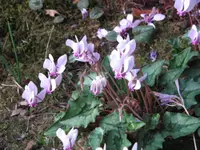
This species flowers in late summer to autumn, often before its leaves fully appear, which allows pollinators to find its pale to deep pink flowers in woodland habitats when few other understory plants are in bloom.

Distinctive ivy-like leaves

Its leaves develop after flowering and show strong variability in silvery and green marbling, often resembling miniature English ivy leaves, a key trait that helps distinguish it from other hardy cyclamen species.

Explosive seed dispersal

As seed capsules mature, the coiling flower stems bring them close to the soil surface, where ants attracted to the fleshy seed appendages (elaiosomes) carry the seeds away, aiding in local spread.

Botan icon

Did you know?

This species has naturalized widely in parts of western and northern Europe, including the UK, where long-lived colonies originating from garden plantings can persist and slowly expand for many decades under suitable woodland or shade-garden conditions.

FAQs about Ivy-leaved cyclamen

This species usually flowers in late summer to mid fall, often before or as new leaves emerge. Bloom time varies with climate and planting site but typically lasts several weeks, with individual flowers replaced in succession.

Grow Healthy Plants with Botan Care

Keep your plants happy and healthy with plant identification, disease detection, and easy care guidance.

Botan plant care app — identify plants on mobile

Explore More Plants