Host tree selection
Establish chanterelles only under compatible host trees such as spruce, pine, beech, or birch, and avoid mixing unrelated young tree species in the same small area to reduce competition for mycorrhizal colonization.

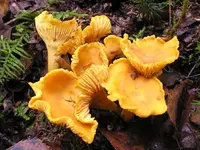
Golden chanterelle, Cantharellus cibarius, is a mycorrhizal fungus that forms a symbiotic partnership with tree roots rather than living as a typical leafy plant. It produces firm, funnel-shaped yellow to golden fruiting bodies with thick, forked ridges instead of true gills, usually emerging in scattered groups on forest floors. This species is native to temperate forests across Europe, North America, and parts of Asia, often associated with conifers and broadleaf trees. It is considered difficult to cultivate because it depends on a stable tree partner, undisturbed soil, and specific seasonal conditions, so most people do not attempt to care for Golden Chanterelle at home.

Care Difficulty
Hard Care

Light Preference
Partial Shade

Water Requirements
Keep Soil Moist

Temperature Preference
Cool Climate

Hardiness Zone
3–8

Soil Texture
Loamy, Sandy, Organic-rich

Soil pH
Strongly acidic (4.5–5.5), Acidic (5.5–6.5)

Soil Drainage
Moist but well-drained

Fertilization
Minimal (feed rarely)
Scan your plant to receive care tips personalized for your specific plant
Available on iOS and Android
This forest fungus prefers light conditions similar to a mixed woodland floor.
This mycorrhizal fungus depends on consistently moist, not saturated, forest soil.
This species thrives in cool to mild woodland temperatures rather than extreme heat or cold.
This species needs consistently moist, cool air to form mushrooms and does poorly in dry environments.
Cantharellus cibarius requires a specific forest-type substrate rather than conventional garden soil.
This species is not suitable for standard container growing because it depends on a stable association with living tree roots in open ground.
This mycorrhizal fungus gains nutrients through partner tree roots and generally does not need direct fertilization.
Cantharellus cibarius does not require pruning because it is a wild mycorrhizal fungus, not a typical garden plant.
This species is not suited to normal repotting and is rarely managed in containers; focus instead on suitable forest-like habitat.
True propagation of this forest mushroom at home is difficult because it depends on complex mycorrhizal relationships with living tree roots.
Established chanterelle colonies in suitable climates are naturally cold hardy and usually need no special winter care.

Plant Health Check
Not sure what's wrong with your plant? Check your plant's health inside the app.
This species forms ectomycorrhizal associations with tree roots, especially spruce, pine, birch, and beech, exchanging mineral nutrients from the soil for sugars from the host tree and improving forest nutrient cycling.
The mushroom typically begins as a convex or slightly depressed cap and gradually matures into a distinct funnel shape with decurrent, forked ridges instead of true gills, which helps distinguish it from many toxic look-alikes.
Its rich yellow to golden color is primarily due to carotenoid pigments, the same class of compounds that color carrots and egg yolks, and this coloration can fade or pale in deep shade or with age.

This species often fruits repeatedly from the same underground mycelial network for many years, so a productive patch in suitable forest habitat can remain a reliable source of mushrooms season after season if harvested carefully.
This fungus is a well-known edible mushroom, prized for its firm texture and mild, fruity aroma. Only harvest when identification is absolutely certain, since some yellow look-alike species can be mildly toxic or cause digestive upset.
Keep your plants happy and healthy with plant identification, disease detection, and easy care guidance.