Host tree pairing
Establish the fungus near compatible host trees such as oaks or beeches, as the mycorrhizal partnership with their roots is essential for reliable fruiting and long-term colony health.

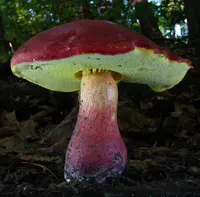
The two-colored bolete, Baorangia bicolor, is a fleshy, mycorrhizal fungus, not a leafy plant. It forms a symbiotic relationship with tree roots, helping both partners access nutrients. The fruiting body has a reddish to pink cap with yellow pores and a stout stem, often showing blue staining when bruised.
This bolete is native to North America and is usually found on the ground in mixed hardwood forests, especially near oaks. It does not adapt well to pots or typical indoor environments, so attempts to care for two-colored bolete focus on maintaining suitable outdoor woodland conditions with undisturbed soil, leaf litter, and moderate moisture.

Care Difficulty
Hard Care

Light Preference
Partial Shade

Water Requirements
Regular Water

Temperature Preference
Cool Climate

Hardiness Zone
Unknown

Soil Texture
Loamy, Sandy, Organic-rich

Soil pH
Acidic (5.5–6.5)

Soil Drainage
Moist but well-drained

Fertilization
Minimal (feed rarely)
Scan your plant to receive care tips personalized for your specific plant
Available on iOS and Android
This bolete prefers dappled woodland light that mimics mixed forest conditions.
Moist but not waterlogged soil is essential for supporting the underground mycelium of this bolete.
This species fruits best in mild to warm conditions typical of late spring to early fall forests.
This fungus fruiting body does not require managed air humidity for successful growth.
Baorangia bicolor develops best where its underground mycelium associates with tree roots in undisturbed, well-structured ground.
This ectomycorrhizal fungus is not suitable for true container growing since it needs long-term association with living tree roots in open ground.
This ectomycorrhizal fungus relies mainly on its tree partners for nutrients, so caring for two-colored bolete focuses on soil health rather than direct feeding.
Baorangia bicolor is a wild ectomycorrhizal mushroom and does not require true pruning, only light management of the surrounding habitat.
This species is not suited to container culture, so Baorangia bicolor care focuses on establishing and maintaining suitable outdoor tree-root habitats rather than repotting.
This bolete is typically spread by spores and mycorrhizal association with trees, so intentional home propagation of Baorangia bicolor is challenging and unreliable.
This fungus is naturally cold hardy in its native range and usually needs no special winter care beyond maintaining a stable forest-like soil environment.

Plant Health Check
Not sure what's wrong with your plant? Check your plant's health inside the app.
When the yellow pore surface or flesh is handled or cut, it bruises and rapidly turns a dark blue due to oxidation of variegatic acid and related pigments. This color change is often used in the field to help distinguish it from similar red-and-yellow boletes.
This species forms ectomycorrhizae, a mutualistic root association, mainly with oaks in eastern North American forests. The fungus trades mineral nutrients and water for sugars from the tree, contributing to the health and productivity of oak-dominated ecosystems.
For many years it was classified as Boletus bicolor based on morphology alone. Molecular phylogenetic studies later showed it belongs in a separate genus, leading to its current name Baorangia bicolor.

Mature fruiting bodies of this species are commonly attacked by specialized bolete-feeding insects and other invertebrates, and heavy larval tunneling often causes mushrooms to decay rapidly, which in turn accelerates nutrient return to the forest floor.
This species is considered an edible wild mushroom when correctly identified and properly cooked, but similar-looking toxic boletes exist. Only experienced foragers or mycologists should collect it, and local regulations and mushroom guides must be followed.
Keep your plants happy and healthy with plant identification, disease detection, and easy care guidance.