Encourage Bushy Growth
Pinch out the soft shoot tips when plants are 10–15 cm tall to promote branching, which results in more flowering stems and a fuller outline during the season.

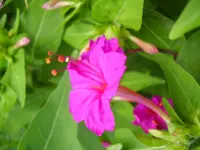
Marvel of Peru, Mirabilis jalapa, is a fast-growing flowering perennial often grown as an annual. It forms bushy clumps with lush green leaves and many trumpet-shaped blooms. Flowers open in late afternoon and evening, often showing mixed colors on the same plant, which gives a distinctive, patterned display. In warm regions it can self-seed and spread, so placement needs some planning. This species comes from tropical and subtropical areas of the Americas but is now widely grown in gardens. It is considered easy to grow, tolerating heat and poor soil, which makes it simple to care for Marvel of Peru.

Care Difficulty
Easy Care

Light Preference
Full Sun

Water Requirements
Moderate Water

Temperature Preference
Tropical / Frost Sensitive

Hardiness Zone
8–11

Soil Texture
Sandy, Loamy, Organic-rich

Soil pH
Acidic (5.5–6.5), Slightly acidic (6.5–7.0)

Soil Drainage
Well-drained

Fertilization
Light (every 4–6 weeks)
Scan your plant to receive care tips personalized for your specific plant
Available on iOS and Android
Mirabilis jalapa grows best with strong, consistent sun exposure in most gardens.
Mirabilis jalapa prefers evenly moist, well-drained soil rather than constant saturation.
This species thrives in warm conditions and is sensitive to frost and prolonged cold.
This species handles a wide humidity range and rarely needs special humidity care.
Mirabilis jalapa prefers loose, well-aerated soil that drains freely yet holds moderate moisture.
This species is suitable for container growing when given enough depth and drainage.
Nutrient-rich soil helps Marvel of Peru produce abundant flowers through the warm season.
Light pruning keeps Mirabilis jalapa tidy and encourages better flowering.
This species is usually grown in garden beds, so care focuses on transplanting tuberous roots rather than frequent repotting.
Mirabilis jalapa is most often propagated from seeds or division of tuberous roots.
In mild climates the plant overwinters in the ground, but in colder regions its tubers need protection from freezing.

Plant Health Check
Not sure what's wrong with your plant? Check your plant's health inside the app.
Individual flowers can open yellow and gradually develop pink or red streaks as pigments accumulate, so a single plant may show multiple flower colors at once on different blooms and even within the same bloom over time.
The flowers typically open in late afternoon and close by the next morning, which is why the species is commonly called four o'clock flower and is mainly pollinated by evening and night-flying moths.
Cultivated Mirabilis jalapa is usually a tetraploid, meaning it carries four sets of chromosomes instead of the usual two, a condition that contributes to its wide range of flower colors and patterns.

Mirabilis jalapa became one of the classic textbook examples of incomplete dominance in genetics when breeders observed that crossing red- and white-flowered plants produced offspring with predictable pink flowers, helping illustrate how some traits blend in hybrids rather than following strict dominant–recessive patterns.
Lack of flowers usually comes from insufficient sun, overly rich nitrogen fertilizer, or stress from drought or waterlogging. Improve light exposure, use a balanced fertilizer, and keep soil evenly moist but well drained to restore blooming.
Keep your plants happy and healthy with plant identification, disease detection, and easy care guidance.