




nightshade Identification (Solanum macrocarpon)

To recognize Solanum macrocarpon, look for a bushy plant with large, simple leaves set alternately on the stems, broad oval to lobed blades, and stout stems that may carry short prickles.

The flowers are star-shaped, pale purple to white, with a yellow cone of fused anthers in the center.

Solanum macrocarpon Identification

Identify Your Plant with Botan

Upload a clear image to check whether your plant ID is correct.

Clear images work best. Avoid photos taken too close or too far away

Check the leaf size, armature, and fruit shape on Solanum macrocarpon.

  • An upright, branching shrub, often about 3 feet (0.9 m) tall.
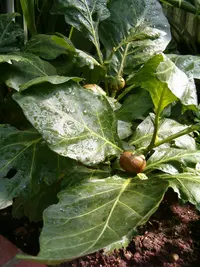
  • Leaves are broad and oval to somewhat lobed, often 4-12 inches (10-30 cm) long, with a coarse surface.
  • Stems and leaf veins may carry short, straight prickles, though some plants are nearly unarmed.
  • Flowers are star-shaped with 5 white to pale purple petals and a bright yellow cone of anthers.
  • Fruits are round to slightly flattened berries, green to yellowish when mature, often with visible ribbing.

Use several traits together, since prickliness and leaf lobing can vary.

Solanum macrocarpon shows clear visual shifts from seedling leaves to flowering and fruiting structure.

  • Seedling: Seedlings show small, simple oval leaves with smooth margins first; later leaves broaden and begin showing the species’ thicker texture and slight lobing.
  • Young plant: The young plant forms a low, leafy clump with broader alternate leaves and a sturdier green stem, before strong branching and reproductive structures appear.
  • Flowering stage: Flowering plants carry star-shaped pale purple to whitish flowers in small clusters, with prominent yellow anthers that stand out against the broad foliage.
  • Fruiting stage: After flowering, rounded glossy berries develop where flower clusters sat, enlarging to about 2-4 inches (5-10 cm) wide and becoming the plant’s main visual feature.

A few edible eggplants are regularly mistaken for this species.

garden egg(Solanum aethiopicum)

Often confused because both are shrubby eggplants with broad leaves and round fruits. Garden egg usually has smaller, firmer fruits and leaves that are less thick and less prominently lobed than Solanum macrocarpon.

eggplant(Solanum melongena)

Confusion happens when broad-leaved forms are young or sold without fruit. S. melongena more often has purple flowers and longer, hanging fruits, while the other plant usually shows paler flowers and flatter, rounded fruits.

Solanum macrocarpon is native to tropical Africa and is widely associated with West and Central Africa. It is found in disturbed ground, field margins, roadsides, village edges, and open secondary vegetation rather than closed forest. That setting can help with identification. A broad-leaved Solanum turning up in cultivated or weedy lowland places in tropical Africa is more likely to be S. macrocarpon than a species tied to intact woodland or wetter forest habitats.

  • Plant parts: Solanum macrocarpon is in the nightshade genus. As with other Solanum species, unripe fruit and vegetative parts such as leaves and stems can contain glycoalkaloids. The concern is ingestion by humans or pets.
  • Handling: Some forms have small prickles on stems and leaf veins. This is a physical injury risk from skin contact, not a poisoning risk.

Not Sure About the ID?

Use Botan to identify or confirm it from a photo, which helps reduce mix-ups before you label, buy, or compare plants.

FAQ

Yes. The species bears round to somewhat flattened berries, often green to whitish or purple depending on form and maturity. Combined with its broad, lobed leaves and star-shaped flowers, fruit is useful for Solanum macrocarpon identification.

More Plant Identification Guides

Identify It. Learn More About It.

Use Botan to identify it from a photo, then get plant details, care information, and common problems for that species.

Botan app identifying a plant from a photo
How to Winterize Your Garden in 6 Steps

5 min read · 28 Sept 2026

How to Winterize Your Garden in 6 Steps

Learn how to prepare your garden for winter with a practical six-step checklist covering cleanup, tender plant care, watering, mulching, winter protection, and winterizing equipment and containers.

Plant Care
How to Winterize Your Garden in 6 Steps
How To Revive a Dying Plant: 6 Steps To Bring A Plant Back To Life

6 min read · 1 Sept 2026

How To Revive a Dying Plant: 6 Steps To Bring A Plant Back To Life

Drooping leaves and brown tips don't always mean the end, and a weakened plant can often recover with a little help. These six simple steps will help you revive a dying plant and restore its health.

Plant Care
How To Revive a Dying Plant: 6 Steps To Bring A Plant Back To Life
Plants That Repel Bugs – 20 Effective Options

12 min read · 16 Jul 2026

Plants That Repel Bugs – 20 Effective Options

Mosquitoes on the patio? Gnats in the kitchen? Some plants keep them away with the scent of their own leaves. Here are 20 that deal with mosquitoes, flies, aphids, and more, plus where to put them so they help.

Plant Recommendations
Plants That Repel Bugs – 20 Effective Options