



Rosemary Identification (Salvia rosmarinus)

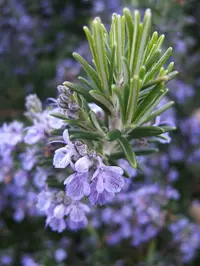
Recognize Rosemary by its narrow, linear leaves set in opposite pairs along woody, much-branched stems. Leaves are about 1 to 1.5 inches (2.5 to 4 cm) long, with edges rolled under and a dark green upper surface.

Flowers appear in small clusters at the leaf axils, usually two-lipped and pale blue to lilac.

Salvia rosmarinus Identification

Check Your Plant with Botan

Take a photo and use Botan to confirm your plant identification.

Clear images work best. Avoid photos taken too close or too far away

Check the shrub’s leaf shape, stem habit, and flower form first.

  • Leaves are narrow, needle-like, and usually 1-2 inches (2.5-5 cm) long, set in opposite pairs along the stems.
  • Leaf edges roll under, making the leaves look thicker; the upper surface is dark green and the underside appears pale.
  • Stems are woody at the base, with many short side branches that create a dense, bushy outline.
  • Flowers are small and two-lipped, borne in short clusters at the leaf axils, often pale blue to lavender.

A woody, many-branched shrub with paired, rolled leaves is a strong visual match for Salvia rosmarinus.

Salvia rosmarinus shows clear visual changes from seedling to flowering shrub stage.

  • Seedling: Seedlings have a thin upright stem and soft first leaves; later true leaves become narrow, opposite, and more needle-like than the initial pair.
  • Young plant: A young plant forms several slender, green, woody-based shoots with short side branches, keeping a compact outline about 8-12 inches (20-30 cm) tall.
  • Mature plant: Mature Rosemary becomes a dense woody shrub with thicker brown stems, many branched twigs, and a broader rounded or somewhat arching framework than younger plants.
  • Flowering stage: Flowers appear in small clusters along upper leaf axils, adding clear two-lipped blooms that interrupt the foliage and make branch tips look less strictly needle-dominated.

Rosemary has several named forms that are easy to separate by habit, foliage pattern, or flower color.

  • 'Prostratus': A trailing form that spreads low and outward rather than making the usual upright shrub.
  • 'Arp': Typically taller and looser than many garden forms, with narrower gray-green leaves and pale blue flowers.
  • 'Irene': A strongly cascading selection with long arching stems and a broad, ground-hugging spread.
  • 'Tuscan Blue': More upright and columnar, often reaching about 4 feet (1.2 m), with relatively broad leaves and deep blue flowers.
  • 'Variegatus': Leaves show creamy yellow to pale gold margins, unlike the solid green leaves of the typical form.

Rosemary stays evergreen, so the narrow, needle-like leaves remain visible year-round rather than dropping for winter. The clearest seasonal clue is flowering. Pale blue to lavender, sometimes white, two-lipped flowers become noticeable from late winter into spring, and in mild climates they may appear again at other times, standing out along the stems against the dark green foliage.

A few woody Mediterranean herbs are regularly mistaken for Rosemary.

lavender(Lavandula angustifolia)

It can look similar from a distance because both are shrubby with narrow gray-green leaves. Lavender leaves are usually softer and more silvery, and its flowers sit in dense spikes on long leafless stems, unlike rosemary’s smaller flowers along leafy stems.

winter savory(Satureja montana)

This is another woody herb with small opposite leaves, so vegetative plants can confuse buyers. Winter savory has shorter, broader leaves and a finer twiggy habit; rosemary has longer needle-like leaves with paler undersides.

Salvia rosmarinus is native to the Mediterranean region, especially coastal areas of southern Europe and parts of North Africa. In the wild it is most often found on dry, rocky slopes, scrubby hillsides, and coastal shrubland. That setting helps narrow identification because this species commonly appears with other Mediterranean scrub plants rather than in woodland or wet habitats. A rosemary-like shrub growing naturally on exposed, stony coastal ground is more likely to be Salvia rosmarinus.

Confirm the Species with Botan

Upload a photo to help identify the plant or verify your result before making decisions based on the name.

FAQ

The clearest feature is the narrow, needle-like leaf with edges rolled under, dark green above and whitish beneath. Crushing a leaf releases a strong resinous scent, which helps with how to identify Rosemary.

More Plant Identification Guides

Identify First. Learn What Comes Next.

Use a photo to identify the plant, then see species-specific plant details, care information, and common problems in Botan.

Botan app identifying a plant from a photo
12 Best Landscaping Trees for Your Garden

8 min read · 6 Oct 2026

12 Best Landscaping Trees for Your Garden

Choosing the landscape tree depends on what your garden needs most. These 12 options include compact flowering specimens, colorful deciduous trees, shade varieties, and evergreens suitable for screening and year-round structure.

Plant Recommendations
12 Best Landscaping Trees for Your Garden
Is Sugar Water Good for Plants?

4 min read · 14 Sept 2026

Is Sugar Water Good for Plants?

Sugar water may sound like an easy boost, but most rooted plants do not need extra sucrose. This guide explains how green tissues produce carbohydrates, when a sweetened solution can be useful, and why too much can cause problems.

Plant Care
Is Sugar Water Good for Plants?
How Often to Water Fruit Trees

7 min read · 11 Aug 2026

How Often to Water Fruit Trees

Irrigation needs change as roots establish and weather shifts. This guide gives practical starting intervals, explains how soil and tree type change them, and shows how to recognize both excess moisture and drought stress.

Plant Care
How Often to Water Fruit Trees