


Western White Pine Identification (Pinus monticola)

To recognize Western White Pine, look first for needles in bundles of five, each about 2 to 4 inches (5 to 10 cm) long, and long, narrow cones that often hang 5 to 10 inches (13 to 25 cm) from the branches.

Mature trees also show a straight central trunk and a narrow, conical crown.

Pinus monticola Identification

Scan to Confirm Western White Pine

Upload a clear photo to check your plant identification with Botan.

Clear images work best. Avoid photos taken too close or too far away

Start with the needles, cones, and overall crown shape.

  • Needles grow in bundles of five, soft and flexible, usually 2 to 4 inches (5 to 10 cm) long.
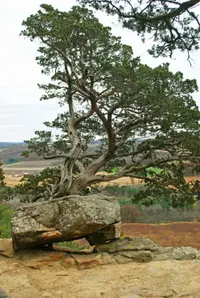
  • The crown is narrow and conical, often with a straight central trunk and layered horizontal branches.
  • Cones are long and slender, about 5 to 10 inches (13 to 25 cm) long, and hang downward from the branches.
  • Branch tips often look slightly feathery because the needles are fine, evenly spaced, and not crowded into stiff tufts.

Check several branches, since needle bundles and hanging cones are the most useful visible clues.

Western White Pine shows clear age-related changes in form, bark, branching, and cones.

  • Seedling: Seedlings have a slim upright stem with juvenile foliage first, then soft blue-green needles appearing in bundles of five near the tip.
  • Young plant: Young plants form a narrow, symmetrical crown with regular whorled branches; bark stays smooth and gray, unlike the broken, furrowed bark of older trees.
  • Mature plant: Mature trees become tall and strongly conical to narrowly cylindrical, often 100-150 feet (30-46 m), with thicker trunks and deeper bark ridges.
  • Fruiting stage: Cone-bearing trees show long, slender hanging cones, often 5-10 inches (13-25 cm), a more diagnostic visual feature than on nonbearing younger plants.

Pinus monticola stays green year-round, so seasonal color change is limited. The clearest seasonal clue is the cone crop: by late summer into fall, long, slender cones become easy to spot hanging from outer branches. In spring, fresh pale shoots and soft new needle clusters briefly stand out at branch tips. During winter, the overall narrow crown and layered branching remain visible because the tree does not lose its needles.

A few five-needle pines can be mistaken for Pinus monticola.

sugar pine(Pinus lambertiana)

Confusion comes from soft blue-green needles in bundles of five and a similar conical crown. Sugar pine is best separated by its very long cones, often 10-20 inches (25-50 cm), while Pinus monticola usually has much shorter cones.

limber pine(Pinus flexilis)

It also has five needles per bundle and pale green to blue-green foliage. Limber pine usually has stouter, often curved cones and thicker, more rigid twigs; Pinus monticola tends to have narrower cones and finer branchlets.

Pinus monticola is native to western North America, from British Columbia and Alberta south through the Pacific Northwest to California, and inland to Idaho, Montana, and Wyoming. It is most often found in montane to subalpine conifer forests, commonly on moist slopes and valleys from about 3,000 to 10,000 feet (900 to 3,050 m). In its native range, a tall five-needled pine in cool mountain forests is more likely to be this species.

Confirm the Species with Botan

Upload a photo to compare key details and get help identifying the plant or confirming your current guess.

FAQ

The quickest check is its needles in bundles of five. They are soft, blue-green, and about 2 to 5 inches (5 to 13 cm) long, often giving the crown a fine, feathery look.

More Plant Identification Guides

Identify the Plant and Get Its Profile

Use a photo to identify it with Botan, then get plant details, care information, and common problems.

Botan app identifying a plant from a photo
Plants That Repel Mosquitoes – 10 Effective Choices

8 min read · 6 Jul 2026

Plants That Repel Mosquitoes – 10 Effective Choices

Plants that repel mosquitoes can help mask human scent naturally and make outdoor spaces more comfortable. Explore the most effective options, their benefits and drawbacks, and choose the right plant for your space.

Plant Recommendations
Plants That Repel Mosquitoes – 10 Effective Choices
Dill Companion Plants – What to Grow Next to Dill

9 min read · 17 Jul 2026

Dill Companion Plants – What to Grow Next to Dill

Dill is an easy-to-grow plant that gets along well with many vegetables. This guide describes 15 plants that can be planted alongside it, a few to avoid, and mistakes that can quietly sabotage the entire process.

Plant Recommendations
Dill Companion Plants – What to Grow Next to Dill
12 Best Cold-Hardy Vegetables for Cold Weather

7 min read · 13 Oct 2026

12 Best Cold-Hardy Vegetables for Cold Weather

Cold-hardy vegetables can keep a garden productive through chilly fall, winter, and early spring weather. This guide covers 12 reliable crops, their frost tolerance, and practical growing tips for better cold-season harvests.

Plant Recommendations
12 Best Cold-Hardy Vegetables for Cold Weather