

red cedar Identification (Juniperus virginiana)

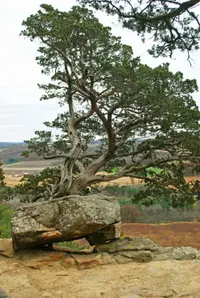
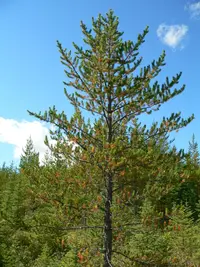
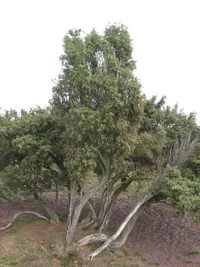
Recognize red cedar by its tight, scale-like leaves pressed to rounded twigs in opposite pairs, forming dense sprays, and by its narrow to broadly conical evergreen crown, often 30 to 50 feet (9 to 15 m) tall.

Older trees usually show a straight trunk with fibrous bark that peels in long strips.

Juniperus virginiana Identification

Is This red cedar?

Upload a clear photo to check your plant identification with Botan.

Clear images work best. Avoid photos taken too close or too far away

Check red cedar for a narrow, often column-like evergreen form and dense branching.

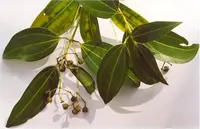
  • Leaves are scale-like and pressed tight to the twigs, usually in opposite pairs.
  • Some shoots show sharp awl-like leaves, especially on vigorous branch tips.
  • Twigs form flat to slightly rounded sprays rather than long loose needles.
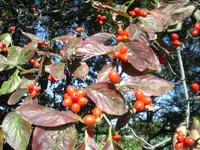
  • Berry-like cones are round, blue to bluish purple, with a pale whitish bloom, about 1/8-1/4 inch (3-6 mm) wide.
  • Bark is reddish brown and peels in long, narrow strips on the trunk.

Use several traits together, especially the tight scale leaves and blue berry-like cones.

Red cedar shows clear age-related changes in foliage, crown shape, bark, and cones.

  • Seedling: First growth carries soft, sharp juvenile needles in opposite pairs or whorls of three, making a spiky, open little plant unlike older branchlets.
  • Juvenile plant: Young shrubs and saplings still show mostly awl-like needles, but branching becomes denser and more upright; scale foliage begins appearing on some shoots.
  • Mature plant: Adult trees are usually narrow to broadly conical, often 30-50 feet (9-15 m) tall, with mostly tight scale-like leaves and fibrous bark peeling in strips.
  • Fruiting stage: Female trees bear rounded, blue seed cones with a waxy coating, typically about 1/4 inch (6 mm) wide, standing out against the finer adult foliage.

Several named selections of red cedar are identifiable by foliage color and crown shape.

  • 'Canaertii': Narrowly pyramidal, often 20-30 feet tall (6-9 m), with soft juvenile foliage persisting in plume-like sprays rather than mostly scale leaves.
  • 'Grey Owl': Broad-spreading and low, usually 2-3 feet tall (0.6-0.9 m) and 5-8 feet wide (1.5-2.4 m), with gray-green foliage instead of the typical darker green.
  • 'Glauca': Foliage has a consistent blue-green to silvery cast, making the whole crown look cooler in color than the species type.
  • 'Emerald Sentinel': Very narrow, columnar habit, often only 3-4 feet wide (0.9-1.2 m) at maturity, unlike the broader pyramidal form typical of the species.

Juniperus virginiana stays evergreen, so the clearest seasonal clues are color and fruit. In late fall and winter, foliage often shifts from medium green to dull green, bronze, or purplish. Female trees show waxy blue, berry-like cones that become conspicuous from late summer into winter. Male trees can show small tan pollen cones in late winter to early spring.

Several conifers are regularly mistaken for red cedar.

Eastern arborvitae(Thuja occidentalis)

Often confused because both are dense evergreens with tiny scale leaves. Arborvitae has flat, fan-like sprays and fibrous gray-brown bark. Juniperus virginiana has more rounded twigs and berry-like cones instead of small upright cones.

Rocky Mountain juniper(Juniperus scopulorum)

Similar because both can be narrow, columnar junipers with blue berry-like cones. Rocky Mountain juniper usually has a cleaner blue-green cast and less shreddy bark; eastern redcedar often shows greener foliage and more obviously peeling reddish-brown bark.

Juniperus virginiana is native to eastern and central North America, from southeastern Canada through the eastern United States and west onto the Great Plains. Knowing that range helps separate it from western junipers when a tree is found growing wild. It commonly occurs in old fields, limestone glades, rocky slopes, fence rows, cedar barrens, and open woodland edges, often on dry, thin, or disturbed soils. In those habitats, especially abandoned pastures and rocky uplands, it is a strong identification clue.

  • Berry-like cones: The blue, berry-like seed cones can cause stomach upset if eaten in quantity. This is an ingestion concern for humans and pets.
  • Foliage and sap: Leaves and plant oils can irritate the mouth if chewed and may irritate skin in sensitive people during handling. This affects humans and pets through ingestion or skin contact.

Does Your Plant Match?

Use Botan to compare a photo and help identify or confirm the plant before you label it or look up care.

FAQ

The most reliable trait is the foliage. This species usually has tiny overlapping scale leaves pressed to twigs, while sharp juvenile needles may also appear. For red cedar identification, also note the bluish berry-like cones on female trees.

More Plant Identification Guides

Find Out What Plant It Is

Identify it from a photo with Botan, then get plant details, care information, and common problems for that species.

Botan app identifying a plant from a photo
How to Plant Pumpkin Seeds for a Fall Harvest and Grow Your Own Patch

7 min read · 4 Nov 2026

How to Plant Pumpkin Seeds for a Fall Harvest and Grow Your Own Patch

A backyard pumpkin patch starts months before the first leaves turn: the harvest that ends up on the porch in October is decided by what a gardener does in late spring.

Beginner Guides
How to Plant Pumpkin Seeds for a Fall Harvest and Grow Your Own Patch
20 Funny Plant Names That Make You Laugh

8 min read · 16 Oct 2026

20 Funny Plant Names That Make You Laugh

Some plants carry names that sound like jokes. This guide explains the origins of 20 funny plant names. You will also see which of these plants you can grow at home.

Plant Recommendations
20 Funny Plant Names That Make You Laugh
How to Mist Plants – Proper Technique and Common Mistakes

7 min read · 30 Jul 2026

How to Mist Plants – Proper Technique and Common Mistakes

Find out when misting works well and when to avoid it. Here, you’ll find detailed information about compatible and incompatible species, tips on how often to mist plants and do it correctly, and some great alternatives for raising humidity.

Beginner Guides
How to Mist Plants – Proper Technique and Common Mistakes