



tulip poplar Identification (Liriodendron tulipifera)

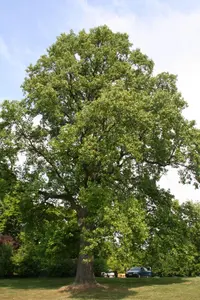
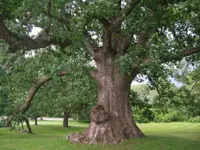
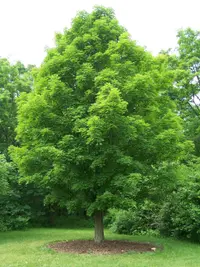
Recognize tulip poplar by its distinct four-lobed leaves with a squared-off, notched tip, arranged alternately along the stems. Mature trees usually form a tall, straight trunk and a high, narrow crown.

The flowers are also diagnostic: tulip-shaped, about 2 to 3 inches (5 to 8 cm) across, with greenish-yellow petals marked orange near the base.

Liriodendron tulipifera Identification

Check Your Plant ID

Take or upload a photo to confirm your plant ID with Botan.

Clear images work best. Avoid photos taken too close or too far away

Check the leaf shape first on Liriodendron tulipifera.

  • Leaves are broad and squared off at the tip, with 4 main lobes and a shallow notch in the center.
  • Each leaf is simple, not divided into leaflets, and usually 5-8 inches (13-20 cm) long.
  • Leaves attach one per node in an alternate pattern along the twig.
  • Flowers are upright, cup-shaped, about 2-3 inches (5-8 cm) across, with greenish-yellow petals and an orange band near the base.
  • Fruits form an upright, cone-like cluster of winged seeds.

The leaf outline is often the fastest single clue.

Liriodendron tulipifera shows clear visual shifts from sapling form to flowering and fruiting maturity.

  • Seedling: Seedlings carry simple alternate leaves, but the first leaves are smaller and less distinctly four-lobed than later growth on older plants.
  • Young plant: Young plants form a straight central stem with widely spaced branches, while leaves become more recognizably squared at the tip and 4-8 inches (10-20 cm) wide.
  • Flowering stage: Once established, the tree bears upright tulip-like flowers high in the canopy, greenish yellow with orange marking, adding a distinctive reproductive feature absent on younger plants.
  • Fruiting stage: After flowering, upright cone-like seed clusters replace the blooms and persist on branch tips, creating a noticeably different silhouette from the flowering stage.

Several named selections of tulip poplar can be recognized by foliage color or growth habit.

  • 'Aureomarginatum': Leaves have a broad yellow margin around the green center, making the four-lobed blade look distinctly outlined.
  • 'Fastigiatum': Growth is narrowly upright to columnar rather than broadly oval, with a much tighter crown than the typical form.
  • 'Ardis': This dwarf form stays much smaller, usually as a dense rounded plant rather than a tall single-trunked tree.
  • 'Little Volunteer': A compact, upright selection with a narrower crown and shorter overall stature than standard seedlings.

In spring, Liriodendron tulipifera leafs out with distinctive four-lobed leaves, and mature trees show upright, tulip-like greenish yellow flowers in late spring to early summer. By fall, the foliage turns clear yellow before dropping. Through winter, bare twigs reveal large duck-bill terminal buds, and the upright cone-like seed clusters often remain visible for a time.

A few broadleaf trees can be mistaken for tulip poplar at a glance.

sassafras(Sassafras albidum)

Both can have oddly lobed leaves. Sassafras leaves are alternate but variable on the same tree, often unlobed, mitten-shaped, or 3-lobed. Liriodendron tulipifera usually has a squared-off leaf tip with 4 main lobes.

American sycamore(Platanus occidentalis)

Its large leaves and tall trunk can cause confusion from a distance. Sycamore leaves are palmate, with 3 to 5 pointed lobes and coarse teeth. Its bark also peels in mottled white patches, unlike the more furrowed bark of tuliptree.

Native to eastern North America, Liriodendron tulipifera occurs from southern New England and the Great Lakes south to Florida and west to the Mississippi Valley. It is most often found in rich, moist deciduous forests, cove forests, and stream valleys, especially on lower slopes and bottomlands. Seeing a very tall tree in mesic woodland, rather than on dry ridges or coastal scrub, helps narrow identification.

Confirm the Species with Botan

Use a photo to identify a plant or verify your ID before spending time on the wrong tree.

FAQ

The clearest feature is the leaf shape: broad, smooth-edged, and squared off at the tip with four main lobes. That unusual outline is central to tulip poplar identification and separates it from most eastern hardwoods.

More Plant Identification Guides

Identify It. Learn More About It.

Use a photo to identify a plant, then get species-specific care information, safety notes, and common problems.

Botan app identifying a plant from a photo
How to Winterize Your Garden in 6 Steps

5 min read · 28 Sept 2026

How to Winterize Your Garden in 6 Steps

Learn how to prepare your garden for winter with a practical six-step checklist covering cleanup, tender plant care, watering, mulching, winter protection, and winterizing equipment and containers.

Plant Care

How to Winterize Your Garden in 6 Steps
20 Most Popular Fruits Around the World

7 min read · 22 Jul 2026

20 Most Popular Fruits Around the World

Curious which fruits the world actually eats the most? Here's the top-20 by production volume, an overview of what people choose in each region, and a few figures that defy common assumptions.

Plant Recommendations
20 Most Popular Fruits Around the World
What Plants Don't Like Epsom Salt?

11 min read · 29 Jul 2026

What Plants Don't Like Epsom Salt?

Learn which plants can be seriously damaged by Epsom salt and which will thrive on it. We’ll explain when and how to use it properly, provide tips for indoor & outdoor plants — read on and enjoy a healthy garden.

Plant Care
What Plants Don't Like Epsom Salt?