



Noble Fir Identification (Abies procera)

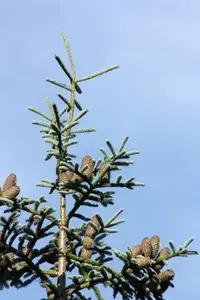
Recognize Noble Fir by its tall, straight trunk, regular whorled branches, and stiff needles that curve upward to expose two pale bands beneath. The needles often crowd into a V-shaped arrangement on upper twigs.

Another strong clue is the large, upright cones borne high in the crown.

Abies procera Identification

Check Your Plant with Botan

Use a clear photo to confirm what plant you have.

Clear images work best. Avoid photos taken too close or too far away

Check the tree’s narrow crown, stout branch pattern, needles, and upright cones.

  • Tall, straight evergreen, often 100-200 feet (30-61 m), with a narrow spire-like crown and layered, upswept branches.
  • Needles are thick, bluish green, 1-1.4 inches (2.5-3.5 cm) long, and crowded along the twig.
  • Needles curve upward, exposing much of the shoot below instead of lying flat in two side rows.
  • Cones stand upright on upper branches, barrel-shaped, 4.5-9 inches (11-23 cm) long, and green to purple before maturing brown.

Upright cones and strongly upturned needles are especially useful visible clues.

Abies procera shows clear age-related differences in form, branching, and cone-bearing structures.

  • Seedling: Seedlings have a single slender stem with short, soft needles and little side branching, giving a narrow, upright outline unlike older plants.
  • Young plant: Young plants form regular whorled branches and a strong central leader; bluish needles crowd the shoots, and the crown becomes narrowly pyramidal.
  • Mature plant: Mature trees develop a tall, spirelike crown, layered horizontal branches, and a thicker trunk; lower branches may droop while upper ones turn upward.
  • Fruiting stage: Cone-bearing trees show upright cylindrical cones near upper branches, about 4.5-9 inches (11-23 cm) long, a key difference from nonfruiting younger plants.

Several cultivated forms of Noble Fir are identifiable by habit and needle color.

  • Abies procera 'Glauca': Shows stronger blue-gray to silvery foliage than the typical species, which is usually greener overall.
  • Abies procera 'Pendula': Has a distinctly weeping habit, with drooping leaders and side branches instead of the species’ upright, broadly conical crown.
  • Abies procera 'Compacta': Forms a much smaller, denser plant with short internodes and a tight pyramidal outline rather than a tall forest tree.
  • Abies procera 'Procumbens': Grows as a low, spreading form, often broader than tall, instead of developing a single tall central trunk.

In spring, fresh shoots appear at branch tips as pale, soft new needles that contrast with the older blue-green foliage. By late summer into fall, upright cones are visible high in the crown, often green to purple before maturing. In winter, Abies procera keeps its needles, so the dense, tiered branching and pointed buds remain visible.

A few western firs are regularly mistaken for Noble Fir.

grand fir(Abies grandis)

Similar tall, spire-shaped tree with flattened needles. Grand fir needles mostly spread in 2 flat ranks, making the twig look combed; Noble Fir needles curve upward and crowd above the shoot. Grand fir cones are usually slimmer.

Pacific silver fir(Abies amabilis)

Also has dense, dark green foliage and upright cones. Pacific silver fir usually shows a strong pale underside with 2 white bands on each needle, and the needles lie flatter. Noble Fir has stiffer, more upward-angled needles and often more glaucous, blue-green new growth.

Abies procera is native to the Cascade Range and Coast Range of Washington and Oregon, with a small extension into northwestern California. It occurs in cool, moist mountain forests, often on upper slopes and ridges, typically around 3,000 to 6,500 feet (900 to 2,000 m). In the wild, finding it in Pacific Northwest high-elevation conifer forest helps separate it from firs native to drier inland ranges or lower coastal sites.

Check Your Plant ID

Use Botan to compare a photo and help verify the plant, which can save time before you label, buy, or plant it.

FAQ

The most reliable trait is the blue-green needles that curve upward and expose the twig below. In Noble Fir identification, the needles often look layered in a V-shape, and the bark develops distinct blocky plates.

More Plant Identification Guides

Identify Your Plant and Learn More

Use Botan to identify a plant from a photo, then see plant details, care information, and common problems.

Botan app identifying a plant from a photo
Best Fertilizer for Vegetable Gardens – What to Use for Each Plant

11 min read · 20 Jul 2026

Best Fertilizer for Vegetable Gardens – What to Use for Each Plant

Here, you’ll find the right fertilizer formula for vegetables in your garden. Learn how to adjust feeding correctly throughout the growing cycle, spot nutrient deficiencies by their symptoms, and keep your plants healthy and prolific.

Plant Recommendations
Best Fertilizer for Vegetable Gardens – What to Use for Each Plant
How to Mist Plants – Proper Technique and Common Mistakes

7 min read · 30 Jul 2026

How to Mist Plants – Proper Technique and Common Mistakes

Find out when misting works well and when to avoid it. Here, you’ll find detailed information about compatible and incompatible species, tips on how often to mist plants and do it correctly, and some great alternatives for raising humidity.

Beginner Guides
How to Mist Plants – Proper Technique and Common Mistakes
How Often to Water Fruit Trees

7 min read · 11 Aug 2026

How Often to Water Fruit Trees

Irrigation needs change as roots establish and weather shifts. This guide gives practical starting intervals, explains how soil and tree type change them, and shows how to recognize both excess moisture and drought stress.

Plant Care
How Often to Water Fruit Trees