




willow Identification (Salix bicolor)

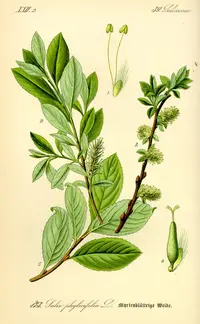
Recognize Salix bicolor by its paired leaves, a useful first clue in a genus where leaves are usually alternate. Look for narrow, lance-shaped leaves and short catkins that sit close to the twigs.

It typically forms a multi-stem shrub rather than a single-trunk tree, which helps narrow identification quickly.

Salix bicolor Identification

Is This willow?

Take a photo and use Botan to confirm your plant identification.

Clear images work best. Avoid photos taken too close or too far away

Use these quick checks for Salix bicolor.

  • A shrub or small tree with many slender twigs and an upright to somewhat spreading outline.
  • Leaves are simple and alternate, narrow to elliptic, usually about 1-3 inches (2.5-7.5 cm) long.
  • Leaf margins are finely toothed, and the blade often looks smoother above than below.
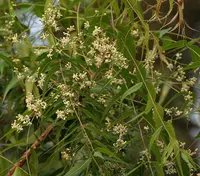
  • Flowers appear in short catkins borne along the twigs, rather than in showy single blooms.

Check several leaves and catkins together, since twiggy habit and leaf shape are most useful by eye.

Salix bicolor shows clear visual shifts in habit, foliage, and reproductive structures with age.

  • Young plant: Young plants are slender and upright, with fewer side branches and relatively longer-looking leaves on thin green to reddish stems.
  • Mature plant: Mature plants form a denser, more branched shrub or small tree, often reaching 6-20 feet (1.8-6 m), with a broader crown and sturdier woody stems.
  • Flowering stage: Before full leaf expansion, Salix bicolor shows short catkins along bare or sparsely leafy twigs, making the branch pattern and flower-bearing shoots easier to recognize.

In spring, Salix bicolor becomes easier to spot when catkins appear on bare or just-opening shoots, often before the foliage fully expands. Fresh leaves then emerge and give the plant a softer, fuller outline. By fall, leaves turn yellow and drop, exposing the finer branching and buds. That bare winter framework can help with recognition when flowers and foliage are absent.

Several shrubby willows can be mistaken for this species at a glance.

purple willow(Salix purpurea)

Often confused because both have narrow leaves and slender twigs. Purple willow usually has opposite or nearly opposite leaves on young shoots, while Salix bicolor has alternate leaves. Its stems also tend to look more uniformly purple.

basket willow(Salix viminalis)

Similar in its long, narrow leaves and upright, twiggy habit. Basket willow has much longer leaves, often 4-8 inches (10-20 cm), with a distinctly silky gray-white underside; S. bicolor is smaller leaved and less strongly two-toned beneath.

Confirm the Species with Botan

Use a photo to identify or verify the plant, which helps avoid mix-ups before you label it or compare similar species.

FAQ

The clearest field mark is its catkins paired with narrow, finely toothed leaves. For willow identification, check the silky, elongated flower spikes that appear before or with the leaves on separate male and female plants.

More Plant Identification Guides

Identify First. Learn What Comes Next.

Use a photo with Botan to identify the plant, then get plant details, care information, and common problems.

Botan app identifying a plant from a photo
12 Best Landscaping Trees for Your Garden

8 min read · 6 Oct 2026

12 Best Landscaping Trees for Your Garden

Choosing the landscape tree depends on what your garden needs most. These 12 options include compact flowering specimens, colorful deciduous trees, shade varieties, and evergreens suitable for screening and year-round structure.

Plant Recommendations
12 Best Landscaping Trees for Your Garden
How Often to Water Fruit Trees

7 min read · 11 Aug 2026

How Often to Water Fruit Trees

Irrigation needs change as roots establish and weather shifts. This guide gives practical starting intervals, explains how soil and tree type change them, and shows how to recognize both excess moisture and drought stress.

Plant Care
How Often to Water Fruit Trees
Best Fertilizer for Grass in Summer: How to Choose the Right One

6 min read · 18 Aug 2026

Best Fertilizer for Grass in Summer: How to Choose the Right One

The right fertilizer in summer can make a lawn thrive. The wrong one can damage it. Here, you’ll learn the best NPK ratios by grass type, when and how to apply your formula, and how to recognize the signs of over- or under-fertilizing.

Plant Care
Best Fertilizer for Grass in Summer: How to Choose the Right One