Early stem training
While young shoots are still flexible, stake and loosely tie main stems in the desired direction to create a stable framework that resists wind and snow loads later.

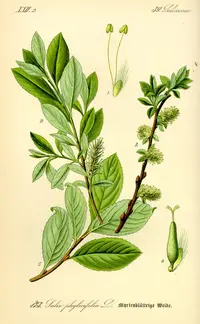
Willow (Salix bicolor) is a hardy deciduous shrub or small tree known for its slender branches and narrow, often silvery-green leaves. It usually forms a loose, upright habit that can look quite light and airy in the landscape.
This species occurs naturally in parts of Europe, often in cool, moist habitats near rivers, streams, and wetlands. It grows fast, responds well to pruning, and roots easily, which can simplify how to care for willow in suitable conditions.
Salix bicolor prefers full sun to light shade, consistently moist soil, and good drainage, which makes it suited to gardens that do not dry out completely.

Care Difficulty
Moderate Care

Light Preference
Full Sun

Water Requirements
Keep Soil Moist

Temperature Preference
Cold Hardy

Hardiness Zone
4–7

Soil Texture
Loamy, Silty, Organic-rich

Soil pH
Acidic (5.5–6.5), Slightly acidic (6.5–7.0)

Soil Drainage
Waterlogged tolerant

Fertilization
Minimal (feed rarely)
Scan your plant to receive care tips personalized for your specific plant
Available on iOS and Android
This shrub performs best in open, bright conditions with consistent sun exposure.
This species prefers constantly moist soil and does not tolerate extended drying.
This willow is cold-hardy yet grows best in cool to mild conditions.
This species prefers moderately moist air but usually adapts to typical outdoor humidity.
This shrub prefers moist, deep, loamy soil with strong structure and consistent water availability.
This species can be grown in containers, but it needs careful moisture and stability management due to its vigorous root system.
Nutrient needs for Salix bicolor are moderate, especially on poor or very fast-draining soils.
Thoughtful pruning keeps Salix bicolor healthy, safe, and appropriately shaped.
Transplanting is more relevant than repotting for Salix bicolor, which is usually grown in the ground.
Salix bicolor is commonly propagated from cuttings rather than from seed for predictable traits.
This willow is generally cold hardy in temperate climates and needs only modest winter care once established.

Plant Health Check
Not sure what's wrong with your plant? Check your plant's health inside the app.
This willow naturally occurs along mountain streams and riverbanks in parts of central and southern Europe, where it is adapted to cold, fast-flowing, well-oxygenated water and periodically shifting gravel or shingle beds.
The species name bicolor refers to its distinctly two-toned catkins and leaves, which often show a contrast between the darker upper surface and a paler, sometimes silky underside, giving shrubs a subtly variegated look in wind or strong light.
In its native range, this willow can hybridize with closely related Salix species, and field botanists often rely on catkin structure, bud shape, and leaf coloration patterns to separate true Salix bicolor from hybrids.
This species grows relatively quickly, often adding 30–60 cm of new growth per year once established, depending on moisture, light, and soil fertility. In optimal conditions, growing willow for screening or structure can be quite efficient.
Keep your plants happy and healthy with plant identification, disease detection, and easy care guidance.