

poison sumac Identification (Toxicodendron vernix)

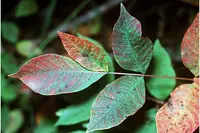
Recognize poison sumac by its compound leaves with 7 to 13 smooth-edged leaflets, usually paired along a central stalk with one terminal leaflet.

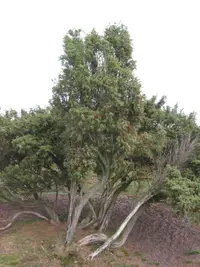
It grows as a tall shrub or small tree, often 6 to 20 feet (1.8 to 6 m) tall, with drooping clusters of pale berries hanging below the leaves.

Toxicodendron vernix Identification

Check Your Plant with Botan

Upload a clear image to check whether your plant ID is correct.

Clear images work best. Avoid photos taken too close or too far away

Use these quick visual checks for Toxicodendron vernix.

  • Leaves are alternate and compound, usually with 7-13 smooth-edged leaflets.
  • Leaflets are oval to oblong, often with a pointed tip; the end leaflet is usually on a longer stalk.
  • Plants grow as a tall shrub or small tree, often 5-20 feet (1.5-6 m) tall.
  • Fruit hangs in loose clusters from the leaf axils; each drupe is pale gray to whitish and about 1/8-1/4 inch (3-6 mm) wide.

Check the leaflet count and the pale hanging fruit together for the most useful field clues.

Poison sumac shows useful visual changes from sapling form through flowering and fruiting stages.

  • Young plant: Young plants are slender and upright, with smooth gray stems and proportionally larger-looking compound leaves on long stalks, before the crown broadens.
  • Mature plant: Mature plants become a tall shrub or small tree, often 6-20 feet (1.8-6 m) tall, with thicker stems and a looser, more openly branched crown.
  • Flowering stage: Flowering branches carry drooping clusters from the leaf axils, with many small greenish flowers that are less visually prominent than the hanging cluster shape.
  • Fruiting stage: Fruiting clusters are more conspicuous, hanging below the leaves and filled with smooth ivory to pale greenish berries, unlike the subtler flower clusters.

In spring, poison sumac leafs out with glossy leaflets that often look bronzy or orange-tinted before turning green. By early summer, hanging clusters of small greenish flowers can be visible. Late summer into fall brings drooping clusters of pale gray to white berries. In fall, the foliage often turns bright yellow, orange, or red before dropping, which makes the smooth gray stems and open branching easier to see.

A few wetland shrubs and small trees are regularly mistaken for poison sumac.

smooth sumac(Rhus glabra)

Both have pinnate leaves with many leaflets. Smooth sumac usually has wingless red fruit clusters and sharply toothed leaflet edges; poison sumac has whitish hanging fruits and mostly smooth margins.

staghorn sumac(Rhus typhina)

Also bears long compound leaves. It differs by fuzzy twigs and upright, dense red fruit cones; poison sumac has smooth twigs and loose, pale fruits.

tree-of-heaven(Ailanthus altissima)

Its large compound leaves can seem similar. Leaflets have glandular lobes near the base and a strong odor when crushed; poison sumac lacks those basal lobes.

Toxicodendron vernix is native to eastern North America, from parts of the northeastern and Great Lakes region south through the eastern United States. Its range overlaps with many harmless shrubs, so geography alone is not enough. Habitat is more useful. This species is strongly tied to acidic wetlands such as swamps, bog margins, wet woods, and peaty thickets. Finding a suspected plant with standing water or saturated soil nearby helps narrow the identification, especially away from dry uplands.

  • Skin contact: All parts contain urushiol, an oily sap that can trigger a strong allergic skin rash in humans and pets after contact with leaves, stems, or roots.
  • Smoke exposure: Burning poison sumac can carry urushiol in smoke. Inhaling it is harmful to humans and pets because it can irritate exposed tissues, including the airways.

Scan. Check. Confirm.

Use Botan to identify or verify a plant from a photo when a closer check can help avoid a mistaken match.

FAQ

The clearest poison sumac identification feature is its compound leaf with 7 to 13 smooth-edged leaflets, usually arranged in pairs with one terminal leaflet. Leaflet stems are often reddish, and the leaves are not toothed.

More Plant Identification Guides

Scan Your Plant. Get the Details.

Use Botan to identify a plant from a photo, then review plant details, care information, and safety notes for that species.

Botan app identifying a plant from a photo
10 Easy Garden Flowers to Grow

8 min read · 10 Sept 2026

10 Easy Garden Flowers to Grow

Discover 10 garden flowers that require minimal care. Learn which characteristics make plants easy to grow and follow tips on how to create a beautiful corner from beginner-friendly blooms on your property.

Beginner Guides

10 Easy Garden Flowers to Grow
Plants That Repel Mosquitoes – 10 Effective Choices

8 min read · 6 Jul 2026

Plants That Repel Mosquitoes – 10 Effective Choices

Plants that repel mosquitoes can help mask human scent naturally and make outdoor spaces more comfortable. Explore the most effective options, their benefits and drawbacks, and choose the right plant for your space.

Plant Recommendations
Plants That Repel Mosquitoes – 10 Effective Choices
How to Winterize Your Garden in 6 Steps

5 min read · 28 Sept 2026

How to Winterize Your Garden in 6 Steps

Learn how to prepare your garden for winter with a practical six-step checklist covering cleanup, tender plant care, watering, mulching, winter protection, and winterizing equipment and containers.

Plant Care
How to Winterize Your Garden in 6 Steps