

buckbrush Identification (Ceanothus cuneatus)

Recognize buckbrush by its small, wedge-shaped leaves, usually under 1 inch (2.5 cm) long, clustered along short spur shoots, and by its dense, stiffly branched shrub form.

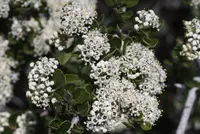
Ceanothus cuneatus also shows opposite to alternate leaf placement and tight clusters of small white to pale blue flowers at branch tips.

Ceanothus cuneatus Identification

Identify Your Plant with Botan

Check your plant ID by uploading a clear photo to Botan.

Clear images work best. Avoid photos taken too close or too far away

Check the shrub’s branching, leaf shape, and flower clusters first.

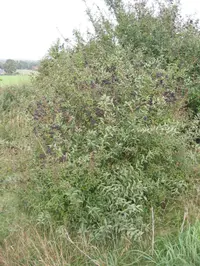
  • Usually a dense, stiff, many-branched shrub, often about 3-10 feet (0.9-3 m) tall.
  • Leaves are small, thick, and wedge-shaped to oval, often about 0.4-1 inch (1-2.5 cm) long.
  • Leaf edges are mostly toothed near the tip, with the base narrower than the outer half.
  • Leaves often show three main veins rising from the base and sit alternately along the stems.
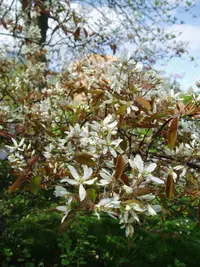
  • Flowers form tight clusters of many tiny white blooms at branch tips.

Spiny branch tips are often visible on older growth.

Buckbrush shows several visible shifts in form, foliage, flowers, and fruit as it develops.

  • Seedling: Seedlings carry a simple upright stem with opposite early leaves; blades are small, thick, and already wedge-shaped, but the twiggy branching is absent.
  • Young plant: Young plants form a low, dense shrub with many short branchlets. Leaves become crowded and firm, often about 1 inch (2.5 cm) long.
  • Flowering stage: At flowering, branch tips hold tight clusters of small white to pale blue blossoms, making the plant look softer and less spiny than vegetative shoots.
  • Fruiting stage: After bloom, the showy clusters are replaced by small three-lobed capsules that dry and darken, standing out against the stiff evergreen foliage.

In spring, buckbrush stands out when its branches are covered with dense clusters of small white to pale blue flowers. The floral display is one of the clearest seasonal field marks. After flowering, small three-lobed capsules become visible and later dry on the plant. The shrub is usually evergreen, so there is no leaf-drop phase that creates a separate winter look.

Several California shrubs can be mistaken for buckbrush at a glance.

wedgeleaf ceanothus(Ceanothus greggii)

Often confused because both are dense, thorny shrubs with small leaves and pale flower clusters. Ceanothus greggii usually has narrower, more elongated leaves; C. cuneatus has broader wedge-shaped leaves with teeth mostly near the tip.

birchleaf mountain-mahogany(Cercocarpus betuloides)

This shrub can match the size and tight branching. The quickest difference is the fruit: Cercocarpus betuloides makes single long, feathery tail-like fruits, while C. cuneatus makes small three-lobed capsules after flowering.

Ceanothus cuneatus is native to California and extends into southwestern Oregon and northern Baja California. That range is useful because it helps separate it from similar shrubs outside the Pacific coast region. It is most often found in dry chaparral, coastal scrub, and open oak woodland, often on rocky slopes and ridges. Seeing it in these habitats helps narrow identification, especially in fire-prone foothill landscapes.

Scan. Check. Confirm.

Use Botan to identify or verify a plant from a photo, which helps avoid mix-ups with similar species.

FAQ

Yes. After flowering, it forms small, dry, horned capsules rather than berries. Those three-lobed fruits support buckbrush identification, especially alongside the thick wedge-shaped leaves and dense shrub form.

More Plant Identification Guides

Know What Plant You Have

Identify a plant from a photo with Botan, then review species details, care information, and common problems.

Botan app identifying a plant from a photo
Frozen vs Fresh Vegetable Nutrients: Which Option Is Healthier?

6 min read · 8 Sept 2026

Frozen vs Fresh Vegetable Nutrients: Which Option Is Healthier?

Frozen and fresh vegetables are nutritionally comparable: frozen produce often retains vitamins just as well as fresh and may sometimes contain more. Here’s how blanching and storage affect nutrients—and when to choose each.

Plant Recommendations
Frozen vs Fresh Vegetable Nutrients: Which Option Is Healthier?
Top 5 Best Indoor Plants for Air Quality

5 min read · 11 Sept 2026

Top 5 Best Indoor Plants for Air Quality

Indoor plants can make a room feel fresher thanks to their air-purifying qualities. Here are 5 of the most suitable choices for your routine and living space.

Plant Recommendations
Top 5 Best Indoor Plants for Air Quality
12 Most Wanted Rare Houseplants to Grow at Home

6 min read · 21 Sept 2026

12 Most Wanted Rare Houseplants to Grow at Home

Rare houseplants can turn an ordinary corner in your apartment into a living botanical collection. This guide covers 12 most admired picks, what makes them special, and how to grow them successfully at home.

Plant Recommendations
12 Most Wanted Rare Houseplants to Grow at Home