

Arborvitae Identification (Thuja occidentalis)

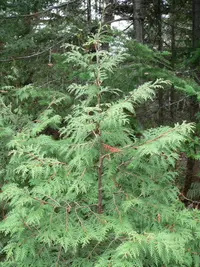
Recognize Thuja occidentalis by its flat, fan-shaped sprays of scale-like leaves set in opposite pairs, forming flattened branchlets.

It usually grows as a narrow, conical evergreen tree. Mature bark is fibrous and peels in thin, lengthwise strips, and the small cones are oblong, about 1/2 inch (1 cm) long.

Thuja occidentalis Identification

Check Your Plant ID

Take or upload a photo to confirm your plant ID with Botan.

Clear images work best. Avoid photos taken too close or too far away

Check Thuja occidentalis for a narrow, dense evergreen form with flattened sprays.

  • Leaves are tiny overlapping scales, not needles, pressed tightly to the twigs.
  • Branchlets form flat, fanlike sprays arranged mostly in one plane.
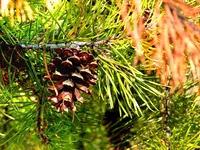
  • Cones are small, upright to slightly drooping, about 1/2 inch (1 cm) long, with 8 to 12 scales.
  • Older trunks often show reddish-brown bark that peels in thin, fibrous strips.

Look at both the flat sprays and the small scaled cones for a quicker visual match.

Thuja occidentalis shows clear age-related shifts in foliage, branching, and cone appearance.

  • Seedling: Seedlings first show short needle-like leaves, not flattened sprays. Stems are slender and upright, with a simpler outline than later stages.
  • Juvenile plant: Juvenile plants keep more awl-shaped, pointed leaves and irregular branching. The plant stays open in form before the dense, fanlike branchlets dominate.
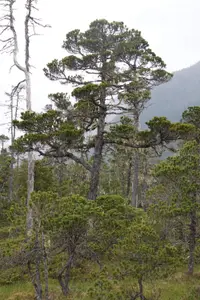
  • Mature plant: Mature Arborvitae carries tightly overlapping scale leaves in flattened vertical sprays. Plants become narrowly conical, sometimes reaching 20-50 feet (6-15 m), with fibrous reddish-brown bark.
  • Fruiting stage: Fruiting branches bear many small upright cones, about 1/2 inch (1 cm) long, changing from green to brown among the flattened sprays.

Arborvitae has several well-established forms that are easy to separate by outline and foliage color.

  • 'Smaragd': A narrow, dense column, usually 10-15 feet tall (3-4.6 m), with bright emerald-green sprays that hold color well in winter.
  • 'Danica': A dwarf globe, often 2-3 feet tall and wide (0.6-0.9 m), with very short, tightly packed green sprays.
  • 'Rheingold': A small rounded shrub with fine juvenile foliage; new growth is golden yellow to orange-bronze, especially in cool seasons.
  • 'Filiformis': Branches are long, thin, and threadlike, giving a loose, weeping texture instead of the usual flat fan-shaped sprays.
  • 'Holmstrup': A compact narrow pyramid, typically 5-10 feet tall (1.5-3 m), with dark green, strongly layered sprays and a tighter outline than the typical form.

Thuja occidentalis stays evergreen, so it does not go bare in winter. In cold weather, the flat sprays often shift from medium green to duller olive or bronze, then return greener in spring. Small upright cones become easiest to notice from late summer into fall, standing above or among the scale-like foliage.

A few conifers are regularly mistaken for arborvitae in landscapes and hedges.

giant arborvitae(Thuja plicata)

Also has flat, scale-like sprays. Usually shows drooping branchlets and larger, longer cones; foliage often looks looser and less densely fan-shaped.

false cypress(Chamaecyparis thyoides)

Can share narrow, evergreen screening form and scaled foliage. Twigs are finer, sprays less flattened, and seed cones are small, round, and pea-like.

Lawson cypress(Chamaecyparis lawsoniana)

Often planted as a similar columnar conifer. Branchlets tend to hang more, foliage sprays are softer-looking, and cones are spherical rather than oblong.

Thuja occidentalis is native to northeastern and north-central North America, from the Canadian Maritimes west through southern Canada to Manitoba, and south into the Great Lakes region and parts of the northeastern United States. In the wild, it is most often found in cool swamps, bog margins, stream edges, and moist limestone woods. Seeing a conifer growing naturally in calcareous wetlands or cedar swamps can help narrow identification.

  • Ingestion risk: Thuja occidentalis contains thujone, especially in the foliage and twigs. Ingestion can be harmful to humans and pets.
  • Skin contact: The foliage and sap can irritate skin in some people after handling or pruning, causing contact irritation rather than poisoning.

Confirm the Species with Botan

Use a photo to identify or verify the plant, which helps avoid mix-ups with similar evergreens.

FAQ

Look for flattened, fan-like sprays of scale leaves, a narrow conical to columnar form, and small upright cones about 1/2 inch (1.3 cm) long. Crushed foliage often has a strong aromatic scent useful in Arborvitae identification.

More Plant Identification Guides

From Plant ID to Plant Info

Identify a plant from a photo with Botan, then get species-specific care information, safety notes, and common problems.

Botan app identifying a plant from a photo
Plants That Repel Mosquitoes – 10 Effective Choices

8 min read · 6 Jul 2026

Plants That Repel Mosquitoes – 10 Effective Choices

Plants that repel mosquitoes can help mask human scent naturally and make outdoor spaces more comfortable. Explore the most effective options, their benefits and drawbacks, and choose the right plant for your space.

Plant Recommendations

Plants That Repel Mosquitoes – 10 Effective Choices
How to Increase Humidity for Plants – 8 Simple Ways That Work

8 min read · 14 Aug 2026

How to Increase Humidity for Plants – 8 Simple Ways That Work

Dry indoor air stresses a lot of houseplants. You usually notice it first in the browning leaf tips. This guide describes 8 simple ways to raise the moisture around your plants, from humidifiers to pebble trays.

Plant Care
How to Increase Humidity for Plants – 8 Simple Ways That Work
Plants That Repel Bugs – 20 Effective Options

12 min read · 16 Jul 2026

Plants That Repel Bugs – 20 Effective Options

Mosquitoes on the patio? Gnats in the kitchen? Some plants keep them away with the scent of their own leaves. Here are 20 that deal with mosquitoes, flies, aphids, and more, plus where to put them so they help.

Plant Recommendations
Plants That Repel Bugs – 20 Effective Options