
prickly ash Identification (Zanthoxylum americanum)

Recognize prickly ash by its paired prickles at each leaf node, compound leaves with 5-11 leaflets, and a shrub or small tree form that often reaches about 10-20 feet (3-6 m) tall.

The leaflets are oval to lance-shaped and arranged along a central stalk, while the stems and branches show stout, sharp prickles.

Zanthoxylum americanum Identification

Check Your Plant with Botan

Upload a clear photo to check your plant identification with Botan.

Clear images work best. Avoid photos taken too close or too far away

Check the twigs, leaves, and fruit for a few plain structural clues.

  • Twigs and young branches usually carry paired, sharp prickles at the nodes and near leaf bases.
  • Leaves are alternate and pinnately compound, often 6-12 inches (15-30 cm) long, with 5-11 leaflets.
  • Leaflets are narrow to oval with fine teeth and a short stalk, except the end leaflet is often longer-stalked.
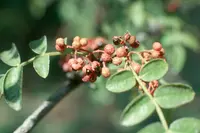
  • Fruit appears in small clusters of round capsules that split open and show a single shiny black seed.

Look closely at the twig prickles and leaflet count first.

Zanthoxylum americanum shows clear stage changes in armature, branching, flowers, and fruit clusters.

  • Young plant: Young plants are upright and sparsely branched, with green twigs and obvious paired prickles at the nodes; leaves look relatively large on thin stems.
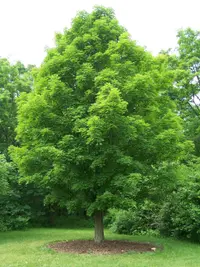
  • Mature plant: Mature plants become a thicket-forming shrub or small tree, often 6-15 feet (1.8-4.6 m) tall, with stouter gray-brown branches and a broader crown.
  • Flowering stage: Flowering appears before full leaf expansion, as small greenish clusters along older wood; the plant looks finer-textured and less leafy than later stages.
  • Fruiting stage: Fruiting stage is distinctive in prickly ash: clustered capsules turn red and split open, exposing single shiny black seeds against the foliage.

In spring, Zanthoxylum americanum leafs out with fresh compound leaves, and small greenish-yellow flower clusters appear before or with the foliage. By late summer into fall, those flowers give way to small reddish fruits that split open and expose shiny black seeds. After leaf drop in fall, the shrub is easier to recognize by its stout paired prickles on twigs and branches and its open, irregular branching.

A few shrubs and small trees can be mistaken for prickly ash at a quick glance.

southern prickly ash(Zanthoxylum clava-herculis)

Confused because both have pinnate leaves and spiny stems. Southern prickly ash is usually a larger tree, often to 25 feet (7.6 m), with thicker corky prickles on twigs and trunk; Zanthoxylum americanum is usually a smaller shrub or small tree with finer paired prickles.

common hoptree(Ptelea trifoliata)

Confused because both can be thorny-looking native shrubs with citrus-scented foliage. Common hoptree has leaves in 3 leaflets and flat round wafer-like fruits; Zanthoxylum americanum has more numerous leaflets and clustered capsules, not wafers.

Zanthoxylum americanum is native to eastern and central North America, from southern Canada into the central and eastern United States. It is most often found in open woods, woodland edges, thickets, limestone slopes, and streambanks. Seeing it in a deciduous woodland or edge habitat within that range helps narrow identification, especially away from coastal plain or deep swamp settings.

Zanthoxylum americanum has sharp spines on its stems and branches. The main safety concern is physical injury from skin contact while handling or brushing past the plant, for both humans and pets.

Confirm the Species with Botan

Upload a photo to compare key details and get help identifying the plant or confirming the name before you label it.

FAQ

The quickest field mark is the paired prickles at the leaf nodes and along twigs. Combined with alternate, pinnately compound leaves, this gives a fast start for prickly ash identification.

More Plant Identification Guides

Identify the Plant and Get Its Profile

Upload a photo to identify it, then see species-specific plant details, care information, and common problems.

Botan app identifying a plant from a photo
How Long Can Flowers Go Without Water? Everything You Need to Know

6 min read · 10 Jul 2026

How Long Can Flowers Go Without Water? Everything You Need to Know

Flowers can survive without water anywhere from 1-2 hours to several months, depending on the plant type, species, and growing conditions. Some strong-looking flowers are drought-sensitive, while delicate-looking plants may tolerate long dry periods surprisingly well.

Plant Care
How Long Can Flowers Go Without Water? Everything You Need to Know
Top 5 Best Indoor Plants for Air Quality

5 min read · 11 Sept 2026

Top 5 Best Indoor Plants for Air Quality

Indoor plants can make a room feel fresher thanks to their air-purifying qualities. Here are 5 of the most suitable choices for your routine and living space.

Plant Recommendations
Top 5 Best Indoor Plants for Air Quality
How Often to Water Fruit Trees

7 min read · 11 Aug 2026

How Often to Water Fruit Trees

Irrigation needs change as roots establish and weather shifts. This guide gives practical starting intervals, explains how soil and tree type change them, and shows how to recognize both excess moisture and drought stress.

Plant Care
How Often to Water Fruit Trees