

Monterey Pine Identification (Pinus radiata)

To recognize Monterey Pine, check for needles grouped in threes, each about 3 to 6 inches (8 to 15 cm) long, and persistent woody cones held close to the branches.

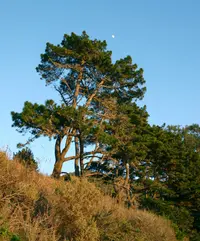
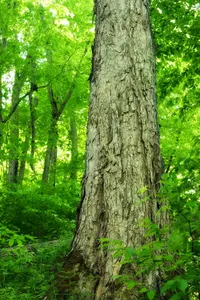
It typically forms a broad, irregular crown with stout twigs and a thick trunk covered in dark, deeply furrowed bark.

Pinus radiata Identification

Check Your Plant with Botan

Upload a clear photo to check your plant identification with Botan.

Clear images work best. Avoid photos taken too close or too far away

Check the needles, crown, bark, and cones of Pinus radiata.

  • Needles grow in bundles of three, sometimes two, and are about 3-6 inches (8-15 cm) long.
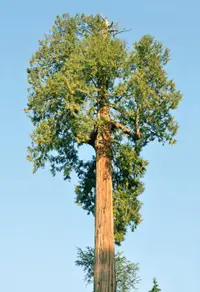
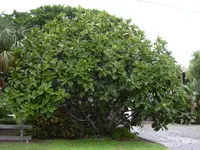
  • The crown is often broad and irregular, with widely spreading, somewhat upswept branches.
  • Bark is dark gray-brown, rough, and broken into deep furrows and thick plates on older trunks.
  • Cones are egg-shaped, about 3-6 inches (8-15 cm) long, and often stay attached in clusters along branches.

A combination of 3-needle bundles and clustered, persistent cones is especially useful to confirm it.

Pinus radiata shows clear age-related changes in needles, branching, bark, and cones.

  • Seedling: Early seedlings carry short juvenile needles singly on the stem, giving a softer, finer look before dense needle bundles become dominant.
  • Juvenile plant: Juvenile plants show longer, looser foliage and more irregular branching, with juvenile needles gradually replaced by adult needles in bundles of three.
  • Mature plant: Mature trees develop a broad, irregular crown and thick, dark, deeply furrowed bark; lower trunks become more exposed as the canopy lifts.
  • Fruiting stage: Cone-bearing Monterey Pine shows asymmetrical, often persistent cones, usually 3-6 inches (8-15 cm) long, clustered on branches and sometimes remaining closed for years.

Pinus radiata stays green year-round, so seasonal color change is limited. The clearest clue is its cones, which become especially noticeable from late summer into fall and often remain closed on the branches for years. In spring, pollen cones may appear in clusters near shoot tips, adding a brief yellow cast. Winter does not expose bare branches because the needles persist.

Several two-needle pines can be mistaken for Monterey Pine at a glance.

bishop pine(Pinus muricata)

Often confused by dense crowns and paired needles. Bishop pine has pricklier, strongly asymmetrical cones that stay attached longer; bark is usually darker and rougher earlier.

Aleppo pine(Pinus halepensis)

Similar loose crown and slender needles can mislead. Aleppo pine usually has finer, paler needles and narrower cones; radiata typically shows stouter cones and heavier branching.

maritime pine(Pinus pinaster)

Another coastal-looking two-needle pine. Maritime pine has much longer, stiffer needles, often 8 to 12 inches (20 to 30 cm), and larger, more elongated cones.

Pinus radiata is native to a very limited stretch of the California coast, mainly Monterey and San Luis Obispo counties, with additional native island populations on Guadalupe and Cedros off Baja California, Mexico. In the wild it is most associated with coastal bluffs, slopes, and low hills in maritime-influenced woodland. That narrow coastal distribution is a useful clue, especially for separating it from other pines found farther inland or across broader western North American habitats.

  • Needle and cone injury: Sharp needle tips and woody cones can scratch skin or injure eyes on contact in humans and pets. This is a contact hazard rather than a poisoning risk.
  • Sap irritation: Resin from bark and broken stems can irritate skin in some people and can stick to fur or paws after contact. The concern is skin contact, not normal handling at a distance.

Confirm the Species with Botan

Upload a photo to compare key details and get help identifying the plant or checking whether your current name is correct.

FAQ

The clearest feature is its needles in bundles of three, usually 3 to 6 inches long (8 to 15 cm), paired with asymmetrical cones that often stay attached and curve slightly downward.

More Plant Identification Guides

Identify the Plant and Get Its Profile

Upload a photo to identify it, then see plant details, care information, and common problems matched to the species.

Botan app identifying a plant from a photo
Best Bedroom Plants – Top 10 to Grow in Your Space

8 min read · 8 Jul 2026

Best Bedroom Plants – Top 10 to Grow in Your Space

Discover the top 10 houseplants that are suitable for growing in your bedroom. Compare their light and water needs, pet safety, and benefits. Find out where best to place greenery in your relaxation space and what species to avoid.

Plant Recommendations
Best Bedroom Plants – Top 10 to Grow in Your Space
What Plants Don't Like Epsom Salt?

11 min read · 29 Jul 2026

What Plants Don't Like Epsom Salt?

Learn which plants can be seriously damaged by Epsom salt and which will thrive on it. We’ll explain when and how to use it properly, provide tips for indoor & outdoor plants — read on and enjoy a healthy garden.

Plant Care
What Plants Don't Like Epsom Salt?
Is Sugar Water Good for Plants?

4 min read · 14 Sept 2026

Is Sugar Water Good for Plants?

Sugar water may sound like an easy boost, but most rooted plants do not need extra sucrose. This guide explains how green tissues produce carbohydrates, when a sweetened solution can be useful, and why too much can cause problems.

Plant Care
Is Sugar Water Good for Plants?