
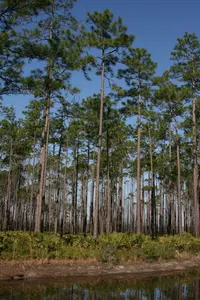

Pacific Yew Identification (Taxus brevifolia)

Recognize Pacific Yew by its flat, narrow needles about 1 inch (2.5 cm) long, arranged in two ranks along the twig, and by its reddish-brown to purplish bark that peels in thin scales.

It usually forms a small tree or large shrub with a slender trunk and short, horizontal branchlets.

Taxus brevifolia Identification

Check Your Plant ID

Use a clear photo to confirm what plant you have.

Clear images work best. Avoid photos taken too close or too far away

  • 1 free identification
  • No sign-up
  • 30,000+ plants in database

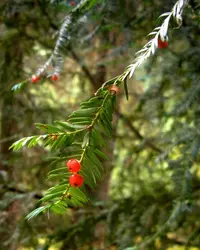
Check the tree’s needles, bark, and red seed cups first.

  • Evergreen needles are flat, narrow, and about 0.5 to 1 inch long (1.3 to 2.5 cm), usually spreading in two ranks along the twig.
  • Needles are dark green above, with a pointed tip and a paler underside.
  • Bark is thin, reddish to purplish brown, and often flakes into small irregular scales.
  • Instead of woody cones, it bears single seeds partly enclosed by a fleshy, cup-like red aril.

The combination of flat ranked needles and red arils is especially useful to confirm Taxus brevifolia.

Pacific yew shows useful visual differences between early growth, maturity, and fruiting stages.

  • Seedling: Seedlings have a single slender stem with soft, flat needles spaced more loosely, not yet forming the layered sprays seen on older branches.
  • Juvenile plant: Juvenile plants are shrubby and irregular, with many thin green twigs and narrower crowns; leaves often appear more two-ranked along side shoots.
  • Mature plant: Mature plants become small trees or large shrubs, often 15-50 feet (4.5-15 m) tall, with reddish brown bark peeling into thin scales and broad, uneven branching.
  • Fruiting stage: Fruiting female plants show single seeds partly enclosed by red cup-like arils at the leaf axils, a conspicuous feature absent on male plants.

Pacific yew stays evergreen year-round, so there is no useful leaf-drop phase for identification. The most noticeable seasonal clue is fruiting: female plants develop fleshy, cup-like red arils around the seed in late summer to fall, standing out against the flat, dark green needles. In spring, small pollen cones on male plants may be visible, but they are subtle. Fruiting branches are usually the clearest seasonal feature to watch for.

A few conifers are regularly mistaken for Pacific yew.

English yew(Taxus baccata)

Similar flat, dark needles and red arils can confuse it with Pacific yew. English yew is usually a denser shrub or tree and often has leaves in more obvious two ranks; Pacific yew is typically looser, with thinner, scaly purple-brown bark.

Western hemlock(Tsuga heterophylla)

Both can have short, flat needles on shaded branches. Western hemlock bears many small hanging cones and has needles of uneven lengths on tiny stalks; yew lacks cones and its needles attach more evenly.

Taxus brevifolia is native to western North America, from southern Alaska through British Columbia, Washington, Oregon, and parts of California, Idaho, and Montana. This range is useful because it is a regional forest tree rather than a widespread eastern or interior species. It usually grows in moist conifer forests, especially as an understory tree in shaded ravines, stream corridors, and coastal to montane woods. Finding a yew in cool, humid forest settings within this Pacific Northwest range helps narrow identification.

  • Poisonous parts: Taxus brevifolia is toxic to humans and pets if eaten. The needles, bark, twigs, wood, and seeds contain toxic compounds.
  • Berry-like aril: The red fleshy aril around the seed is the exception, but the seed inside is poisonous if ingested by humans or pets.
  • Livestock risk: Browsing animals are also at risk. Horses and other livestock can be poisoned by leaves and clippings if eaten.

Confirm It from a Photo

Use Botan to identify the plant or verify your guess from a photo before you spend time comparing details.

FAQ

The quickest clue is its flat, soft-looking needles in two ranks and, on female plants, a single seed partly enclosed by a bright red, cup-like aril. That combination is central to Pacific Yew identification.

More Plant Identification Guides

Identify Your Plant and Learn More

Upload a photo to identify it with Botan, then view plant details, care information, and common problems.

Botan app identifying a plant from a photo
12 Best Cold-Hardy Vegetables for Cold Weather

7 min read · 13 Oct 2026

12 Best Cold-Hardy Vegetables for Cold Weather

Cold-hardy vegetables can keep a garden productive through chilly fall, winter, and early spring weather. This guide covers 12 reliable crops, their frost tolerance, and practical growing tips for better cold-season harvests.

Plant Recommendations
12 Best Cold-Hardy Vegetables for Cold Weather
20 Funny Plant Names That Make You Laugh

8 min read · 16 Oct 2026

20 Funny Plant Names That Make You Laugh

Some plants carry names that sound like jokes. This guide explains the origins of 20 funny plant names. You will also see which of these plants you can grow at home.

Plant Recommendations
20 Funny Plant Names That Make You Laugh
How to Winterize Your Garden in 6 Steps

5 min read · 28 Sept 2026

How to Winterize Your Garden in 6 Steps

Learn how to prepare your garden for winter with a practical six-step checklist covering cleanup, tender plant care, watering, mulching, winter protection, and winterizing equipment and containers.

Plant Care
How to Winterize Your Garden in 6 Steps