

Slash Pine Identification (Pinus elliottii)

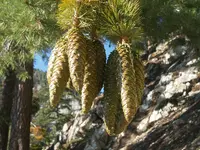
Recognize Slash Pine by its long needles in bundles of two or three, usually 8 to 12 inches (20 to 30 cm) long, and its woody cones, often 3 to 6 inches (8 to 15 cm) long.

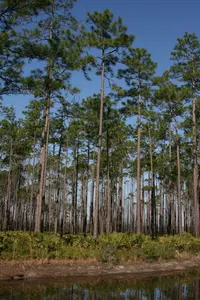
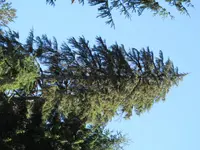
It typically forms a straight trunk with an open, narrowly conical crown.

Pinus elliottii Identification

Identify Your Plant with Botan

Take or upload a photo to confirm your plant ID with Botan.

Clear images work best. Avoid photos taken too close or too far away

Check a few big, easy-to-see traits on Pinus elliottii.

  • Needles are in bundles of 2 or 3, usually 8 to 12 inches (20 to 30 cm) long, and noticeably drooping.
  • The crown is open and irregular, with long, bare-looking branch sections and tufts of needles toward the ends.
  • The trunk is usually straight and tall, often with a narrow, self-pruning lower stem.
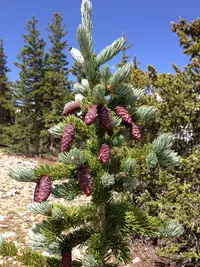
  • Cones are slender and egg-shaped to cylindrical, about 3 to 6 inches (8 to 15 cm) long, and hang downward.

A combination of long drooping needles and hanging cones is especially useful to confirm it.

Pinus elliottii shows clear stage-by-stage changes in needles, crown shape, bark, and cones.

  • Seedling: Early plants carry a few short juvenile needles around a thin stem, giving a sparse, tufted look unlike the long bundled needles later.
  • Young plant: Saplings show long needles in bundles of two or three, with a narrow, upright crown and regular whorled branches along a straight trunk.
  • Mature plant: Older trees develop thick reddish-brown bark in broad plates and a taller trunk, while the crown opens and becomes more irregularly rounded.
  • Fruiting stage: Seed cones become obvious, glossy brown, narrowly ovoid, and about 3 to 6 inches (8 to 15 cm) long, hanging from branch tips.

In spring, new candles elongate at branch tips, followed by fresh needle bundles. This pale, soft new growth stands out against older, darker needles. By late fall into winter, mature cones are often easiest to spot on Pinus elliottii. The tree stays green, so there is no leaf-drop phase that reveals bare branching.

Several southeastern pines can be mistaken for Pinus elliottii.

longleaf pine(Pinus palustris)

Confusion is common because both have long needles in bundles of 2 or 3. Longleaf pine has very large cones, often 6 to 10 inches (15 to 25 cm), and prominent silvery buds; slash pine cones are usually smaller.

loblolly pine(Pinus taeda)

Both are tall southern pines with 3-needle bundles on many shoots. Loblolly usually has shorter, stiffer needles, often 5 to 9 inches (13 to 23 cm), and prickly cones; slash pine needles are typically longer and more drooping.

Pinus elliottii is native to the southeastern United States, mainly the Atlantic and Gulf Coastal Plain from South Carolina to Florida and west to Louisiana. It naturally grows in flatwoods, wet pine savannas, and other low, poorly drained coastal sites. Finding it in these coastal plain habitats helps separate it from similar southern pines that are more typical of drier uplands.

Check Your Plant ID

Use Botan to identify or confirm the plant from a photo when you want a quicker, more confident answer.

FAQ

Yes. This species has woody cones, not pods. Mature cones are usually 3 to 6 inches (8 to 15 cm) long, glossy brown, and often remain attached; each scale bears a small prickle useful in Slash Pine identification.

More Plant Identification Guides

Know What Plant You Have

Identify it from a photo with Botan, then get plant details, care information, and common problems for that species.

Botan app identifying a plant from a photo
8 Glow-in-the-Dark Plants and Fungi That Really Exist

8 min read · 6 Nov 2026

8 Glow-in-the-Dark Plants and Fungi That Really Exist

Plants that glow in the dusk really exist. Some of them produce their own light, while others need UV exposure or special treatments. Explore eight fascinating examples, including glowing petunias, bioluminescent mushrooms, fluorescent flowers, and experimental succulents.

Plant Recommendations

8 Glow-in-the-Dark Plants and Fungi That Really Exist
How Fast Does Bamboo Grow Per Day, Month, and Year

10 min read · 7 Jul 2026

How Fast Does Bamboo Grow Per Day, Month, and Year

Bamboo grows extremely fast: some species can reach 5-6 m in just 3-4 months under the right conditions. This guide explains how much bamboo can grow per day, week, and year, and what affects its growth rate.

Plant Recommendations
How Fast Does Bamboo Grow Per Day, Month, and Year
How to Water Houseplants: Watering Guide

7 min read · 24 Aug 2026

How to Water Houseplants: Watering Guide

Learn how often to water indoor plants, key factors for proper watering, and how to adjust the care routine by plant type, season, pot size, light, and indoor conditions.

Plant Care
How to Water Houseplants: Watering Guide