

Aleppo Pine Identification (Pinus halepensis)

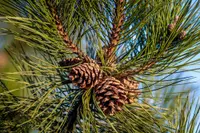
Recognize Aleppo Pine by its pairs of thin needles, each 2.5 to 4 inches (6 to 10 cm) long, and by its small, narrow cones on short stalks.

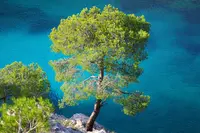
It usually forms an open, irregular crown with a often leaning trunk and orange-gray, fissured bark on older stems.

Pinus halepensis Identification

Is This Aleppo Pine?

Take a photo and use Botan to confirm your plant identification.

Clear images work best. Avoid photos taken too close or too far away

Check a few visible features of Aleppo Pine before confirming the ID.

  • Needles are thin, flexible, and borne in pairs, usually 2–4 inches (5–10 cm) long.
  • The crown often looks open and irregular, with long, somewhat drooping branchlets.
  • Bark is gray to reddish brown and becomes plated and fissured on older trunks.
  • Cones are narrow-ovoid, about 2–5 inches (5–12 cm) long, and often hang on short stalks.

Use several traits together, especially paired needles and hanging cones.

Pinus halepensis shows clear age-related changes in crown form, bark, and cone display.

  • Seedling: First growth is a slender stem with soft, short juvenile leaves borne singly, not yet in the paired needle bundles typical later.
  • Young plant: As it establishes, needles appear in pairs and lengthen to about 2-4 inches (5-10 cm), while branching becomes open and irregular rather than upright.
  • Mature plant: Older trees develop a broad, airy crown with twisting limbs and a leaning trunk; bark shifts from smoother gray to plated, fissured orange-gray.
  • Fruiting stage: Conspicuous cones hang on short stalks, often persistent in the canopy, changing the outline by adding many narrow, pointed ovoid structures.

In spring, Aleppo Pine shows clusters of small yellow male cones near shoot tips. At the same time, reddish female cones may be visible higher on the branchlets. Older woody cones often stay attached for years, so the crown can show both fresh spring cones and mature brown cones at once. This layered cone display is a useful seasonal clue.

Several Mediterranean pines are often mistaken for Aleppo Pine.

Turkish pine(Pinus brutia)

Often confused because both have fine, light green needles in pairs and an open crown. Pinus brutia usually has stiffer, denser needles and larger cones, often about 2-4 inches (5-10 cm) long.

Italian stone pine(Pinus pinea)

Young trees can look similar from a distance. It separates by its thicker needles and, with age, a broad umbrella-like crown rather than the looser, irregular branching of Pinus halepensis.

Canary Island pine(Pinus canariensis)

Another warm-climate pine with a somewhat airy habit. The quickest check is needle number: Pinus canariensis usually has three needles per bundle, not two.

Pinus halepensis is native to the Mediterranean Basin, including southern Europe, North Africa, and parts of the Near East. In identification, that range matters because self-sown or naturalized pines in Mediterranean-climate landscapes often point toward this species. It typically occurs in open pine woodland, scrub, and rocky coastal or inland slopes, often on dry limestone hills from near sea level to about 3,300 feet (1,000 m). Finding it on exposed, dry slopes in low-elevation Mediterranean settings helps narrow identification.

Confirm the Species with Botan

Upload a photo to compare key details and get help identifying the plant or confirming your current ID.

FAQ

The best field mark is its needles in pairs, usually 2.5 to 4 inches (6 to 10 cm) long, thin and flexible, combined with slender, often curved cones that persist on branches.

More Plant Identification Guides

Identify First. Learn What Comes Next.

Use Botan to identify a plant from a photo, then get species-specific care information, plant details, and common problems.

Botan app identifying a plant from a photo
How Long Can Flowers Go Without Water? Everything You Need to Know

6 min read · 10 Jul 2026

How Long Can Flowers Go Without Water? Everything You Need to Know

Flowers can survive without water anywhere from 1-2 hours to several months, depending on the plant type, species, and growing conditions. Some strong-looking flowers are drought-sensitive, while delicate-looking plants may tolerate long dry periods surprisingly well.

Plant Care
How Long Can Flowers Go Without Water? Everything You Need to Know
Best Time to Mow Lawn – A Complete Guide

5 min read · 10 Aug 2026

Best Time to Mow Lawn – A Complete Guide

Explore when to mow your lawn for its health and a pleasant green color. Find out the best time for this task during the summer heat, and follow practical tips for correctly cutting the grass, and learn common mistakes to avoid.

Plant Care
Best Time to Mow Lawn – A Complete Guide
How To Revive a Dying Plant: 6 Steps To Bring A Plant Back To Life

6 min read · 1 Sept 2026

How To Revive a Dying Plant: 6 Steps To Bring A Plant Back To Life

Drooping leaves and brown tips don't always mean the end, and a weakened plant can often recover with a little help. These six simple steps will help you revive a dying plant and restore its health.

Plant Care
How To Revive a Dying Plant: 6 Steps To Bring A Plant Back To Life