
red maple Identification (Acer rubrum)

Recognize red maple by its opposite, simple leaves with 3 to 5 pointed lobes and shallow V-shaped sinuses. Leaves are usually 2 to 6 inches (5 to 15 cm) wide.

Twigs are slender and red to reddish brown, and the bark on mature trunks breaks into long, narrow ridges.

Acer rubrum Identification

Identify a Plant by Photo

Use a clear photo to confirm what plant you have.

Clear images work best. Avoid photos taken too close or too far away

Check leaf shape, twig arrangement, and the paired winged seeds of Acer rubrum.

  • Leaves are simple and opposite, usually with 3 main lobes and 2 smaller basal lobes.
  • Leaf blades are about 2 to 6 inches (5 to 15 cm) long, with pointed lobes and toothed edges.
  • Twigs and buds sit in opposite pairs along the stem, a useful branch pattern to spot.
  • Fruits are paired samaras, each with a wing, hanging in joined sets from slender stalks.

Use several of these traits together for a more confident ID.

Acer rubrum shows clear visual shifts from sapling form to flowers and fruit.

  • Young plant: Young plants are slender and upright, with smooth gray bark and opposite leaves that are often shallower-lobed than on older trees.
  • Mature plant: Mature trees develop a broader rounded to oval crown, a single stout trunk, and bark that darkens and breaks into narrow ridges.
  • Flowering stage: Before full leaf expansion, small red flowers appear in dense clusters along twigs; each flower is only about 1/8 inch (3 mm) across.
  • Fruiting stage: Fruiting branches carry paired winged samaras, usually red to tan, hanging in clusters and showing the species' distinctive two-winged maple fruit.

Several red maple selections are distinct enough to recognize at a glance.

  • 'October Glory': A large tree with a broad oval crown and especially strong scarlet to red fall color that often holds late into the season.
  • 'Red Sunset': Typically shows a more upright oval crown than the species and turns vivid orange-red to red in fall.
  • 'Columnare': Noticeably narrow and column-shaped, staying much slimmer than the typical rounded crown.
  • 'Scanlon': A fastigiate form with steeply ascending branches, giving a tight upright outline compared with the usual spreading habit.

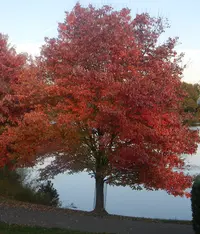
In early spring, Acer rubrum often shows small red flowers before or as the leaves open, making the crown look lightly red from a distance. Paired winged fruits then develop and are often noticeable by late spring to early summer. Fall is the strongest visual shift. Leaves commonly turn bright red, orange, or yellow before dropping, and winter reveals opposite branching with red buds on bare twigs.

Several maples and one common hybrid are regularly mistaken for Acer rubrum.

Silver maple(Acer saccharinum)

Both have opposite, lobed leaves. Silver maple has much deeper sinuses and very silvery leaf undersides; its lobes look narrow and cut more sharply.

Freeman maple(Acer × freemanii)

This red maple hybrid often overlaps in shape and fall color. Leaves usually show deeper sinuses, combining red maple proportions with some silver maple sharpness.

Black maple(Acer nigrum)

Confusion happens when leaves are only shallowly lobed. Black maple usually has three main lobes, drooping leaf sides, and paler undersides rather than a cleaner five-lobed outline.

Acer rubrum is native to eastern North America, from southeastern Canada through the eastern and southeastern United States. That range helps separate it from some maples centered farther west or with narrower regional ranges. In the wild it is especially common in wet woods, swamps, stream edges, and floodplains, though it also appears on upland forest sites. Finding a maple in moist low ground is a useful clue toward Acer rubrum.

Scan. Check. Confirm.

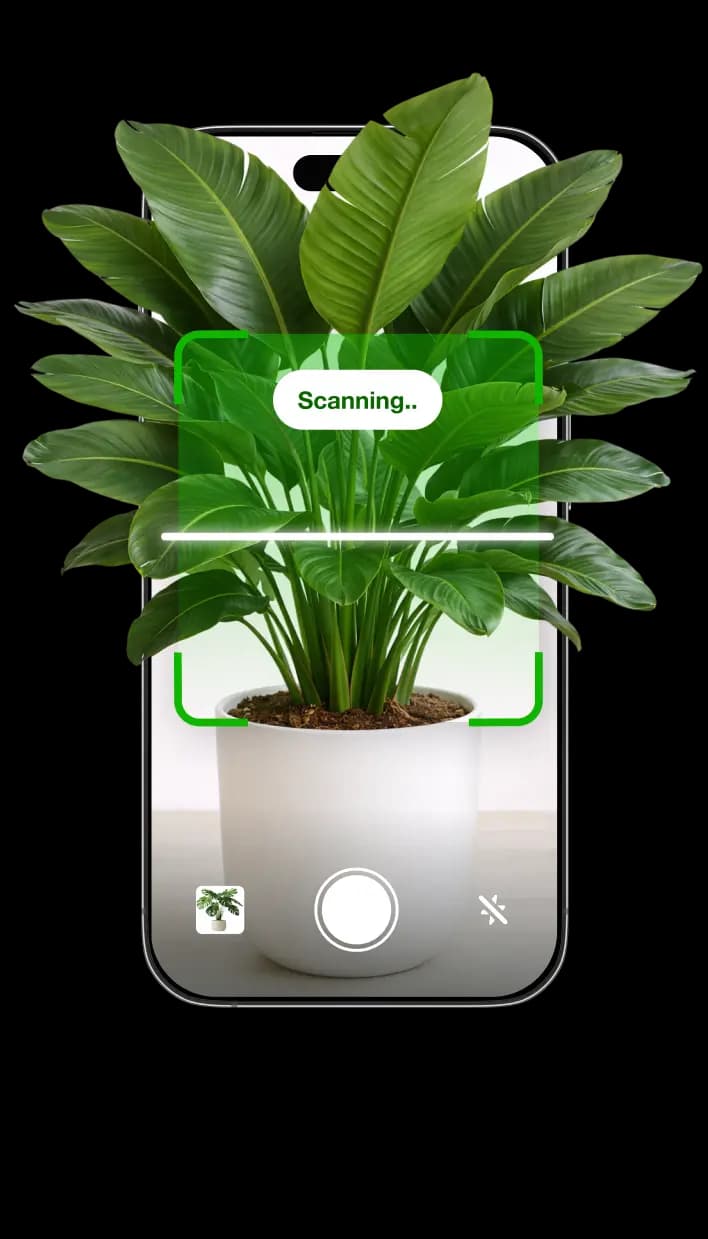
Use Botan to identify or verify a plant from a photo when you want a quicker, more confident answer.

FAQ

The clearest clue is the leaf. It usually has 3 main lobes, sometimes 5, with toothed margins and pale undersides. Opposite leaf arrangement and red leafstalks also help with red maple identification.

More Plant Identification Guides

Scan Your Plant. Get the Details.

Identify a plant from a photo with Botan, then see plant details, care information, and common problems.

Botan app identifying a plant from a photo
Best Time to Water Grass in Summer – Lawn Watering Tips

5 min read · 21 Jul 2026

Best Time to Water Grass in Summer – Lawn Watering Tips

Summer watering is easy to get wrong. This guide explains when to turn on your sprinkler, how much liquid your grass needs each week, and how to tell if you're overwatering or underwatering.

Plant Care
Best Time to Water Grass in Summer – Lawn Watering Tips
12 Most Wanted Rare Houseplants to Grow at Home

6 min read · 21 Sept 2026

12 Most Wanted Rare Houseplants to Grow at Home

Rare houseplants can turn an ordinary corner in your apartment into a living botanical collection. This guide covers 12 most admired picks, what makes them special, and how to grow them successfully at home.

Plant Recommendations
12 Most Wanted Rare Houseplants to Grow at Home
How to Increase Humidity for Plants – 8 Simple Ways That Work

8 min read · 14 Aug 2026

How to Increase Humidity for Plants – 8 Simple Ways That Work

Dry indoor air stresses a lot of houseplants. You usually notice it first in the browning leaf tips. This guide describes 8 simple ways to raise the moisture around your plants, from humidifiers to pebble trays.

Plant Care
How to Increase Humidity for Plants – 8 Simple Ways That Work