

Wild licorice Identification (Glycyrrhiza lepidota)

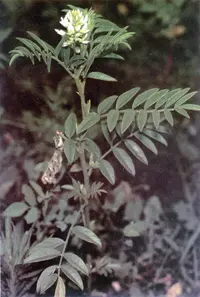
To recognize Wild licorice, look for upright stems with odd-pinnate leaves made of many narrow leaflets, usually 9 to 17, arranged in opposite pairs with one terminal leaflet.

It also shows dense, spike-like clusters of small pale flowers from the leaf axils and later forms short, curved pods covered in hooked bristles.

Glycyrrhiza lepidota Identification

Check Your Plant ID

Check your plant ID by uploading a clear photo to Botan.

Clear images work best. Avoid photos taken too close or too far away

Check the plant’s compound leaves, upright stems, flowers, and pods.

  • Forms clumps of upright stems, often about 2-4 feet (0.6-1.2 m) tall.
  • Leaves are alternate and pinnate, with many oval leaflets, often 9-17 per leaf.
  • Flower clusters are dense and spike-like, packed with small pea-shaped flowers.
  • Seed pods are short, curved, and thickly covered with hooked prickles that cling to fur or clothing.

The bur-like pods are one of the quickest visual clues for Glycyrrhiza lepidota.

Wild licorice shows clear visual shifts from early leafy shoots to distinctive flowers and pods.

  • Young plant: Young plants appear as upright shoots with alternate pinnate leaves; stems are simple or lightly branched, and the clump stays relatively narrow.
  • Mature plant: Mature plants form broader, colony-like patches from spreading rhizomes, with several branched stems and fuller compound leaves on a bushier framework.
  • Flowering stage: Flowering stems carry dense, spike-like clusters of small pale flowers above the leaves, adding a more top-heavy outline than nonflowering shoots.
  • Fruiting stage: After bloom, Glycyrrhiza lepidota develops tightly curved, prickly pods about 1/4 to 1/2 inch (6-13 mm) long, replacing the softer flower clusters.

In spring, Wild licorice emerges from the ground as fresh green shoots and quickly develops compound leaves, making patches much easier to spot after winter dormancy. Late spring into summer is the most useful season for identification, when dense spikes of pale flowers become visible, followed by small burr-like seed pods that often remain noticeable after flowering.

A few legume relatives can be mistaken for Wild licorice at a glance.

American vetch(Vicia americana)

Both have pinnate leaves and purple pea-like flowers. American vetch usually has a branched tendril at the leaf tip, not a terminal leaflet, and its pods are smoother and lack the dense prickly burs seen on licorice fruit.

Canada milkvetch(Astragalus canadensis)

This prairie legume also forms upright clumps with many leaflets and pale flower spikes. It differs by having longer, narrower flower clusters and inflated smooth pods, rather than short spikes followed by burr-like pods.

Glycyrrhiza lepidota is native to much of North America, especially the Great Plains, western and central United States, and parts of southern Canada. Its range helps separate it from similar pea-family plants when it appears far from these regions. It is most often found in prairies, open meadows, streambanks, roadsides, and other moist to seasonally wet disturbed ground. Seeing it in open grassland or near water is a useful clue, especially in inland plains habitats.

Does Your Plant Match?

Upload a photo to Botan to identify it or confirm the match before spending time on the wrong plant.

FAQ

Look for an upright perennial with pinnate leaves, short dense spikes of small pale flowers, and very distinctive seed pods covered in hooked prickles. Those burr-like pods are the easiest clue when identifying Wild licorice.

More Plant Identification Guides

From Plant ID to Plant Info

Use a photo with Botan to identify the plant, then get plant details, care information, and common problems.

Botan app identifying a plant from a photo
Rice Water for Plants – Which Plants Love It and How to Make It

8 min read · 14 Jul 2026

Rice Water for Plants – Which Plants Love It and How to Make It

Rice water can be an ideal DIY solution for orchids, roses, or fruiting plants. It supports growth, leaf count, and height. We’ll share how to make and apply it correctly for your plant.

Plant Care
Rice Water for Plants – Which Plants Love It and How to Make It
Best Fertilizer for Grass in Summer: How to Choose the Right One

6 min read · 18 Aug 2026

Best Fertilizer for Grass in Summer: How to Choose the Right One

The right fertilizer in summer can make a lawn thrive. The wrong one can damage it. Here, you’ll learn the best NPK ratios by grass type, when and how to apply your formula, and how to recognize the signs of over- or under-fertilizing.

Plant Care
Best Fertilizer for Grass in Summer: How to Choose the Right One
How to Plant Pumpkin Seeds for a Fall Harvest and Grow Your Own Patch

7 min read · 4 Nov 2026

How to Plant Pumpkin Seeds for a Fall Harvest and Grow Your Own Patch

A backyard pumpkin patch starts months before the first leaves turn: the harvest that ends up on the porch in October is decided by what a gardener does in late spring.

Beginner Guides
How to Plant Pumpkin Seeds for a Fall Harvest and Grow Your Own Patch