broadleaf plantain Identification (Plantago major)

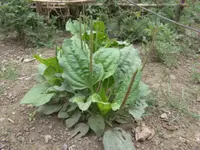
Recognize broadleaf plantain by its basal rosette of broad, oval leaves that lie close to the ground, each leaf showing 5 to 9 strong parallel veins from base to tip.

Leafless flower stalks rise from the center and carry narrow, upright spikes of tiny greenish flowers, usually above the leaves.

Plantago major Identification

Confirm What Plant You Have

Not sure about your plant ID? Upload a photo and check it with Botan.

Clear images work best. Avoid photos taken too close or too far away

Check broadleaf plantain for a low basal rosette with leafless flower stalks.

  • Leaves are oval to broadly egg-shaped, usually 2-6 inches (5-15 cm) long, with smooth or slightly wavy edges.
  • Several strong veins run from the leaf base to the tip in near-parallel lines.
  • Flowers sit in dense, narrow spikes at the top of upright stalks that rise above the leaves.
  • The plant forms a flat clump close to the ground rather than branching stems.

Look for the rosette, parallel veins, and spike-like flower heads together.

Broadleaf plantain shows clear visual shifts from a low rosette to seed-bearing spikes.

  • Seedling: Cotyledons are narrow, but the first true leaves soon appear oval to spoon-shaped, forming a tiny basal rosette close to the ground.
  • Young plant: The rosette expands with broader leaves showing several strong parallel veins; leaf stalks lengthen, and the plant spreads flat rather than sending up stems.
  • Flowering stage: Leafy rosettes produce leafless stalks 4-12 inches (10-30 cm) tall, each topped by a dense, slender spike of tiny greenish flowers.
  • Fruiting stage: After flowering, the spikes persist but look browner and rougher, with many small capsules packed along the stalk where flowers were.

In spring, Plantago major forms a low rosette of broad, oval leaves with strong parallel veins. The leaves usually stay green through much of the growing season. From late spring into summer, thin leafless stalks rise above the rosette and carry dense spikes of tiny greenish flowers, later turning into narrow seedheads. In cold winter periods, the rosette may die back or look flattened and sparse.

A few low rosette weeds are regularly mistaken for Plantago major.

buckhorn plantain(Plantago lanceolata)

Both form basal rosettes with strong parallel veins. This species has narrow, lance-shaped leaves, usually under 1 inch (2.5 cm) wide, not the broad oval leaves of broadleaf plantain.

blackseed plantain(Plantago rugelii)

It is very close in overall shape and leaf size. The quickest check is the leaf stalk base, often reddish or purple, while P. major is usually green there.

common dandelion(Taraxacum officinale)

Young plants can resemble a flat rosette from a distance. Dandelion leaves are deeply toothed or lobed, while Plantago leaves are unlobed with several arching veins.

Plantago major is native across much of Europe and temperate Asia. It is now widely naturalized in North America and many other temperate regions, so range alone does not confirm identification. Habitat is still useful. This species commonly appears in compacted, disturbed ground such as paths, lawns, roadsides, field edges, and vacant lots. Finding a broadleaf plantain in trampled urban or rural sites helps separate it from look-alikes that are more restricted to wetlands, dunes, or undisturbed woodland.

Confirm It from a Photo

Use Botan to identify or verify a plant from an image, helping avoid mix-ups before you label it or look up details.

FAQ

It is often confused with ribwort plantain, Plantago lanceolata, and other plantains. This species has broad, oval leaves in a basal rosette, while ribwort plantain has much narrower, lance-shaped leaves with similarly strong parallel veins.

More Plant Identification Guides

One Photo. More About Your Plant.

Identify a plant from a photo with Botan, then review plant details, care information, and common problems.

Botan app identifying a plant from a photo
What Plants Don't Like Epsom Salt?

11 min read · 29 Jul 2026

What Plants Don't Like Epsom Salt?

Learn which plants can be seriously damaged by Epsom salt and which will thrive on it. We’ll explain when and how to use it properly, provide tips for indoor & outdoor plants — read on and enjoy a healthy garden.

Plant Care
What Plants Don't Like Epsom Salt?
Top 15 Plants That Don’t Need Sunlight

8 min read · 17 Sept 2026

Top 15 Plants That Don’t Need Sunlight

Some plants thrive in dim rooms, shaded corners, and places with indirect light. In this guide, you’ll explore the top 15 species best suited to low-light conditions and how to care for them.

Plant Recommendations
Top 15 Plants That Don’t Need Sunlight
How To Revive a Dying Plant: 6 Steps To Bring A Plant Back To Life

6 min read · 1 Sept 2026

How To Revive a Dying Plant: 6 Steps To Bring A Plant Back To Life

Drooping leaves and brown tips don't always mean the end, and a weakened plant can often recover with a little help. These six simple steps will help you revive a dying plant and restore its health.

Plant Care
How To Revive a Dying Plant: 6 Steps To Bring A Plant Back To Life