

Japanese barberry Identification (Berberis thunbergii)

To recognize Japanese barberry, look for a dense, many-stemmed shrub with sharp single spines at each node and small, spoon-shaped to oval leaves borne in tight clusters along the stems.

The stems arch outward, and the leaves are usually under 1.5 inches (4 cm) long with smooth edges.

Berberis thunbergii Identification

Identify Your Plant with Botan

Not sure about your plant ID? Upload a photo and check it with Botan.

Clear images work best. Avoid photos taken too close or too far away

Use a few simple traits to check Berberis thunbergii by eye.

  • Dense, many-stemmed shrub, usually rounded to arching in outline.
  • Leaves are small, simple, and spoon-shaped to oval, often 1/2 to 1 1/4 inches (1.3-3 cm) long, clustered along short side shoots.
  • A single sharp spine sits at each node on the stem.
  • Flowers are small, pale yellow, and hang singly or in small clusters from the leaf axils.
  • Fruits are bright red, oblong berries that hang beneath the stems.

Check the one-spine-per-node pattern with the clustered small leaves first.

Berberis thunbergii shows clear visual shifts from sparse thorny starts to fruiting shrubs.

  • Seedling: Seedlings have a thin stem with few side shoots, tiny spatula-shaped leaves, and early single spines at nodes rather than dense twiggy branching.
  • Young plant: Young plants form many short branchlets and a compact outline, with small clustered leaves and more obvious nodal spines than seedlings.
  • Flowering stage: Small pale yellow flowers hang singly or in few-flowered clusters beneath the twigs, each about 1/4 inch (6 mm) wide, standing out against fresh leaves.
  • Fruiting stage: After flowering, branches carry bright red, oblong berries that hang below the stems, creating a dotted look absent on nonfruiting plants.

Japanese barberry has several well-known forms that can be separated by leaf color and growth habit.

  • 'Atropurpurea': Leaves are deep reddish purple through the growing season instead of plain green; shrubs usually reach about 4 to 6 feet tall (1.2 to 1.8 m).
  • 'Aurea': Foliage is bright yellow to yellow-green rather than green, often on a smaller shrub about 3 to 5 feet tall (0.9 to 1.5 m).
  • 'Crimson Pygmy': This form stays low and dense, often about 2 to 3 feet tall (0.6 to 0.9 m), with small burgundy to purple leaves.
  • 'Rose Glow': Purple leaves are mottled with pink and white, creating a spotted or marbled pattern not seen in the typical form.

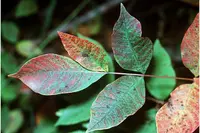
In spring, Berberis thunbergii leafs out with small, spatula-shaped leaves and soon shows pale yellow flowers along the stems, making the thorny branching easier to notice. By fall, foliage often turns bright red to orange-red before dropping. Red berries can remain into winter, when the bare, zigzag stems and single spines become much more visible.

A few shrubs outside this species are regularly mistaken for Japanese barberry.

common barberry(Berberis vulgaris)

Often confused because both are spiny deciduous shrubs with small oval leaves and red berries. Common barberry usually has leaf margins with small teeth, while this plant has smooth-edged leaves. Its spines are typically 3-parted at each node rather than single.

Ottawa barberry(Berberis × ottawensis)

Confusion is common because it combines a similar dense habit with small leaves and red fruit. It is usually taller, often reaching 6 feet (1.8 m) or more, and its leaves tend to show slight teeth or a bluish cast rather than plain smooth green.

Berberis thunbergii is native to Japan. In the wild it occurs in open woodland, forest edges, thickets, and on slopes, often in sunny to lightly shaded sites. This habitat context can help with identification because the species is often found as a dense understory or edge shrub rather than a wetland, desert, or alpine plant. Knowing its native setting helps narrow similar ornamental shrubs when location history is considered.

  • Sharp spines: Berberis thunbergii has stiff spines on the stems. Skin contact can cause puncture wounds or scratches in humans and pets that brush against or are handled near the shrub.
  • Ingestion concern: The plant should not be eaten. Ingestion of plant parts, especially berries, is a safety concern for humans and pets.

Confirm It from a Photo

Use Botan to compare a photo and help verify the plant, so you can rule out common mix-ups more confidently.

FAQ

Leaves are alternate, not opposite. They cluster tightly on short spur shoots, which can make them seem whorled at a glance. This pattern is useful when identifying Japanese barberry on dense, twiggy branches.

More Plant Identification Guides

Know What Plant You Have

Identify it from a photo with Botan, then get species-specific care information, plant details, and common problems.

Botan app identifying a plant from a photo
Dill Companion Plants – What to Grow Next to Dill

9 min read · 17 Jul 2026

Dill Companion Plants – What to Grow Next to Dill

Dill is an easy-to-grow plant that gets along well with many vegetables. This guide describes 15 plants that can be planted alongside it, a few to avoid, and mistakes that can quietly sabotage the entire process.

Plant Recommendations

Dill Companion Plants – What to Grow Next to Dill
Best Time to Water Grass in Summer – Lawn Watering Tips

5 min read · 21 Jul 2026

Best Time to Water Grass in Summer – Lawn Watering Tips

Summer watering is easy to get wrong. This guide explains when to turn on your sprinkler, how much liquid your grass needs each week, and how to tell if you're overwatering or underwatering.

Plant Care
Best Time to Water Grass in Summer – Lawn Watering Tips
When to Harvest Tomatillos: How to Tell When They're Ripe

4 min read · 20 Oct 2026

When to Harvest Tomatillos: How to Tell When They're Ripe

Tomatillos grow inside papery husks, making it hard to judge ripeness at a glance. This guide explains how to know when tomatillos are ripe and offers practical advice on harvesting and storage.

Plant Recommendations
When to Harvest Tomatillos: How to Tell When They're Ripe