Protect Surface Roots
Apply a wide, 5–8 cm deep mulch ring and keep it mulched every year to protect the shallow root system from mower damage, soil compaction, and temperature swings.

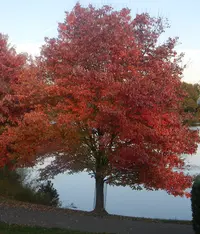
Red maple, Acer rubrum, is a deciduous tree known for its bright red autumn foliage and smooth gray bark when young. It typically grows with a strong central trunk and a rounded to oval crown.
This species is native to eastern North America, where it occurs in forests, swamps, and along streams. It adapts to many garden and urban conditions, although it prefers moist, slightly acidic soil.
Red maple generally grows fast and can be relatively easy to establish if planted in a suitable site. Understanding how to care for red maple helps maintain healthy growth and good color over many years.

Care Difficulty
Moderate Care

Light Preference
Full Sun

Water Requirements
Regular Water

Temperature Preference
Cold Hardy

Hardiness Zone
3–9

Soil Texture
Loamy, Sandy, Clay

Soil pH
Strongly acidic (4.5–5.5), Acidic (5.5–6.5)

Soil Drainage
Moist but well-drained

Fertilization
Minimal (feed rarely)
Scan your plant to receive care tips personalized for your specific plant
Available on iOS and Android
This species performs best in full sun to light shade with thoughtful site placement.
Acer rubrum prefers evenly moist, well-drained soil and is sensitive to extremes of drought or saturation.
This tree is cold-hardy yet responds best to moderate seasonal temperatures.
This species grows well outdoors in typical ambient humidity and rarely needs special humidity management.
This species prefers evenly moist, deep, loamy soil with strong structure and consistent drainage.
This tree is only moderately suitable for long-term container culture and is better kept in large, stable outdoor tubs when potted at all.
Acer rubrum grows well in average soil and usually needs only modest fertilization once established.
Acer rubrum responds well to thoughtful pruning that maintains a strong structure and safe clearance.
Acer rubrum is usually grown in the ground, with transplanting more relevant than long-term container culture.
Acer rubrum is commonly propagated from seed, with cuttings used mainly for selected forms.
Acer rubrum is cold hardy in much of North America and usually needs minimal winter care in the ground.

Plant Health Check
Not sure what's wrong with your plant? Check your plant's health inside the app.
Red maple naturally occurs from dry ridgetops to seasonally flooded swamps in eastern North America, showing one of the broadest site tolerances among native hardwood trees.
It flowers very early in spring, often before leaf-out and before many other tree species, providing one of the first nectar and pollen sources for insects.
This species produces red pigments in flowers, twigs, seeds, and autumn leaves, giving it red accents in multiple seasons rather than only in fall foliage.

Fossil evidence indicates that close relatives of red maple have been present in North America since at least the Miocene epoch, showing that the Acer rubrum lineage has deep evolutionary roots on the continent.
This species is generally fast growing, often adding 30–60 cm per year in average conditions and up to about 90 cm with ideal moisture and soil. Young trees grow fastest, then gradually slow as they mature.
Keep your plants happy and healthy with plant identification, disease detection, and easy care guidance.