Root-zone protection
In climates with occasional frost, apply a 5–8 cm gravel or coarse sand mulch in late fall to insulate the root zone while still keeping the crown dry and well aerated.

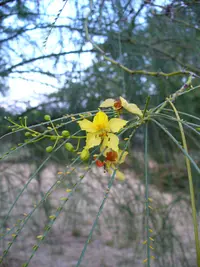
Jerusalem thorn (Parkinsonia aculeata) is a fast-growing, semi-evergreen shrub or small tree known for its fine, feathery foliage and showy yellow flowers. It often develops a multi-stemmed, thorny structure and a light, open canopy. This species is native to arid and semi-arid regions of the Americas but is now naturalized in many warm climates worldwide, sometimes becoming invasive. It tolerates heat, drought, and poor, sandy or rocky soils, which generally makes it easy to establish in dry landscapes. Understanding how to care for Jerusalem thorn starts with providing full sun and well-drained soil, as prolonged wet conditions can cause decline.

Care Difficulty
Easy Care

Light Preference
Full Sun

Water Requirements
Low Water

Temperature Preference
Warm Climate

Hardiness Zone
8–11

Soil Texture
Sandy, Loamy, Rocky

Soil pH
Slightly acidic (6.5–7.0), Slightly alkaline (7.0–7.5)

Soil Drainage
Well-drained

Fertilization
Minimal (feed rarely)
Scan your plant to receive care tips personalized for your specific plant
Available on iOS and Android
This desert tree thrives in intense sun and needs strong light to flower well.
This drought-adapted tree prefers infrequent, deep watering and fast-draining soil.
This heat-loving species prefers warm to hot conditions and is only slightly frost tolerant.
Humidity is rarely limiting for Parkinsonia aculeata, which thrives in dry air.
Parkinsonia aculeata prefers very free-draining, lean soil that imitates arid, rocky habitats.
This species can be grown in large containers where space or climate control is needed.
Parkinsonia aculeata usually grows well in lean soils and needs only light feeding in cultivation.
Pruning Parkinsonia aculeata helps maintain a stable canopy and safe, accessible structure.
This species is most often grown in the ground, so focus on careful transplanting rather than frequent repotting.
Parkinsonia aculeata is most often propagated from seed, which germinates reliably under warm conditions.
This desert-adapted tree has moderate frost tolerance but benefits from some winter attention in colder climates.

Plant Health Check
Not sure what's wrong with your plant? Check your plant's health inside the app.
Parkinsonia aculeata often appears leafless because its true leaves are tiny and short-lived, while the long green leaf stalks (phyllodes) take over most of the photosynthesis, helping it cope with intense heat and drought.
This species forms symbiotic associations with nitrogen-fixing bacteria in its roots, allowing it to enrich poor soils and colonize arid, nutrient-depleted environments where few tree species can survive.
Its abundant yellow flowers provide a key nectar and pollen source for bees and other pollinators in semi-arid and arid regions, especially during dry seasons when few other plants are in bloom.

In several regions outside its native range, including parts of Australia and South Africa, Parkinsonia aculeata has become a declared invasive weed, forming dense thorny thickets that block livestock movement, alter waterways, and outcompete native vegetation, leading to extensive biological control programs targeting this single species.
In several warm, dry regions, especially parts of the southern United States and Australia, this species is classified as invasive. It forms dense thickets, outcompetes native vegetation, and spreads readily via seeds carried by water and animals.
Keep your plants happy and healthy with plant identification, disease detection, and easy care guidance.