
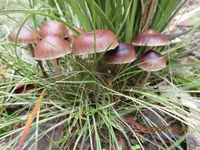

birch polypore Identification (Fomitopsis betulina)

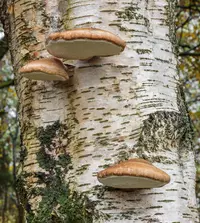
To recognize birch polypore, look for a single hoof- to kidney-shaped bracket attached directly to wood, usually 2 to 8 inches (5 to 20 cm) across, with no stem.

The upper surface is smooth and pale tan to light brown, while the underside is white to cream with very fine pores rather than gills.

Fomitopsis betulina Identification

Check Your Plant ID

Upload a plant photo and check the identification in seconds.

Clear images work best. Avoid photos taken too close or too far away

Check the fruiting body shape, attachment, and pore surface at a glance.

  • Forms a single shelf-like bracket attached directly to the trunk, with no visible stem.
  • Cap is rounded to hoof-shaped, often 2-8 inches (5-20 cm) across, and projects outward like a small ledge.
  • Upper surface is smooth to slightly uneven and pale tan, buff, or light brown.
  • Underside is white to cream with very fine pores, not gills.

A cluster of these bracket shelves on birch strongly supports identification.

Birch polypore shows clear age-related changes in shape, surface texture, and pore structure.

  • Young plant: New fruiting bodies appear as pale, rounded knobs on birch bark, with a smooth surface and no clear shelf shape yet.
  • Mature plant: The cap expands into a thick, hoof-like or cushion-shaped bracket, often 2-8 inches (5-20 cm) across, with a white to buff underside.
  • Fruiting stage: At full development, the pore surface becomes more distinct and even, while the upper surface often turns duller, tougher, and slightly cracked with age.

Birch polypore is often easiest to notice from late summer through winter, when its pale, hoof-like brackets stand out on bare or thinning birch trunks. Older fruiting bodies commonly persist after leaves drop, so the contrast against bark becomes clearer in late fall and winter. Fresh brackets are most often seen during the warmer growing season and look smoother, paler, and more rounded than weathered older ones.

A few bracket fungi can be mistaken for birch polypore at a glance.

red-belted conk(Fomitopsis mounceae)

Both form hooflike brackets on birch. Fomitopsis mounceae usually shows a dark red to orange band near the margin and a harder, varnished-looking top. Birch polypore is paler, smoother, and more evenly buff to gray-brown.

artist’s conk(Ganoderma applanatum)

Both can appear as pale shelf fungi on hardwood. Artist’s conk is flatter and broader, often with a brown upper surface and a white pore layer that bruises dark when scratched. Birch polypore is thicker, rounder, and lacks that strong drawing reaction.

Fomitopsis betulina is native across temperate and boreal parts of Europe, Asia, and North America. It is most often found in birch woodland and mixed forest wherever birch is present. Habitat is a strong identification clue because this bracket fungus grows chiefly on dead or dying birch trunks and logs. Finding it on birch, rather than on many different tree types, helps separate it from several similar hoof-like polypores.

Because this is a mushroom, misidentification is the main safety issue. Fomitopsis betulina grows on birch and forms a smooth, pale bracket with pores underneath, but beginners should not rely on one feature if considering any handling or use.

  • Misidentification risk: The concern is indirect ingestion by humans or pets if a different bracket fungus is mistaken for it. Check that it is attached to birch wood and has a white to pale buff pore surface rather than gills.

Does Your Plant Match?

Botan compares your photo to likely matches to help identify it or confirm the name before you label or share it.

FAQ

Yes. This species is a bracket fungus, so it does not produce flowers. Birch polypore identification relies on its smooth, pale tan to whitish hoof-shaped caps and white pore surface on birch wood.

More Plant Identification Guides

Find Out What Plant It Is

Identify it from a photo with Botan, then view plant details, care information, and common problems for that species.

Botan app identifying a plant from a photo
Best Water for Plants – How to Choose the Right Type

7 min read · 13 Aug 2026

Best Water for Plants – How to Choose the Right Type

Rainwater, filtered, distilled, and tap water affect plants differently. Learn which types support healthy growth and which cause slow damage. Match each to your plants and discover how to easily improve tap water quality.

Plant Care
Best Water for Plants – How to Choose the Right Type
What Do Plants Need to Grow – 5 Things Every Greenery Can't Live Without

8 min read · 31 Jul 2026

What Do Plants Need to Grow – 5 Things Every Greenery Can't Live Without

To keep plants healthy and thriving, provide the right balance of light, humidity, nutrients, airflow, and quality soil. This guide covers the essentials of year-round plant care.

Beginner Guides
What Do Plants Need to Grow – 5 Things Every Greenery Can't Live Without
Best Time to Water Grass in Summer – Lawn Watering Tips

5 min read · 21 Jul 2026

Best Time to Water Grass in Summer – Lawn Watering Tips

Summer watering is easy to get wrong. This guide explains when to turn on your sprinkler, how much liquid your grass needs each week, and how to tell if you're overwatering or underwatering.

Plant Care
Best Time to Water Grass in Summer – Lawn Watering Tips