




Fig tree Identification (Ficus carica)

To recognize Ficus carica, look first for its large, alternate leaves, usually 3 to 5 deeply cut lobes, often 4 to 10 inches (10 to 25 cm) across, on thick twigs.

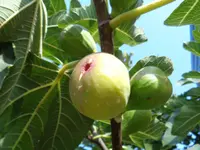
Another strong clue is the fig itself: a rounded, pear-shaped structure borne singly in the leaf axils, with smooth gray bark on older trunks.

Ficus carica Identification

Identify Your Plant with Botan

Upload a clear photo to check your plant identification with Botan.

Clear images work best. Avoid photos taken too close or too far away

Check the leaves, branching, and fruit shape on Ficus carica.

  • Leaves are single, alternate, and usually 3-5 lobed, with deep rounded sinuses and a broad, hand-like outline.
  • Leaf blades are large, often 4-10 inches (10-25 cm) long, on long stalks, with rough upper surfaces.
  • Twigs are thick and gray, and older plants form a short trunk with many spreading branches.
  • Fruits are pear-shaped to rounded, borne singly or in pairs in the leaf axils, about 1-3 inches (2.5-7.5 cm) long.

Look for the combination of big lobed leaves and axillary fig fruits.

Ficus carica shows useful visual changes from early growth to fruit-bearing maturity.

  • Seedling: Seedlings have thin green stems and simple early leaves that are smaller, less deeply lobed, and more delicate than later foliage.
  • Young plant: Young plants form broader, rough leaves, often with 3-5 lobes, on a shrubby framework before a distinct trunk and heavy scaffold branches develop.
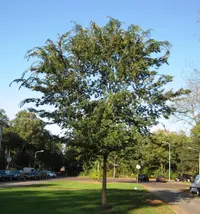
  • Mature plant: Mature plants become small trees with a stout gray trunk, wide-spreading crown, and coarse, strongly lobed leaves often 4-10 inches (10-25 cm) long.
  • Fruiting stage: At fruiting, pear-shaped figs appear singly in leaf axils, changing the outline with hanging fruits and making branch tips look heavier than nonfruiting shoots.

Several Fig tree selections are easy to separate by leaf pattern or growth habit.

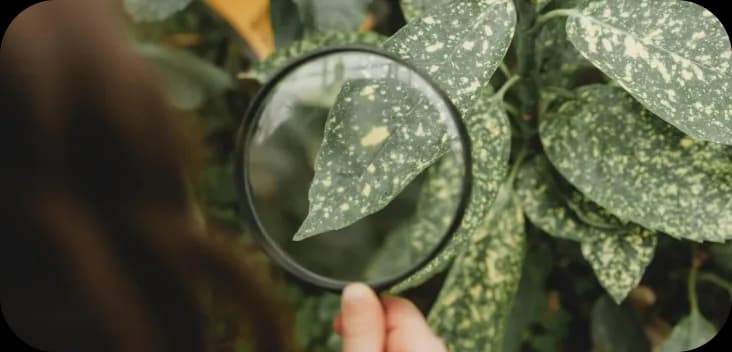
  • Ficus carica 'Variegata': Leaves are irregularly marked cream to yellow with green, unlike the solid green leaves of the typical form.
  • Ficus carica 'Ice Crystal': Leaves are much more deeply cut into narrow lobes, giving a fine, jagged outline instead of the broader lobes typical of the species.
  • Ficus carica 'Little Miss Figgy': This cultivar stays much smaller, often around 4 to 6 feet tall and wide (1.2 to 1.8 m), with a denser, bushier outline than a standard fig.

In spring, Ficus carica leafs out with large, rough, deeply lobed leaves that quickly give the plant a bold, tropical look. By late fall, leaves turn yellow and drop. Winter exposes the pale gray bark, thick twigs, and knobby branch structure. Small fig fruits become visible from summer into fall.

A few broad-leaved shrubs and small trees are regularly mistaken for Ficus carica.

paper mulberry(Broussonetia papyrifera)

Often confused because the leaves can be large and variably lobed. It differs by rough, hairy leaves and clearly serrated edges; fig leaves are thicker, usually rough above but not hairy beneath, with broader, blunter lobes.

castor bean(Ricinus communis)

Can suggest a fig from a distance because of its large palmate leaves. The quickest check is that castor bean leaves have 7-11 narrow pointed lobes on long, soft green stems, not the thicker woody twigs and broader 3-5 lobes of fig.

Ficus carica is native to the eastern Mediterranean and western Asia, including areas from the Balkans and Aegean region through Turkey to parts of the Middle East. In the wild it is associated with sunny rocky slopes, scrub, open woodland edges, old walls, and disturbed ground, often in dry lowland settings. Seeing a fig naturalized in Mediterranean-type habitats helps narrow identification better than geography alone.

  • Skin contact: The milky sap in leaves, stems, and unripe fruit can irritate human skin. In some people, sap exposure followed by sun can cause a stronger rash called phytophotodermatitis.
  • Ingestion: Ficus carica is not usually treated as a poisoning plant, but the sap and unripe fruit can irritate the mouth and stomach if eaten by humans or pets.

Does Your Plant Match?

Upload a photo to Botan to identify it or confirm your guess before labeling, buying, or troubleshooting the wrong plant.

FAQ

Leaves are usually broad and deeply lobed, most often with 3 to 5 lobes. The outline is rough, somewhat hand-shaped, and the margins are irregularly toothed, which is a strong Fig tree identification clue.

More Plant Identification Guides

Know What Plant You Have

Identify it from a photo with Botan, then get species details, care information, and common problems.

Botan app identifying a plant from a photo
How to Group Plants in Landscaping: A Practical Layout Guide

8 min read · 31 Aug 2026

How to Group Plants in Landscaping: A Practical Layout Guide

Good plant grouping can mean the difference between a well-planned garden and one that looks sloppy. This guide explores layers, spacing, cluster shapes, and the plants that thrive when you group them.

Plant Care

How to Group Plants in Landscaping: A Practical Layout Guide
How to Tell if a Plant Is Dead

6 min read · 19 Aug 2026

How to Tell if a Plant Is Dead

A plant can lose its leaves, stop growing, or collapse and still remain alive. A closer look at the stems, roots, bulbs, and tubers can show whether the plant still has a chance to recover.

Beginner Guides
How to Tell if a Plant Is Dead
12 Best Plants for Bathroom That Thrive in Humid Conditions

9 min read · 29 Sept 2026

12 Best Plants for Bathroom That Thrive in Humid Conditions

Discover the 12 best plants for bathroom spaces. Each pick comes with its own advantages, plus light, humidity, watering, and placement tips. Take a look and match the plant to your specific bathroom.

Plant Recommendations
12 Best Plants for Bathroom That Thrive in Humid Conditions